
Reconciliation Effort Benchmarks for Usage-Based Billing
Usage-based billing loses 4% to 9% of revenue and drains engineering resources monthly.
Usage-based billing has a reconciliation problem, and that problem now has a price tag. Companies running consumption pricing lose more revenue to leakage, burn more engineering hours on metering pipelines, and spend more finance-team days on month-end close than companies running flat subscriptions. This is not a hunch. The benchmarks exist, they're measurable, and they point to a break-even test any finance or engineering leader can run against their own numbers.
Adoption trends expanding the population of companies with a reconciliation problem
Subscription billing reconciliation is a solved problem. Fixed charge, fixed period, nothing to validate against event data. Usage-based billing breaks that simplicity apart: metering, deduplication, rating against tiers and commitments, overage reconciliation, then a handoff to invoicing and revenue recognition. NetSuite's own breakdown of the workflow, metering, rating, aggregation, validation, invoicing, payment and reconciliation, treats each step as a distinct failure point, because each one is.
The population exposed to that failure is growing fast. OpenView's data shows usage-based pricing moving from a minority of SaaS companies in 2023 to a clear majority now, and OneBill cited OpenView data in 2026 putting 60% of companies either fully implementing or experimenting with consumption-based pricing. That's the mainstream, not the fringe.
Hybrid pricing is where it gets sharper. G2's study of 108 companies selling AI products found 85% using hybrid pricing, and 73% with a usage component built in. Hybrid is now the dominant model among AI vendors, and hybrid is exactly where reconciliation is hardest: ASC 606 and IFRS 15 require allocating transaction price across performance obligations, a task that's close to trivial for a pure subscription and genuinely difficult once usage, credits, and committed spend all sit on the same invoice.
The infrastructure market is following the complexity, not leading it. 360iResearch projects the usage-based billing software market to hit $11.5 billion by 2032, a jump of roughly 68% from 2025. Every token, every inference call, every autonomous agent action consumes real compute, and pricing has to reflect that variable cost, which makes AI the accelerant driving all of it. IDC forecasts 70% of software vendors moving away from pure per-seat pricing by 2028. Companies that haven't felt reconciliation pain yet are on a clock, not exempt from it.
Revenue leakage rates by billing model, what the benchmarks say
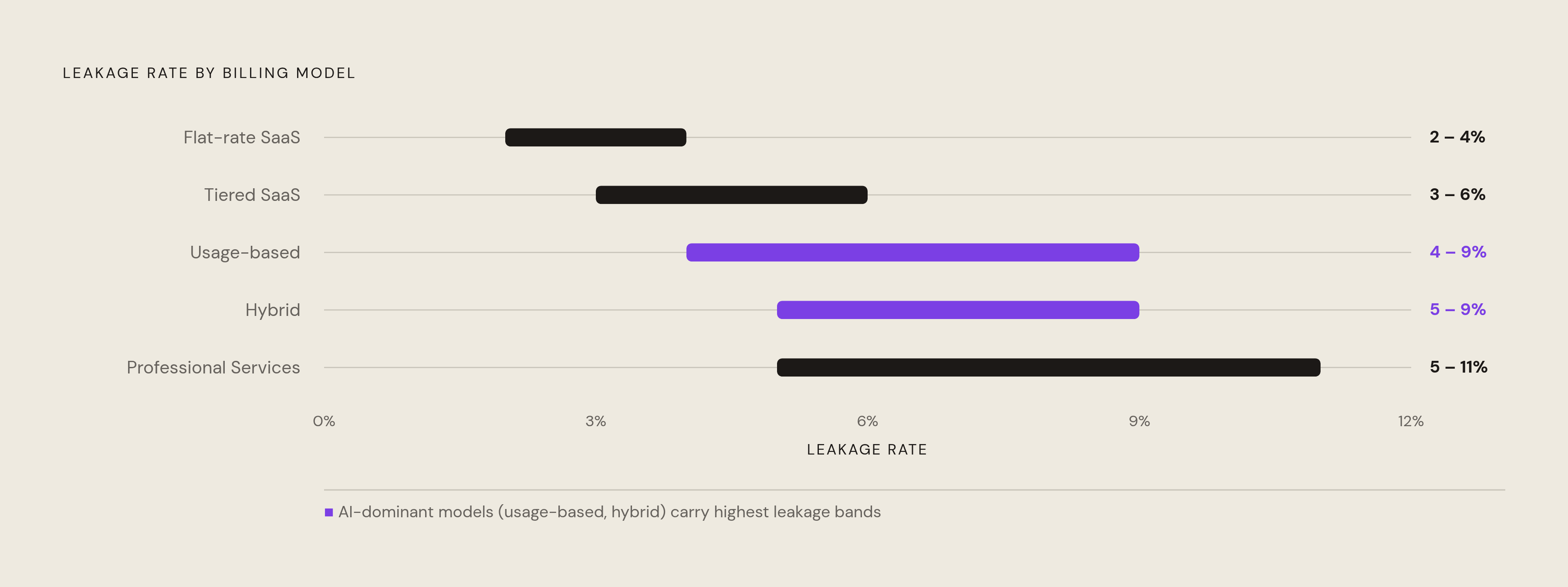
Industry benchmarks put subscription revenue leakage at 3% to 9%, and the range moves in lockstep with billing complexity. Flat-rate SaaS loses 2% to 4%. Tiered SaaS runs 3% to 6%. Usage-based climbs to 4% to 9%. Hybrid is 5% to 9%. Professional services, the messiest model of all, tops out at 5% to 11%.
The pattern holds without exception: the more moving parts in a pricing model, the more revenue slips through the cracks. And the biggest single cause isn't what most finance teams assume. LeakShield's 2026 benchmark data attributes 38% of leakage to pricing configuration errors, not to broken pipelines, not to fraud, but to misconfigured pricing rules applied to events that were metered correctly. The data was right. The rule that turned it into a dollar amount was wrong.
Running that leakage rate against enterprise value makes the number stop looking like an operational footnote. At a 7x revenue multiple per the Bessemer Cloud Index: a company losing 4% to 9% of a large ARR base to leakage is destroying several million dollars in enterprise value from that leakage alone. Every dollar of annual leakage is seven. It's seven.
Engineering hours: what metering failures and DIY pipelines cost the team
DIY reconciliation scales the way most homegrown infrastructure scales: fine, until it isn't. At low event volume, a database with deduplication on insert gets the job done. As event volume scales, that stops working, and the requirement becomes a streaming pipeline with idempotent writes and at-least-once delivery guarantees. At high enough volume, the requirements escalate again: retransmission, replay, dead-letter queues, distributed tracing, full audit logging.
Each of those thresholds is a rebuild. Engineering cost doesn't rise with volume in a straight line, it jumps.
Metering errors themselves, missed events, duplicates, failed reconciliations, account for 1% to 3% of annual billing leakage in usage-based SaaS businesses specifically, and 2% to 5% of total leakage across every cause combined, industry data on the space shows. The pipeline is a place revenue goes missing. It's a place revenue goes missing.
Pricing changes make the engineering burden worse, not better. The PricingSaaS 500 Index tracked more than 1,800 pricing and packaging changes across 500 SaaS companies in a single year, an average of 3.6 changes per company, and every change that needs an engineering ticket opens a window where intended pricing and billed pricing diverge. The pattern that comes out of all this is consistent: as billing calculation time accumulates month over month, manual process becomes increasingly error-prone and starts creating compliance risk. Vendor-reported throughput figures, not independently benchmarked, MintMCP's blog notes, range from a default rate limit of 5,000 events per second up to 110,000, and past a million at the high end. The gap between a default rate limit and what production actually demands is exactly where homegrown pipelines fall over.
Open-source billing infrastructure doesn't dodge this cost, it just relocates it. Someone still owns the upgrades, the debugging, the on-call rotation, indefinitely.
Finance team days: the month-end close burden in usage-based environments
PwC's 2024 Finance Effectiveness Benchmark Study found finance teams spending more than half their time on work that should be automated, and unautomated usage-based billing is a major contributor to that number. The pattern is familiar to anyone who's run a close under consumption pricing: the first week of every month goes to reconciling billing errors that piled up quietly across the prior period.
ASC 606 and IFRS 15 compliance is the specific mechanism forcing this. Hybrid models, subscription minimums plus usage overages plus credit drawdowns, require allocating transaction price across performance obligations for variable consideration. That allocation cannot be done reliably in a spreadsheet once volume climbs past a handful of customers.
Fragmentation compounds it further. Companies that bolted usage billing onto a subscription-first system often end up running multiple billing codepaths that were never designed to talk to each other, and finance ends up reconciling across all of them by hand, every month, on a deadline.
What drives reconciliation effort up: the four compounding factors
Pricing model complexity is the first lever, and it's multiplicative rather than additive. Every extra pricing dimension, tokens, GPU-minutes, audio minutes, megapixels, hardware tier, adds a new strand of rating logic that has to be checked against actual consumption. Hybrid models that stack subscription minimums, usage overages, and prepaid credits force simultaneous reconciliation across three separate mechanics at once. Credit-based pricing piles on more surface still: balance tracking, expiration logic, drawdown sequencing, each one needing its own audit trail.
Pricing change frequency is the second. At 3.6 pricing and packaging changes per company per year across the 500 companies analysts tracked, reconciliation logic is under near-constant revision. Every change that requires an engineering ticket opens a gap between the price a company intends to charge and the price actually billed. The spring of 2026 showed how fast this can move in practice: HubSpot and GitHub both announced AI repricing within a 30-day window that April (Atlassian followed with its own AI repricing announcement that September). Companies watching those moves and considering something similar are staring down the same reconciliation pressure, just compressed into a shorter runway.
Event pipeline reliability is the third factor, and it's mechanical rather than strategic. At-least-once delivery without exactly-once accounting produces duplicates, and without idempotency keys those duplicates make it all the way to an invoice. Late-arriving events, from an outage, a renegotiated contract, a late renewal, require backdating and rerating, and without automated handling that becomes a manual finance task performed under deadline pressure. Dead-letter queue failures and failed replays leave gaps in metered consumption, and those gaps become leakage nobody can trace back to a cause when they appear later in reconciliation.
Fragmented billing architecture is the fourth, and often the most stubborn. Companies running three separate billing codepaths spend the first week of every month reconciling across all three, the textbook failure pattern for a business that layered usage billing onto a subscription system after the fact. The standard fix the market offers, a metering tool bolted to a billing tool via integration, doesn't close the gap so much as make it permanent: two systems now need to agree with each other forever. ASC 606 and IFRS 15 demand a clean, traceable chain from usage event to recognized revenue, and a fragmented architecture breaks that chain at exactly the point finance needs it most.
What reduces reconciliation effort: architectural and operational levers
Idempotency and deduplication at the point of ingestion is the single most effective architectural control available. An event that can't be double-counted can't produce a duplicate charge, and this has to live inside the pipeline itself, not get patched on as a downstream check.
Storing raw events immutably, then generating invoices by querying that event history at read time, gives a system the ability to backfill, backdate, and correct without re-ingesting anything. Reconciliation becomes something the system computes deterministically, rather than something finance reconstructs by hand from fragments.
Automated backdating and rerating removes the manual reconstruction work that eats finance hours whenever a contract term changes or a late usage correction comes in. Real-time metering with in-period visibility matters just as much on the customer side: a customer who can see consumption as it happens doesn't get ambushed by the bill at period close, and disputes stop concentrating at month-end the way they do when visibility is absent.
Pricing changes that don't require an engineering ticket close the exposure window between intended and billed pricing almost entirely, and this matters more than it sounds. Many companies run pricing experiments less often than they intend to, and that gap often reflects an operational constraint, not a lack of ambition. A native revenue recognition output, one that generates ASC 606 and IFRS 15 schedules directly from reconciled consumption data, removes the largest single source of manual month-end work. And a single-system architecture, metering and billing under one roof instead of two tools stitched together, eliminates the reconciliation surface between them. The time saved through automated revenue recognition only fully materializes when data doesn't have to move between systems before finance can trust it.
Benchmarks as a break-even test: when the current approach stops being sustainable
Assembled together, the research points to a set of thresholds a finance or engineering leader can test against directly. At some point on the growth curve, manual, spreadsheet-driven processes stop being merely painful and start being non-compliant. Once billing calculation time grows large enough each month, switching approaches becomes justified on effort alone, independent of any leakage argument.
The leakage math closes the loop. At 4% to 9% leakage on a large ARR base, a company is leaving a substantial sum on the table every year, and at a revenue multiple consistent with Bessemer Cloud Index benchmarks, that's several million dollars in enterprise value gone. Against a 2 to 4 month payback period for reconciliation automation, per available benchmarking on the space, the math resolves quickly in favor of fixing it.
Two more tests round it out. If pricing changes more than twice a year and each change needs an engineering ticket to implement, the current architecture's cost is compounding. And if finance is still reconstructing variable consideration and performance obligation allocation in spreadsheets every single month, the billing system isn't doing the job it was built for, whatever else it might be doing well. None of this requires taking anyone's word for it. Plugging in the ARR, the leakage range, and the hour count produces the conclusion on its own.
Features in billing infrastructure that reduce reconciliation load
The evaluation criteria fall out of the benchmarks directly rather than from any vendor's marketing copy. Idempotent ingestion with deduplication built into the pipeline, not bolted on after. Immutable event storage that supports query-time invoice generation, so backdating and correction don't require re-ingesting anything. Automated rerating when contract terms shift or usage corrections arrive late. Native ASC 606 and IFRS 15 output generated from the same reconciled consumption data finance already trusts, rather than a second spreadsheet built to match it after the fact. Pricing and packaging changes that product and finance teams can make without opening an engineering ticket. And architecture where metering and billing sit inside one system, because every seam between two systems is a place reconciliation has to happen manually, forever, on somebody's calendar.
It's the shape of the curve: reconciliation effort scales with pricing complexity, event volume, and change frequency, and it scales in steps rather than smoothly. The break-even test measures reconciliation cost against the cost of fixing the problem, not against reconciliation cost alone. It asks whether it's more expensive than fixing it, and for a widening set of companies, the answer already tips the other way.

