Quarter-End Invoice Crunch Patterns in High-Growth SaaS
Hybrid pricing models strain billing systems unprepared for usage-based contracts.
Pricing model complexity and its effect on the surge over the past five years
Five years ago, the deal that closed at quarter-end was probably a seat-based subscription with some number of licenses, a fixed price, and an annual renewal. That deal is rare now. What closes today typically carries a hybrid structure, combining a subscription tier bundled with an included usage allowance, an overage rate above that allowance, maybe a prepaid credit wallet, and increasingly a separate charge for AI consumption stacked on top of all of it.
Pricing has become a moving target, and the churn is the business model. It's the business model. More than 1,800 pricing and packaging changes were tracked among the top 500 B2B and AI companies in 2025, an average of 3.6 changes per company in a single year. That means contracts flowing into the quarter-end surge increasingly reflect pricing architectures that didn't exist when the billing system was first configured. Usage-based pricing has gone from a novelty to the default, with adoption spreading broadly across SaaS companies in 2025, so the contracts closing at quarter-end are less likely to be simple subscription records and more likely to demand real metering: counting events, aggregating consumption, applying rating logic against several dimensions at once.
A billing system that only knows how to track "customer has plan, plan has price" is structurally unequipped for what lands in its queue at quarter-end. Everything that follows in this piece traces back to that single mismatch.
What breaks during a quarter-end invoice surge: the failure modes in order
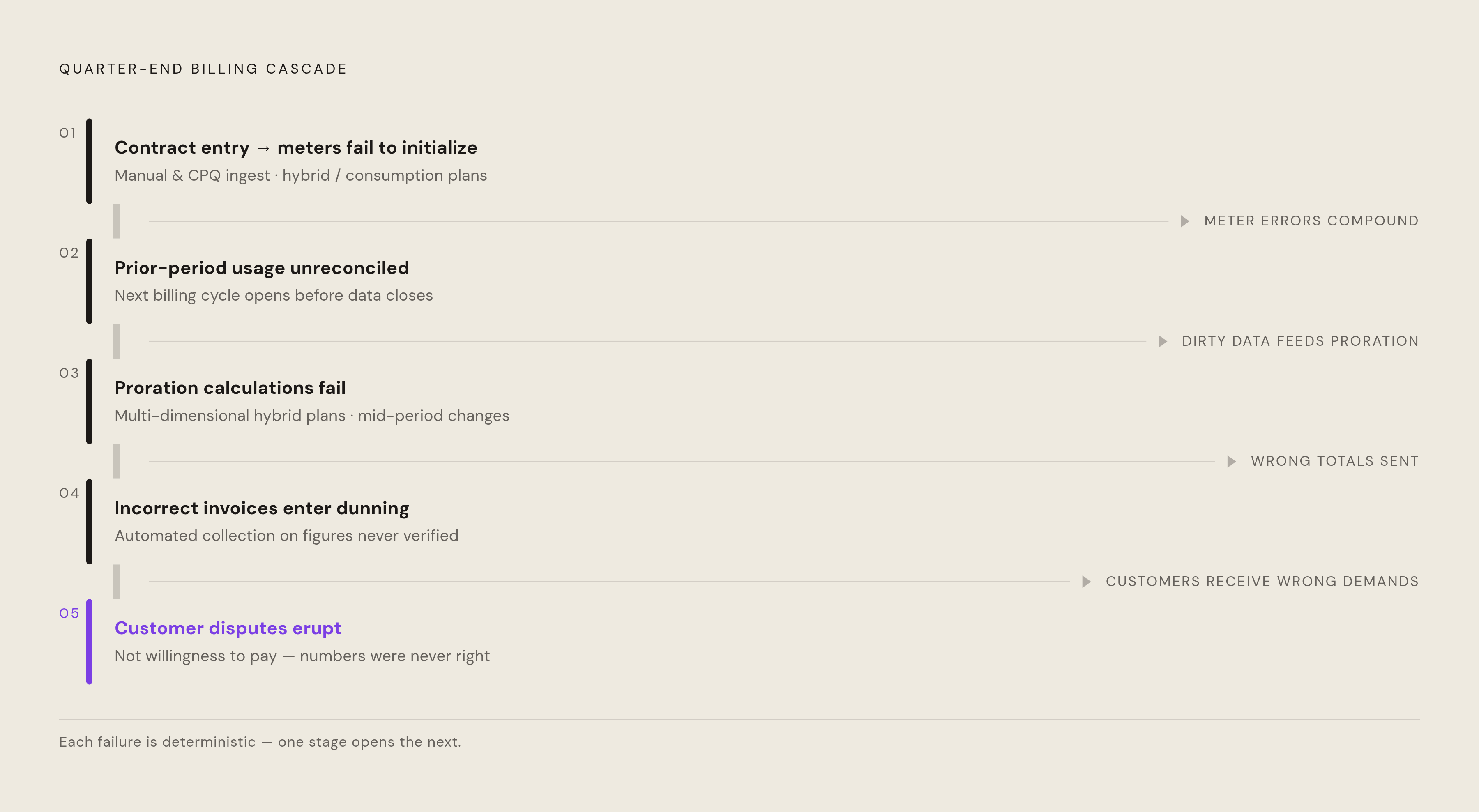
Billing errors during a surge don't happen randomly. They follow a cascade, and the sequence is consistent enough to walk through step by step.
It starts when new contracts get entered manually, or pushed through a CPQ tool, and the system fails to initialize usage meters correctly for hybrid or consumption-based plans. Meters that should track a specific dimension (API calls, GPU-minutes, seats plus overage) either don't get created, get created against the wrong dimension, or get created too late to catch the customer's usage from day one. From there the problem compounds: usage data from the prior period often hasn't been reconciled before the next billing cycle opens, so new invoices generate against meter reads that are incomplete or stale.
Proration makes it worse. Getting a partial-period calculation right on a simple subscription is trivial. Getting it right on a hybrid plan with several pricing dimensions running at once is not, and this is where most systems quietly get it wrong. By the time dunning flows kick in on invoices that were wrong from the start, the customer dispute that follows has nothing to do with willingness to pay. It has everything to do with a number that was never correct.
Billing error rates are commonly estimated to sit between 1% and 5% of total revenue. For a company running a substantial annual recurring revenue base, the high end of that range works out to a real chunk of yearly revenue lost to missed renewals, miscalculated invoices, and payment follow-up that never resolves. Usage-based SaaS businesses carry a second, distinct risk on top of that: metering errors carry a second, distinct risk of billing leakage, additive to the general error rate rather than overlapping with it.
None of this is a staffing failure so much as a scheduling collision. The same finance team setting up new contracts during the surge is also closing the prior quarter's books that same week. Two high-load tasks competing for the same people at the same time is a flaw in the calendar as much as it is a flaw in the software.
The cash flow and forecasting consequences that finance teams absorb downstream
Billing errors don't stay contained to the invoice where they originate. They move the invoice-to-cash cycle in the wrong direction: research suggests that cutting that cycle by just 10 days can improve cash flow by around 15% on average, which tells you how sensitive the metric is in the other direction too. A disputed or delayed invoice from the surge period rarely gets resolved in the quarter it was generated. It slides into the next one, dragging reported ARR, cash flow, and burn-rate figures out of sync with what actually happened on the ground.
Forecasting absorbs a separate hit, and it's arguably the more dangerous one. Finance teams build models around fixed entitlements and known renewal dates, but usage charges, especially the AI consumption layer, keep generating cost mid-contract without giving finance the visibility to plan around it. Buyers feel the same whiplash from the other side of the ledger: 61% of organizations report cutting projects or initiatives in the past 12 months because of unplanned SaaS cost increases they didn't see coming.
That has made buyers watchful in a way they weren't a few years back. Zylo's SaaS Management Index found that 79% of IT leaders encountered a price increase at renewal in the past 12 months, and a customer burned once by surprise pricing is slower to pay the next invoice the moment a number looks off. That behavioral shift lands directly on top of a finance team already absorbing surge-period error rates. The downstream cost of a billing mistake is now partly a trust cost, and treating it as only a cash-timing problem misses half of what it actually damages.
The billing infrastructure most SaaS companies inherited and its inability to handle the surge
Most SaaS billing infrastructure was built for a world where a new deal meant adding a subscriber to an existing plan: create the plan, set the price, renew annually. That assumption is baked deep into the architecture, and it breaks the moment a deal requires initializing a multi-dimensional usage meter instead of adding a row to a subscriber table.
The mismatch appears in the numbers on pricing change. 98% of SaaS companies modify their pricing at least once, yet 55% report they can't efficiently accommodate those changes with their current billing stack. The gap is a structural, permanent lag between the pricing reality of the contracts closing and the system meant to invoice them. It's a structural, permanent lag between the pricing reality of the contracts closing and the system meant to invoice them.
The standard market fix has been to stitch together two separate systems: a subscription billing platform paired with a metering tool bolted on after the fact. That is the wrong fix, even though it's the common one. It requires ongoing maintenance across the integration seam, forces reconciliation between two data models that were never designed to agree, and puts a failure point exactly where load concentrates hardest during a surge.
AI-era pricing has made that seam worse, not better. New cost primitives, tokens consumed, GPU-minutes burned, agent steps executed, requests resolved, don't map cleanly onto the usage dimensions legacy metering integrations were built to count years ago. Cost-per-token, cost-per-resolution, and cost-per-agent-minute are emerging as standard pricing structures, and most billing systems running in production today were never built to support any of them natively.
What real-time metering architecture requires, and where batch-based systems fall apart under surge load
Batch billing processes usage events on a fixed schedule: hourly, daily, or once at month's end. Under that model, billing state is always at least one period behind actual consumption. That lag is tolerable under normal load. Under surge load it compounds, because events pile up faster than the reconciliation process can clear them, and each unreconciled batch increases the odds that the next one inherits its errors too.
Stream processing works on a different premise. Metering, aggregation, and rating apply to usage events as they arrive, writing results to a billing state store with sub-second latency. Knowing what a customer has consumed in real time is a different technical problem than reconstructing what they consumed after the fact, at the moment an invoice needs to go out, and conflating the two is exactly where most legacy architecture goes wrong.
Three components define what a real-time billing system actually looks like, and none of them is optional if the goal is surviving surge load rather than just surviving ordinary periods of low demand. Stream processing handles high-throughput event ingestion as it happens. Event sourcing keeps an immutable record of every billing-relevant state change, so nothing gets overwritten when something needs correcting or auditing later. CQRS separates the write path, recording events as they land, from the read path, generating the views finance and customers look at, so the two workloads stop competing for the same resources the moment volume spikes.
The build-vs-buy decision finance and engineering teams face when the crunch exposes the gap
Building in-house is the default first instinct, and it's the wrong one more often than not. The initial scope always looks bounded: a few meter types, a handful of customers on the new pricing model, one pricing structure to support. Usage billing systems don't stay bounded, though. Complexity accumulates as the product's own pricing evolves, and the system that looked manageable at launch starts demanding constant attention within a year or two.
The real cost of an in-house system is the engineering team that has to own, patch, and debug it indefinitely. It's the engineering team that has to own, patch, and debug it indefinitely, long after the people who built it have moved on to other projects. Every pricing change becomes an engineering ticket instead of a finance team configuration change, and with companies averaging 3.6 pricing changes a year and 55% already unable to accommodate changes on their current stack, that bottleneck compounds fast.
Buying a platform doesn't remove engineering work. It relocates it, from maintaining billing infrastructure indefinitely to integrating a third-party platform through an API. That relocation is the entire point of the decision. The quality of a vendor's developer API and the design of its SDKs deserve to sit alongside commercial terms as a first-order evaluation criterion, not an afterthought once the contract's basically done.
Finance operations practices that reduce the damage while infrastructure modernization is underway
Infrastructure changes take time, and the quarter-end surge doesn't wait for a migration to finish. Some practices reduce the damage in the meantime, and the first is straightforward: the surge is predictable, so build the reconciliation calendar around it in advance instead of reacting once it hits. Finance teams that do this absorb the same volume with noticeably less chaos.
Renewal calendar management is the second control, and it's closely related to the first. Auto-renewal clauses that trigger without a prior-period review are a compounding liability, quietly generating errors that don't surface until a customer disputes an invoice months later. A renewal calendar with a defined review window ahead of the notice deadline gives finance time to verify usage data and catch billing configuration errors before an invoice ever generates, not after the customer has already flagged it.
Sharing usage visibility with customers ahead of the invoice may be the single highest-leverage move available right now, and it's the one most companies still treat as optional rather than mandatory. Customers who can see in-flight consumption dispute invoices less often and generate fewer support escalations when the bill lands, simply because the number stops being a surprise. That's an operational fix, not a UX nicety, and skipping it carries a concrete cost. Dodo Payments' industry reporting shows AI usage alone can add somewhere between 30% and 100% to a SaaS bill. Without visibility into that consumption as it accrues, that increase lands on the customer as a shock, at exactly the moment finance is already buried under surge-period volume.
Billing infrastructure built for the surge, not against it
A surge-ready billing system isn't defined by the absence of errors. Errors will happen; that much is close to guaranteed in any system processing high volume against complex, multi-dimensional pricing. What separates a surge-ready system from an inherited one is when the error gets caught.
A system built for the surge catches the problem in real time, at the moment the meter misreads or the proration calculation goes sideways, not weeks later when a customer calls in disputing an invoice that's already been sent, logged, and quietly damaging the relationship. Catching the failure at the point it occurs, instead of at the point someone else discovers it, is the entire difference between infrastructure that absorbs the quarter-end wave and infrastructure that gets pulled under by it again, on schedule, every three months.