
Invoice Timing Policies and Their Effect on DSO
Faster invoicing alone can cut days sales outstanding by up to eight days.
DSO measures the average number of days between a credit sale and the moment cash actually lands in the bank. It governs how much working capital a company has tied up at any given point, and finance teams typically treat four levers as roughly interchangeable ways to move it: credit policy, payment terms, collections cadence, and invoice timing. That's a mistake, because each of the four levers behaves differently in practice. Credit policy takes months of underwriting revision. Payment terms require renegotiating with customers who have no incentive to agree. Collections cadence only kicks in after an invoice has already gone out, so it's downstream of a decision that's already been made. Invoice timing is different: it's the one lever entirely inside the billing team's control, and it can be pulled this week, not next quarter. For a company with a billion dollars in revenue, each single day shaved off DSO frees up roughly $2.7 million in cash. For a company with a billion dollars in revenue, each single day shaved off DSO frees up roughly $2.7 million in cash.
Where your DSO stands: 2026 industry benchmarks and what the gap costs
According to the Credit Research Foundation's domestic trade receivables survey and the Hackett Group's Working Capital Survey, as reported by CreditPulse, the broad median DSO across industries is 40.5 days. Globally, across all sectors, the average is higher, at 59 days.
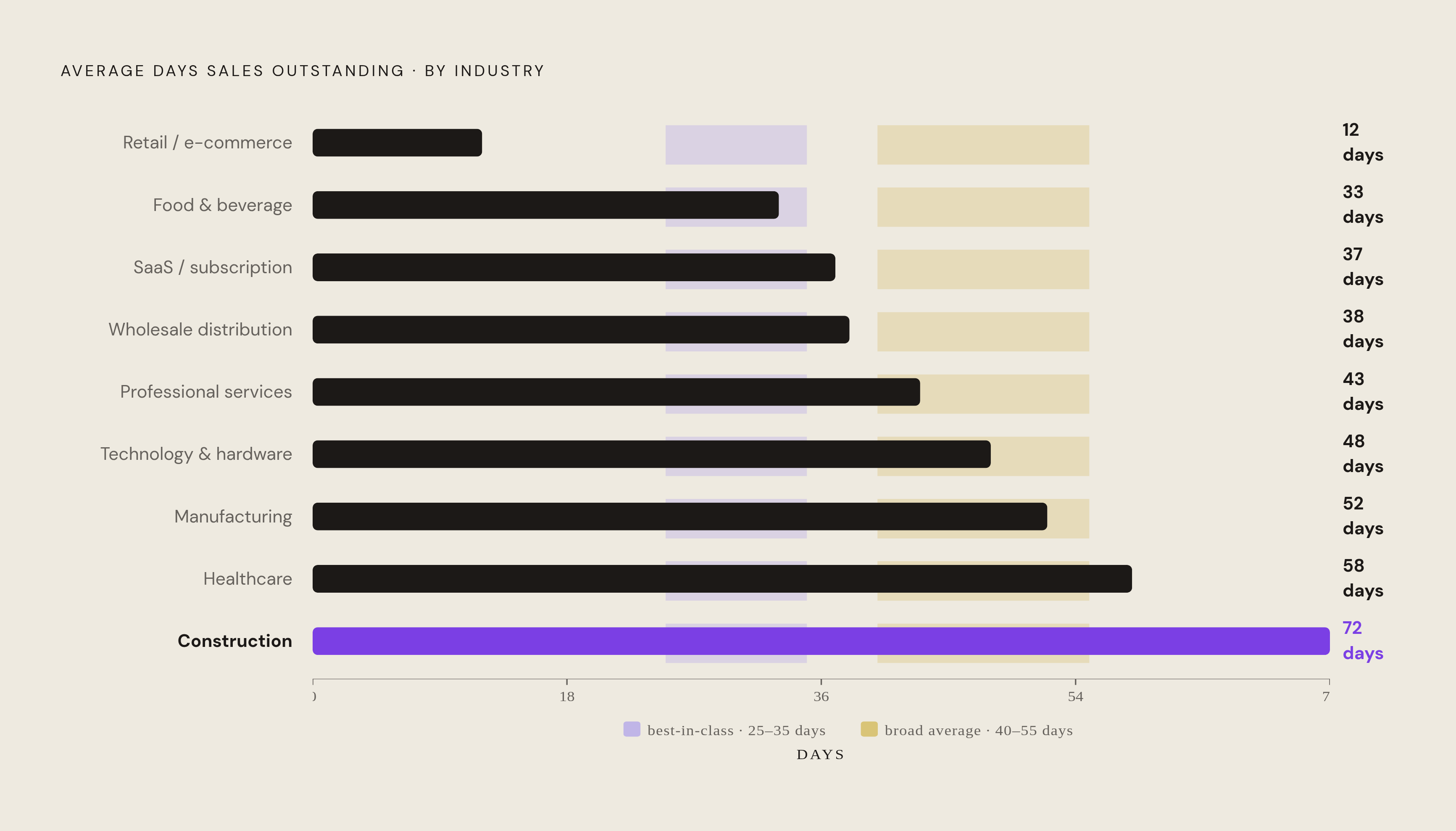
The spread by industry is wide, and the terms attached to each sector explain part of it. Retail and e-commerce are at the bottom, averaging 12 days with a typical range of 5 to 20, largely because so much of that revenue clears on immediate or card terms. Food and beverage averages 33 days on Net 21 terms, with a range of 22 to 45. Wholesale distribution runs Net 30 and averages 38 days, ranging from 28 to 50. SaaS and subscription businesses, also on Net 30, average 37 days with a 28-to-48 day range. Professional services average 43 days on Net 30, ranging from 30 to 58. Technology and hardware, on Net 45 terms, average 48 days with a range of 38 to 58. Manufacturing, also Net 45, averages 52 days, ranging from 40 to 65. Healthcare averages 58 days on Net 45 terms, with a wide spread of 42 to 75. Construction is at the far end: 72 days average on Net 30 terms, ranging from 55 to as much as 95.
Best-in-class companies are in the 25-to-35 day DSO band. The broader average clusters at 40 to 55 days. That gap, somewhere between 10 and 20 days depending on industry, is the working capital sitting on the table for any company willing to fix its invoicing mechanics rather than wait for a credit policy overhaul.
The measurable DSO impact of sending invoices faster and more accurately
Sending an invoice within 24 hours of delivery cuts DSO by 5 to 8 days on its own. A huge share of the DSO gap between average and best-in-class companies traces back to a task that has nothing to do with the customer's willingness or ability to pay, and no other single process change moves the needle that much on its own.
Delays and errors work the other direction. An incorrect invoice doesn't just annoy a customer, it slows the entire payment cycle, because most accounts payable departments won't release funds against a line item they don't trust. It's a billing accuracy problem. It's a billing accuracy problem, and it resets the clock on the whole transaction.
Consider what that reset actually looks like in practice. A Net 30 invoice issued three days late already has an effective window of 33 days before it's even technically overdue, and that's before anyone in AP has looked at it twice. Worse, an invoice with a disputed line item often stops the clock altogether: many enterprise payment runs simply won't clear a flagged invoice, full stop, regardless of how many days remain on the terms. An invoice that misreports consumption, either over- or under-counting usage, tends to trigger a dispute or hold, adding not days but weeks to the time it takes to collect.
Automated reminder cadences outperform manual follow-up by 12 to 18 days on average. But that number only holds if the invoice underneath the reminder is accurate and arrived on time. A reminder chasing a disputed invoice doesn't speed up payment: it just accelerates the argument.
How usage-based and AI product billing makes invoice timing structurally harder to get right
Flat-rate subscription billing has always had an easy answer to invoice timing: generate it on the calendar, regardless of what the customer did that month. Usage-based billing doesn't have that luxury. An invoice can't exist until consumption data has been aggregated, validated, and priced, and that dependency introduces a structural lag that most subscription-era billing tools were never built to handle.
This isn't a niche problem anymore. Usage-based pricing among SaaS companies rose from around 30% in 2019 to roughly 85% by 2024, according to industry tracking. The majority of the SaaS market is now wrestling with a timing problem that barely existed at scale five years ago.
AI companies feel this most acutely, because infrastructure has stopped being a rounding error on their cost structure. Infrastructure costs at some AI companies have climbed from a small share of total costs early on to as much as 35 to 40% as they scale, which turns delayed or inaccurate invoicing from a cash flow annoyance into a direct hit on the P&L.
The mechanics of usage-based billing make invoice timing worse, not incidentally but structurally. Usage arrives as a continuous stream of events, not as a single transaction at a point in time, so the billing system has to close a period and aggregate that stream before an invoice can exist. If aggregation takes three days after period close, DSO starts three days late, by construction, before a single reminder email goes out. And disputed token counts or API call totals stop the clock, the same way a disputed line item does in traditional billing.
What real-time metering architecture does to the invoice-generation timeline
Usage-based billing runs through three stages: ingestion of raw telemetry, metering (turning those raw events into billable metrics), and rating (applying pricing tiers, credits, and overage rules). How fast each stage runs determines how quickly, after the billing period closes, an invoice can actually go out.
Batch processing accumulates events and runs them through scheduled jobs. The billing system's view of reality can be hours or even days stale at any given moment. Stream processing works differently: it ingests continuously from a message broker like Kafka, Kinesis, or Pub/Sub, applies transformations as events arrive, and writes to a billing state store with sub-second latency. A streaming architecture can close a billing period and produce a validated invoice within minutes of period-end, while a batch architecture, by design, cannot. A streaming architecture can close a billing period and produce a validated invoice within minutes of period-end. A batch architecture, by design, cannot.
AI agent workloads push this to an extreme. An agent can generate around 3,000 events per minute, and at that volume a batch pipeline falls behind in real time: enforcement systems read stale state, overages get charged incorrectly, and the metering layer only catches up an hour later, after the damage is done. The resulting invoice, unsurprisingly, gets disputed.
Confluent's guidance targets 30 seconds to 2 minutes from event ingestion to usage record emission, using Apache Kafka and Apache Flink as the underlying stack. That window is the operational benchmark that makes same-day invoice generation something more than a slogan.
The four invoice timing policy decisions that directly add or remove days from DSO
Each of these is a decision, not a best practice buried in a policy document somewhere. Each has a default behavior that most companies fall into by inertia, and an improved behavior that costs real engineering effort but pays back in measurable days.
Decision 1: when the billing period closes and aggregation begins. The default is to wait for accounting to formally close the books before triggering invoice generation, a habit that adds meaningful days to the cycle by design, not by accident. The improved version fires an automated trigger the instant the billing period ends, running aggregation against data the metering layer has already accumulated in real time, so the invoice generates within hours instead of days. This single decision is where most of that 5-to-8-day timing improvement gets recovered.
Decision 2: how fast invoices go out once they're generated. Without intervention, generated invoices often sit in a queue, waiting on manual review or a scheduled batch email send, adding material hours of pure delay. The fix is automated delivery the moment an invoice is generated and validated, so payment terms start when the customer's inbox actually receives it, not whenever someone remembers to trigger the batch job. In many enterprise AP workflows, the invoice receipt timestamp is the contractual start of the payment clock. Whether anyone notices or not, a 48-hour delivery delay adds 48 hours to DSO, written into the terms.
Decision 3: how accurately the invoice reflects actual consumption. The default setup generates invoices from batch-aggregated or manually reconciled usage data, and errors occur whenever metering and billing run as separate systems that have to be reconciled after the fact. The improved approach has the invoice pull from the same event stream the metering layer has been accumulating all along, which eliminates the reconciliation step and, with it, the errors that step tends to introduce. Incorrect invoices make customers delay payment, and a single disputed invoice in an enterprise account can significantly extend collection time. Accuracy is a DSO variable with a number attached to it. It's a DSO variable with a number attached to it.
What billing infrastructure limitations cost in DSO terms and what to look for when evaluating a replacement
Every one of the four decisions above depends on infrastructure that can actually execute them. A billing system that can't trigger aggregation the moment a period closes, that queues invoices for manual send, or that runs metering and billing as two systems requiring reconciliation is adding days to DSO, quietly, every single billing cycle, whether or not anyone on the finance team has connected the dots. It's adding days to DSO, quietly, every single billing cycle, whether or not anyone on the finance team has connected the dots.
The cost compounds with scale. A company running flat-rate subscriptions can tolerate a sluggish batch pipeline because the invoice amount was never in question. A company running usage-based or AI infrastructure billing doesn't have that cushion: the invoice amount depends entirely on how fast and how accurately the system can close out a stream of continuous events, and any weakness in that pipeline directly slows cash collection.
Evaluating a replacement means asking about the mechanics that actually determine the invoice timeline. How long does it take, in practice, from period close to invoice generation? What's the architecture behind metering: does it run on a stream that can produce sub-second updates to billing state, or does it batch and catch up later? Is there a reconciliation step between the system that tracks usage and the system that generates the invoice, because every reconciliation step is a place where an error can survive undetected until a customer disputes it? And does invoice delivery happen automatically the instant validation completes, or does it sit in a queue waiting for a human?
None of these questions are about vendor features in the abstract. They're about which of the four timing decisions above the infrastructure makes possible, and which ones it quietly forecloses. A billing system built around batch processing and manual review isn't just slower: it's structurally incapable of hitting the 5-to-8-day DSO improvement that same-day, accurate invoicing makes available. That gap between what's structurally possible and what most systems actually deliver is, in the end, the same gap sitting between average and best-in-class DSO in the benchmark data above. It didn't close itself, and it won't.


