Manual Invoice Correction Volume as a Close Efficiency Indicator
Manual invoice corrections reveal broken billing infrastructure, not careless accountants.
Manual invoice correction volume at close is not clerical noise. It is a direct measurement of whether a company's billing system can actually count what it's supposed to charge for, and for any business selling usage rather than seats, that measurement is one of the sharpest efficiency signals finance has access to. When corrections spike at month-end, the cause almost never sits at the AP desk. It sits upstream, in usage data that wasn't captured when it happened, in pricing dimensions the billing system was never built to model, or in metering and billing running as two separate systems that have to be reconciled before a single invoice can go out.
This distinction matters most for companies charging by consumption: tokens, API calls, compute minutes, or another usage-based unit. A flat subscription shop issuing the same invoice every month has little room for this kind of failure. A usage-based business regenerates its exposure to it every single cycle.
What the benchmarks reveal about how much correction costs
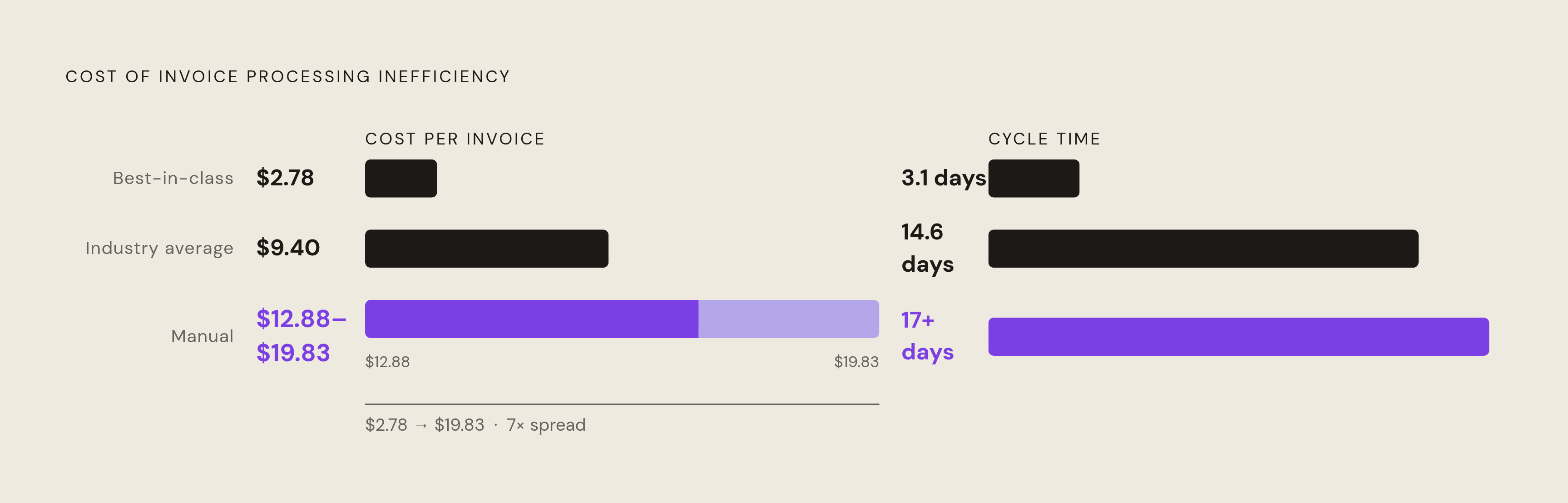
Ardent Partners research puts the cost of processing a single invoice at $2.78 for best-in-class AP teams. The overall industry average is $9.40. Fully manual organizations, the ones still moving paper or PDFs through email chains, run $12.88 to $19.83 per invoice. Every corrected invoice gets processed at least twice, so the correction multiplier isn't additive, it's compounding against whichever baseline cost a given team is stuck with.
Cycle time tells the same story from a different angle. Ardent Partners reports that best-in-class organizations close invoice-to-approval in 3.1 days. The industry average is 14.6 days. Bottom-quartile performers exceed 17. Corrections are a primary driver of that spread, and the touchless processing rate is the variable that separates the groups: teams processing more than half their invoices without a human touch consistently land under five days.
The downstream effect on cash isn't abstract either. Companies that cut invoice-to-cash time by just 10 days saw overall cash flow improve by 15% on average. Set that against SaaS DSO benchmarks, where the industry average runs 45 to 55 days and leading companies push under 40, and correction volume starts to look less like a housekeeping metric and more like one of the friction points holding the average up. For a usage-heavy AI or SaaS business, every correction issued at close is a delayed revenue recognition event, and often a small ding to customer trust that compounds with every future invoice the customer has learned to scrutinize.
Where most corrections originate: the billing infrastructure layer, not the AP layer
Most finance teams, when asked what causes correction volume, point to formatting inconsistencies, vendor discrepancies, or a missing purchase order. Formatting inconsistencies, vendor discrepancies, and missing purchase orders are real causes of correction volume. They are also not the dominant source once a company bills for usage.
The dominant sources sit further upstream. Usage events that weren't captured in real time, sitting in a batch system whose state is hours or sometimes days out of date by the time an invoice generates. Pricing dimensions the billing system simply can't model, a tool designed for flat monthly subscriptions suddenly asked to price tokens, GPU-minutes, audio-minutes, and hardware tiers all at once, in the same invoice, for the same customer. A metering tool and a billing tool that were integrated once at implementation now have to be reconciled every single close, forever, and that reconciliation burden is the source of both problems.
That reconciliation requirement is not a one-time cost. It recurs on a schedule, which means it generates a predictable, recurring correction load. Research from Factura.ai found that 39% of manually processed invoices contain at least one error, and the per-field error rate at scale runs around 2%. Those numbers don't describe careless employees. They describe a process that was designed to fail at a certain rate and then quietly does. An organization still reconciling metering and billing as two separate systems in 2026 is operating with a billing state that's never current enough to produce a clean invoice on the first attempt, month after month. That structural gap makes clean first-attempt invoicing consistently difficult to achieve.
Fixing that requires understanding what changed in pricing itself, because the modeling burden on billing infrastructure today is not the burden it carried five years ago.
How the shift to usage-based and credit-based pricing raised the modeling bar
The share of SaaS companies using some form of usage-based pricing rose from 30% in 2019 to roughly 85% by 2024, and 74% of software vendors had adopted usage-based models as of 2026, according to Stripe. That's not a niche pricing experiment anymore, it's close to the default. IDC research cited in Revenera's Monetization Monitor found prepaid and postpaid usage models combining for 42% buyer preference against 38% for straight subscriptions, making usage-based structures the leading category.
Subscription billing never had to solve for this. It needed a renewal date and a price. Usage-based billing needs accurate event capture at the moment consumption happens, not at the moment a contract renews. It needs aggregation across several pricing dimensions running simultaneously, support for prepaid credit wallets and postpaid invoicing on the same engine, and a billing state that reflects what actually occurred rather than a batch estimate of what probably occurred.
Credit-based pricing raises the difficulty further. A customer buys a bundle of credits, spends them against product usage, and the billing system has to track that balance in real time, reconciling live consumption against a shrinking credit pool before it can issue anything. A batch system, by its nature, cannot do this accurately, because its view of consumption is already stale by the time it runs.
And the ground keeps shifting underneath. Outcome-based pricing, billing for a completed result rather than a unit of consumption, has grown rapidly as a share of AI company monetization models. Each new pricing dimension a company adopts is a new place for the billing system to get it wrong, unless the value metric is designed around how the customer actually extracts value (a completed transcription, a resolved ticket) rather than an internal infrastructure unit like CPU-seconds that means nothing to the buyer and generates confusion, disputes, and corrections in roughly equal measure.
Bill shock as a visible, public case of what uncorrected metering failure looks like
Bill shock is what this failure looks like when it becomes a headline instead of a line item. In July 2025, a single developer generated a $7,225 invoice in one day after a team member burned through 500 requests under an annually-billed plan on Cursor. Aakash Gupta's February 2026 analysis found the post documenting it reached 797,000 views within a week.
The invoice, notably, was correct. It followed the plan's rules exactly. The failure wasn't in the billing logic, it was in the absence of any real-time visibility or spend alert that could have interrupted consumption before it reached five figures. That's a correction scenario even though nothing on the invoice was technically wrong, because the cost of that incident wasn't the credit memo, it was the support ticket, the public thread, the reputational hit, and whatever churn risk followed.
Spend visibility is the prerequisite for preventing this class of failure. A billing system that can't show a customer their in-flight consumption can't stop them from walking off a cliff, and preventing that walk is structurally cheaper than writing a correction afterward. Bill shock is the loud version of the problem. The quiet version, undercounting that appears during reconciliation, or a dimension mismatch that becomes visible when finance compares billing output against raw metering logs, is more common and gets far less attention because nobody tweets about it.
What real-time metering architecture does that batch systems cannot, and its importance at close
Stream processing applies billing logic to usage events as they arrive. Batch processing collects events and runs an aggregation job on a schedule, which means the billing state in a batch system is always some number of hours or days behind reality. At close, that staleness turns into invoices built on incomplete aggregations, corrections that only appear once actual usage is reconciled against the batch estimate, and a correction window that's structurally baked into every cycle rather than being an occasional accident.
A real-time metering pipeline typically ingests events from a message broker (Kafka is a widely adopted message broker for high-throughput billing workloads at scale), applies stateful transformations with sub-second latency, and writes the results to a billing state store that reflects current consumption rather than yesterday's snapshot. The specific event schema matters more than it might seem. An event_id field allows deduplication, without it, a retried event gets counted twice and produces a double-charge that becomes a correction. A timestamp field has to capture when the event happened at the source, not when it arrived at the server, because billing period cutoffs depend on it, and a wrong timestamp routes an event into the wrong invoice. A customer_id or subscription_id field links the event to the right billing entity, a misrouted event bills the wrong customer. An event_type field categorizes usage for pricing, which multi-dimension billing can't function without.
Idempotency underlies all of it: every billable event has to be counted exactly once. Without idempotent ingestion, network retries generate duplicate events that show up later as corrections nobody can explain until someone traces it back to the pipeline. A metering architecture that gets these fundamentals right closes the reconciliation gap that produces most structural corrections in the first place, because the invoice was built from a live state that was never behind to begin with.
Reading correction volume as a diagnostic: the pattern and the response
The raw count of corrections per close is a weak signal on its own. The pattern of where those corrections land is the useful part.
Corrections clustered in a specific customer segment usually point to a pricing dimension the billing system can't model for that segment's usage pattern. Corrections that recur at the same point in every cycle usually point to a batch aggregation boundary that's misaligned with the actual billing period. Corrections that track closely with pricing changes usually mean the billing system requires an engineering ticket to implement new pricing logic, rather than letting someone configure it directly. Corrections that require finance and engineering to sit down and reconcile metering logs against billing output by hand make the reconciliation burden between the two separate systems fully visible.
Leading SaaS companies maintain billing accuracy above 98%. Anything below that is a signal to act on, not statistical noise to average out over a quarter. High-performing SaaS companies also keep revenue leakage under 1 to 2% of total revenue; leakage is the silent cousin of correction volume, since undercounting errors that never generate a dispute, because the customer never noticed, are still a billing infrastructure failure. They do not appear in the correction count.
The useful output of this diagnostic is a map that separates incidental errors, the fat-fingered entry, the vendor data mismatch, from structural ones, the kind that justify a conversation about infrastructure rather than a training memo about process. That conversation needs finance, product, and engineering in the same room, because finance owns the count, engineering owns the metering architecture, and product owns the pricing model, and none of the three can fix a structural correction problem alone. ICONIQ's January 2026 survey found that 37% of AI companies plan to change their monetization model within the next 12 months. Every one of them is accumulating structural correction debt if the underlying billing system can't absorb a pricing change without a code deployment.
What purpose-built usage billing infrastructure changes about correction volume at close
The distinction that matters here is architectural. A subscription billing tool that's been extended over time to handle metering is not the same thing as a system built from the ground up to count usage. One was designed to renew a contract on a schedule. The other was designed to count events accurately as they happen. That's not a difference in configuration depth, it's a difference in what the system was built to do.
When metering and billing run on a single engine, the reconciliation gap disappears, because the billing state is the metering output, not a downstream copy that has to be checked against it. Pricing dimensions can be added or changed without an engineering ticket, so every pricing experiment doesn't open a new correction surface. Prepaid credit wallets and postpaid invoicing run on the same rails instead of two codepaths that need separate reconciliation at close. Real-time usage dashboards and spend alerts become something the billing layer does natively, which means bill shock prevention is built in rather than bolted on after the first public incident.
For enterprises that require sovereign cloud or on-premises deployment, that requirement disqualifies most cloud-only billing vendors before evaluation even starts, so deployment flexibility functions as a first-order filter, not a footnote. Developer API quality matters here too: a billing platform with thin event-ingestion APIs or weak SDK coverage forces engineering teams to build their own abstraction layer on top, and that abstraction layer becomes a new source of mapping errors, which becomes a new source of corrections.
Numeric's finance automation guide states that automation can cut manual work by up to 90%, but that ceiling assumes the underlying billing data is correct to begin with. Automating a correction-prone process just automates the errors faster. Building real-time metering infrastructure in-house is the alternative many teams consider, and it costs months of engineering time up front and creates a permanent maintenance obligation afterward, one that pulls engineers away from the product and onto a pipeline that has to be kept alive forever. The correction volume that leaks out of a maintained-but-never-improved internal system is a tax paid at every single close.
The practical payoff, when the infrastructure is right, is that the first week of the month stops being a reconciliation exercise. Correction volume approaches zero because the system generating the invoices produces accurate results from the start.