
Invoice Generation Lag and Monthly Close Duration in SaaS
Billing data delays force SaaS teams to double industry close benchmarks each month.
Cross-industry benchmarks say the monthly close should take about a week. SaaS finance teams routinely need twice that, and the gap between the two numbers is the actual subject of this article. APQC's open-standards benchmarking puts the median monthly close at roughly 6.4 calendar days across a large cross-industry sample, and top-quartile teams finish well ahead of that mark, but growth-stage SaaS teams average well into double-digit days and laggards run past 20. That median has sat still for a decade, so something more than tooling keeps SaaS teams so far outside it. The constraint sits in the structural inputs feeding the close: SaaS finance teams produce two distinct monthly outputs, the accounting close and the reporting package, and the two often run on separate timelines because ARR, net revenue retention, and customer counts draw on CRM and billing data that lives outside the general ledger. What follows traces why that structure makes the SaaS close harder than the benchmark suggests, and what it would take to close that gap.
Where the close days go in a SaaS finance team
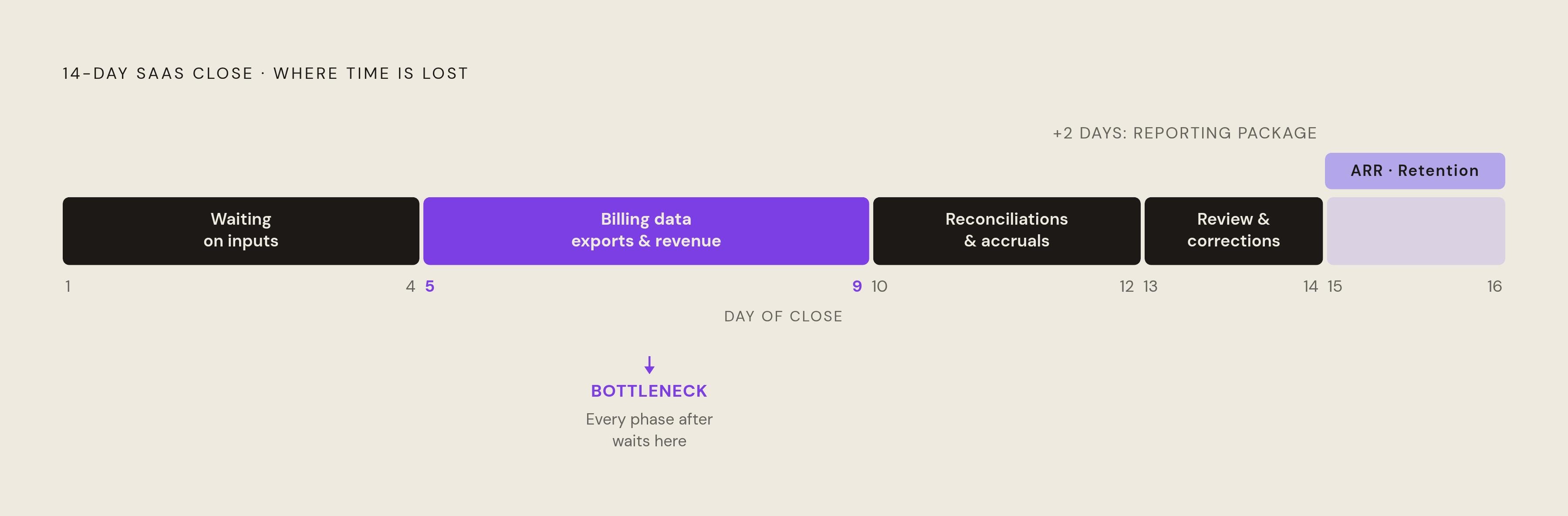
The benchmark gap becomes legible once you break a close down task by task, and the pattern is consistent: time piles up in revenue work, not in the reconciliation or review stages finance teams usually get blamed for. G-Squared's close breakdown of a growth-stage SaaS team shows a 14-day close splitting roughly into four phases: days one through four spent waiting on inputs, days five through nine consumed by billing data exports, manual revenue schedule updates, and deferred revenue reconciliation, days 10 through 12 spent on reconciliations and accruals that cannot start until revenue work finishes, and days 13 and 14 spent on review and corrections. Most lost close time concentrates in revenue and deferred revenue work rather than in reconciliation or review, a billing data problem. Layering the reporting package on top makes the close stretch further still: ARR and retention figures come from the CRM and billing system, and the team has to reconcile and explain the gap between billing-based SaaS metrics and recognized revenue, adding roughly two more days.
None of these phases run independently. The 10-day close sequence gates each stage on the one before it, so revenue recognition on days five and six cannot start until sub-ledgers and accruals are stable, and any delay upstream in billing data cascades through every phase that follows. That cascading structure is why a narrow bottleneck in billing data output turns into a company-wide close delay. It also explains why speed and reliability have to be tracked as separate measures: a team that delivers financials early and then books a material correction days later has an effective close duration that extends to that correction date, and the cost of that correction can exceed the cost of simply running a slower, cleaner close in the first place.
Invoice Generation as a Data Engineering Problem
Counting API calls, tokens, or compute accurately and continuously, then turning that into a charge, is a data problem that flat subscriptions never had to solve, and recurring revenue now fluctuates with consumption. About half of SaaS companies now run the hybrid seat-plus-usage model, a base subscription covering platform access paired with metered overages, and it has become the dominant pricing structure. It earns that position because it combines the predictability of recurring revenue with the gross margin protection usage pricing provides, but it comes at a structural cost: a single invoice now needs two separate metering paths to run correctly, one for the flat fee and one for consumption.
A single account today might combine a platform fee, metered usage, a seat count that moves mid-cycle, and an outcome-based line, spread across multiple entities and currencies, and every one of those lines is a place where an invoice can go wrong. Mid-cycle change never stops: customers upgrade, downgrade, and cancel partway through a billing period, and seat-based pricing means headcounts shift constantly, each shift requiring proration. Proration calculated by hand is slow and lets errors creep into revenue schedules that finance teams later have to track down during the close. What used to be a scheduling task, generate the invoice on the first of the month, is now a continuous data problem that has to be solved in real time or it compounds downstream.
What fragmented metering architecture does to invoice timing
Invoice lag is not a symptom of slow accounting work. It comes from billing infrastructure that cannot produce an accurate usage total until well after the billing period has already ended. Processing usage events at the scale modern pricing requires calls for stream processing rather than batch jobs: dumping event records into a database and running them through an overnight batch process produces data that is already stale by the time anyone reads it, and invoices cannot go out until well after the period closes. Most platforms built to solve this problem run on Kafka-based streaming architectures that process usage events as they happen, and this one architectural choice decides whether usage totals are ready on day one of the close or day five.
The ingestion pattern matters as much as the processing pipeline behind it. The recommended approach is fire-and-forget: application code emits a single billable event the instant a transaction occurs, and for continuous workloads a heartbeat pattern sends records at regular intervals rather than tracking separate start and end events, which risks losing data if a system crashes mid-job. The industry has already run this experiment at scale. AWS set the template in 2017 when it introduced per-second billing for EC2 instances, and to support that it had to build an entirely separate billing infrastructure stack. Snowflake took a different approach: it built a credit-based abstraction layer to shield customers from the complexity of per-second compute metering while giving Snowflake pricing flexibility across editions, regions, and cloud providers. Both cases show that accurate real-time metering is a real engineering investment.
When usage data arrives late or contracts get missed during billing, the consequence is not confined to a delayed invoice. AI automation can compress close duration, but if you apply it to a fragmented data source, it just reconciles bad data faster, not accurate financials. A metering and billing platform purpose-built for consumption-based pricing, such as Flexprice, removes the waiting period by making usage-based and hybrid revenue figures available immediately instead of requiring post-period batch processing and reconciliation. When companies run separate billing codepaths for subscriptions, usage, and credits, the reconciliation burden at period end scales directly with the number of systems involved, since each codepath has its own data model and its own chance to disagree with the others.
The downstream costs of invoice lag beyond a slow close
A slow close is the internal cost of invoice lag. The external cost appears on customers' invoices, and it is larger. Cursor generated a $7,225 invoice for a single developer in July 2025, and the root cause was uncapped usage after the company switched from 500 flat requests to a usage-metered credit pool. That was a metering architecture decision: spend caps, usage dashboards, and alert thresholds have to be built as engineering requirements from the start, not bolted on afterward as optional UX polish.
The same dynamic plays out at enterprise scale. Uber rolled out Anthropic's Claude Code to its engineers in December 2025, and by April 2026, four months into the year, the company had burned through its entire 2026 AI budget. Uber's president and COO publicly questioned whether that token spend tied to any measurable product improvement, and the company moved to cap employee use. Both examples trace back to the same root cause: consumption billing running without real-time visibility into what is actually being consumed.
Variable invoices carry a quieter cost too. When a customer opens a bill that is far higher than expected, the result is a dispute, a support ticket, and added pressure on days sales outstanding, a hidden tax that accrues from every instance of inaccurate or delayed metering. Revenue integrity suffers along the same path: when billing data arrives late or gets assembled by hand, multi-element allocation, variable consideration, and contract modifications all get handled under time pressure, raising the risk of recognition errors that have to be corrected in a later period. And because board decks, investor updates, hiring plans, and burn forecasts all depend on the month-end close, a reporting package built on billing data sitting outside the general ledger is only as trustworthy as the billing infrastructure that feeds it.
Why manual reconciliation and spreadsheet-heavy closes persist despite better tooling
None of this is news to finance teams, which raises an obvious question: if the problem is this well understood, why do spreadsheet-heavy closes persist? Discipline is not the problem. The billing and revenue tools most SaaS companies run were built for flat subscriptions, and they cannot produce the clean, timely data a usage-based close actually requires. Ledge's 2025 study found that most teams still rely on Excel for close activities, with about half naming Excel itself as a key reason their close runs slow. Cash reconciliation alone eats 20 to 50 hours a month for many finance teams, time that traces directly back to inputs arriving on no fixed schedule from billing systems that never surface real-time totals in the first place.
The market's standard fix has been to run two vendors side by side, a metering tool and a billing tool, stitched together with integration code. That integration carries its own ongoing maintenance burden, and the seam between the two systems is precisely where reconciliation errors accumulate. Finance tooling overall has not kept pace with how complicated pricing has become: the metrics SaaS finance teams now need, revenue by cohort, net dollar expansion, usage trends, require billing data at a level of granularity that subscription billing systems were never designed to expose.
AI-driven automation helps, but only up to a point. BlackLine's 2025 benchmark data shows that once SaaS and technology teams deploy AI across reconciliation and reporting, they close a lot faster. Applied to a fragmented data source, though, AI just reconciles bad data faster. It does not produce accurate financials. That limitation is what pushes the decision back to the infrastructure layer itself, and from there to a build-versus-buy choice finance and engineering leadership have to make together.
The economics of building metering and billing infrastructure in-house
Segwise spent three weeks of engineering time building credit-based pricing in-house and never shipped it, then went live on a purchased platform in three days. That gap, three weeks of internal effort against three days on a bought platform, is the clearest illustration available of what the build-versus-buy decision actually costs in practice.
The underlying numbers back up what Segwise's experience suggests. The Bureau of Labor Statistics puts the median software developer wage well above six figures as of May 2025, and at a fully-loaded rate, an initial billing engine build runs into the hundreds of thousands of dollars, with annual maintenance and pricing changes adding $73,000–$90,000 per year. Billing done right for simple flat subscriptions, covering upgrades, downgrades, trials, proration, and failed payments, can take two to four weeks of engineering time on its own, and metered hybrid plans multiply that scope considerably. Bessemer's State of the Cloud 2024 puts the fully-loaded median SaaS engineering hour at a significant premium, and integration code carries a substantial annual maintenance burden on top of the original build cost, moving the build-versus-buy break-even decisively toward buying over a three-year horizon.
Usage-based pricing is a product decision and an engineering commitment made at the same time, one most SaaS companies underestimate the first time they consider moving off flat-fee subscriptions. None of this means building in-house is always the wrong call. Internal development is often the right decision when authentication, billing, or infrastructure is itself the product being sold, when a regulated environment demands controls no off-the-shelf tool implements, or when an existing internal platform already owns the relevant capabilities. Outside those three conditions, the economics tend to run against the build path.
What purpose-built billing infrastructure eliminates from the close
G-Squared's close breakdown shows that the nine days lost to billing exports and manual revenue work, and the cascading dependency across every close phase, trace to days five through nine of a 14-day close. They are the predictable output of billing infrastructure designed for flat subscriptions being asked to count usage it was never built to measure. Purpose-built infrastructure removes each of those delays at its source rather than compressing them after the fact.
The complexity of hybrid and outcome-based pricing, seat counts that shift mid-cycle, tokens consumed across several dimensions at once, results that require attribution back to a specific usage event, is no longer a feature request finance can file away for later. It is a data infrastructure requirement that has to be met before the close can even start on time. Platforms built to model and measure multiple pricing dimensions on a single engine, Flexprice among them, remove the fragmentation that otherwise forces finance teams to reconcile across separate metering and billing codepaths.


