Billing Infrastructure Downtime and Close Schedule Risk
Cloud billing outages near month-end corrupt financial records and audit trails.
Billing infrastructure downtime is a financial reporting event that reaches beyond an engineering incident. When it happens near period-end, it corrupts the invoice records, the usage logs, and the accruals that finance depends on to close the books, and it does so in a way that ordinary system monitoring rarely catches until the damage is already baked into the numbers.
SaaS downtime as a structural risk rather than an occasional incident
Downtime across cloud DevOps platforms is getting worse, not better. GitProtect's report, cited in The Hacker News, found that total service performance degradation across leading cloud platforms nearly doubled, rising from 4,755 hours in 2024 to more than 9,255 hours in 2025. That's close to a doubling in a single year. The same report tracked a 69% year-over-year jump in critical and major incidents, from 48 in 2024 to 156 in 2025.
None of this reads as noise. It reads as a trend line, and the trend line points the wrong way for anyone who built financial processes on the assumption that cloud infrastructure is simply always there. That assumption was never actually guaranteed. Under the shared responsibility model that governs most cloud contracts, the provider is on the hook for the underlying infrastructure, but the customer still owns data protection and recovery on their own side of the line. So when an outage hits, the bill for cleanup doesn't automatically land on the vendor.
The bill for the outage itself is large enough on its own. Industry estimates put the true cost of an hour of cloud downtime somewhere between $300,000 for a mid-sized company and $5 million or more for a large enterprise, and that's before anyone counts what happens downstream in finance. For billing systems specifically, the compounding is worse than for most other services, because the immediate losses are visible right away while the real damage, delayed invoices and corrupted usage records, becomes visible only weeks later at close. Billing outages rarely get their own line item in uptime reports. They sit folded into general SaaS availability statistics, as if a failure in the system that generates revenue records were equivalent to a failure in, say, a marketing dashboard. A billing outage doesn't just interrupt service, unlike a failure in something like a marketing dashboard: it damages the financial record itself. A billing outage doesn't just interrupt service. It damages the financial record itself.
What billing downtime disrupts when it happens near period-end
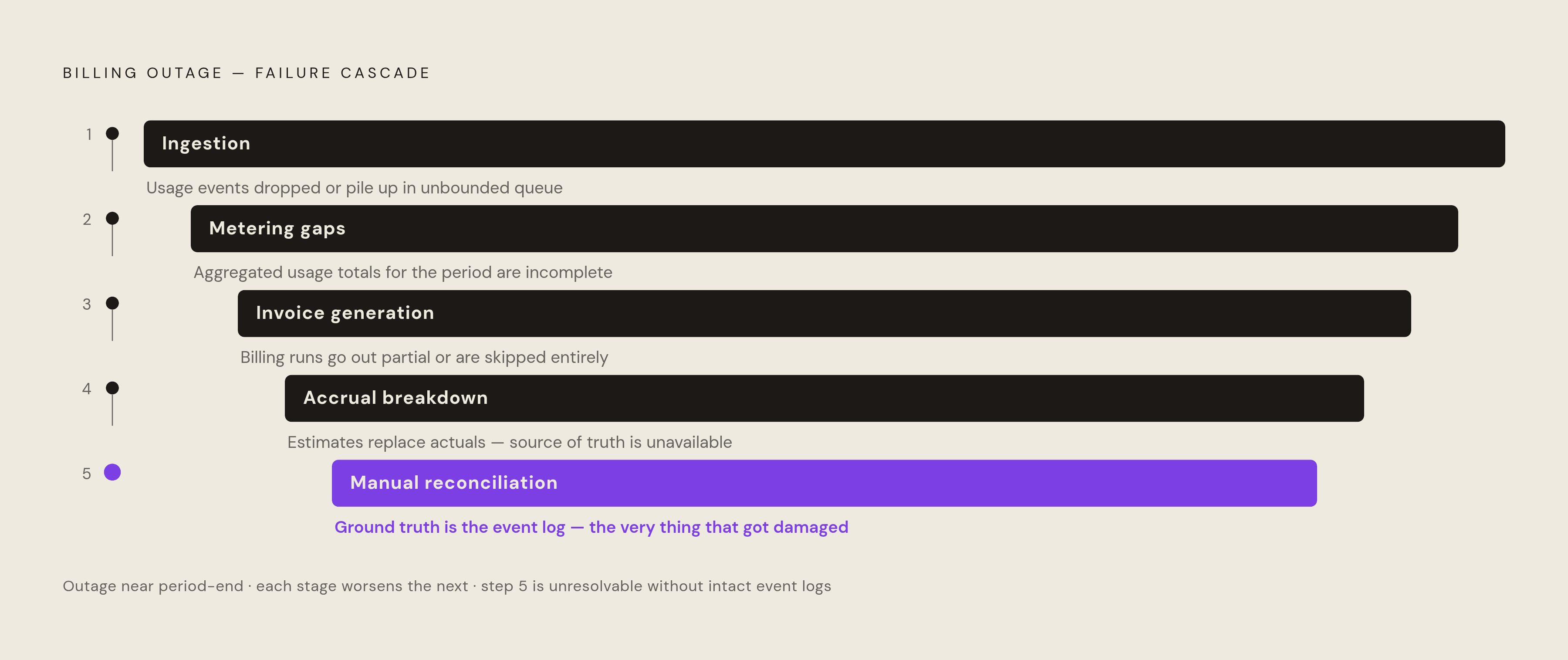
The disruption follows a sequence, and each step makes the next one worse.
It starts with ingestion. Usage events generated while the system is down either get dropped outright or pile up in a queue, and if that queue has no upper bound, the systems downstream get flooded the moment things come back online. From there, metering gaps appear: the aggregated usage totals for the period are incomplete, and depending on how the billing architecture is built, those gaps might not even be visible until someone starts reconciling records after the fact.
Invoice generation is where the gaps become concrete. Invoices that depend on complete metering data simply can't be finalized, so billing runs either go out partial or get skipped for the period. That pushes finance into accrual territory it didn't plan for. Cloud usage that won't be invoiced until the following week already requires an accrual estimate under ordinary circumstances, but when the billing system itself, the source of truth for that accrual, is unavailable, the estimate becomes a guess instead. Close runs longer, and the burn figure finance is tracking starts drifting away from what's actually been committed.
Then comes manual reconciliation, which costs the most time. Card charges, billing-platform entries, and ERP records live in separate systems, and when the billing platform's own data has holes in it, producing an accurate accrual schedule means cross-referencing multiple sources by hand. That's a known structural weak point at SaaS companies generally, and a billing outage during close week turns it from a known weak point into an active fire. The result: delayed revenue recognition, human error introduced by manual reconciliation, and figures that may diverge materially from actuals. That's audit exposure, not just an inconvenience.
Timing decides how bad it gets. A billing outage in the middle of the month is annoying but recoverable, since there's time to catch the gaps before anyone needs final numbers. An outage in the last 48 to 72 hours of a period compresses that recovery window down to almost nothing. And the type of pricing model determines the severity here: with flat subscription billing, a missed invoice is at least a known, bounded problem, something you can name and fix. With consumption-based billing, a gap in the metering data means the revenue figure is unknowable in principle until the missing events get replayed, and replay takes time the close schedule was never built to absorb. Cloud infrastructure bills already work this way, arriving only after the billing period closes so finance operates on estimates until the actual number lands. A billing system outage stacks a second layer of uncertainty directly on top of that first one.
How usage-based and AI billing models amplify every failure in the cascade
Consumption pricing raises the stakes on billing accuracy because the system now has to count correctly, continuously, at real scale, not just once a month. Hybrid pricing, combining a subscription base with usage-based components, had become the model for the majority of SaaS companies by 2025, and industry forecasts point toward consumption-based pricing appearing across most leading SaaS portfolios within the next few years.
AI billing pushes billable-event volume further than seat-based or even standard usage-based billing ever did. AI workloads can generate billable events at a rate and granularity that seat-based billing never approached, and agentic workflows compound that volume further still. That's a system processing millions of events continuously rather than one invoice per customer per month. It's a system processing millions of discrete events continuously, every day of the period.
Credit wallet billing adds a layer of state that has to survive downtime intact. Credit deductions need to be atomic: a partial deduction caught mid-failure corrupts the wallet balance, and a corrupted balance means customers end up overcharged or undercharged for the period, with no clean way to tell which. Fixing that after the fact requires replaying events against the wallet, and replay only works if the event log is complete and correctly ordered. If it isn't, there's no reconstructing the truth, only estimating it.
Outcome-based billing, where the customer pays for a result rather than for consumption, adds yet another failure mode. If the system recording outcomes is down at the moment an outcome occurs, the revenue tied to it is either lost or has to be manually rebuilt from whatever partial evidence exists elsewhere. Outcome-based terms now show up in a notable share of enterprise SaaS contracts. And the accrual uncertainty, already sharp under ordinary usage-based billing, gets sharper still: a large share of IT leaders report unexpected charges from consumption or AI pricing models, and cost forecasting ranks as the top challenge for most CIOs. Those figures describe the buyer's version of the exact uncertainty that billing downtime creates for the vendor at close.
Atlassian's approach to Rovo AI credits is a useful illustration of how tangled this gets even without an outage. Standard plans include a fixed monthly allotment of Rovo credits per user, with additional usage billed per credit once that allotment runs out. A single contract now carries both a flat subscription component and a metered component layered on top of it. If downtime corrupts the record of which credits were used and when, the overage charges on that invoice become unverifiable, not just delayed.
The architectural requirements that determine whether a billing system survives period-end pressure
Every metering pipeline runs through three stages, and each one is a place where things can go wrong in a different way. Ingestion collects the raw telemetry, API calls, tokens processed, storage writes, agent actions, and standardizes it; this is where events get lost outright if the system goes down mid-stream. Metering takes that normalized stream and aggregates it into billable metrics; this is where gaps in the input produce incorrect totals for the period. Rating applies the pricing logic to those metrics to calculate what's actually owed; incorrect totals here become incorrect invoices, full stop.
The choice between stream processing and batch processing decides how much of that risk turns into actual close-schedule damage. Batch systems collect events and process them on a schedule, so billing state can sit hours or even days out of date, and a failure right at period-end risks losing the most recent batch. Stream processing applies billing logic as events arrive, with latency measured in fractions of a second, so billing state stays current and recovery can resume from the last committed point in the stream rather than from whatever batch happened to be running when things broke.
Idempotency isn't optional in either architecture. Without idempotency keys attached to every event, replaying the log after a failure double-counts everything that already made it through before the outage, and double-counting corrupts the metering totals just as thoroughly as a gap does, except now customers get overcharged instead of undercharged. That's a trust problem layered on top of a close problem. Backpressure handling matters for the same reason: when downstream systems start lagging, ingestion needs to slow down gracefully rather than dropping events on the floor, because an unbounded queue overwhelms the system on recovery and produces the same metering gaps a full outage would.
For billing specifically, the recovery targets worth building toward are a recovery time objective of about one hour, so that no more than an hour passes before events stop being metered correctly, and a recovery point objective of zero events, so that no data is lost. Hitting those targets isn't a matter of writing them down. It requires multi-region replication, replay procedures that get tested on a real schedule rather than documented once and forgotten, and disaster recovery runbooks that operations teams have actually rehearsed.
A separate metering tool bolted onto a separate billing tool through an integration layer is one more structural risk. If either vendor in that pairing goes down, the combined pipeline breaks, and the seam between the two systems is exactly where data loss is hardest to spot and hardest to replay, since the event log may live in one tool while the invoicing logic lives in the other.
What finance teams face when they open close week after a billing incident
Plenty of SaaS finance teams still run parts of accounts payable through spreadsheets and card statements, reconciling disconnected tools by hand at close. That workaround holds up fine at low invoice volume. It stops holding up once volume grows past what a spreadsheet can track without silently dropping line items, and a billing outage accelerates the arrival of that breaking point by exactly the amount of data it corrupts.
Three sources of truth are supposed to agree at close, and after an incident, they won't. The billing platform's own invoice records are incomplete if downtime hit during the period. The GL entries already posted reflect accruals made while the billing data was unavailable, so they're estimates dressed up as entries. Bank and card statements show what actually got charged, which reflects real cash movement but not necessarily correct metered usage. Reconciling those three by hand isn't just slow, it's genuinely uncertain in a specific way: finance can't tell which discrepancies represent real undercharging and which represent events that simply got dropped, because the event log, the only actual ground truth here, is the very thing that got damaged.
Cloud infrastructure bills offer a useful parallel on the expense side. Those invoices tend to land as one undifferentiated number, and finance can't act on a number like that without allocation and coding behind it. A billing outage produces the mirror image of that problem on the revenue side: a total that finance can't break down into customer-level or product-level figures with any confidence.
The board sees the consequence eventually. An underdeveloped accounts payable function already makes burn, gross margin, and budget reporting harder to defend, which turns AP quality into something boards actually ask about. The same logic runs straight through to revenue reporting when billing data has holes in it. A CFO walking into a board meeting with known gaps in the usage record is standing in a fundamentally different position than one presenting complete, auditable numbers, and everyone in that room knows the difference.
Pricing changes make the whole situation worse. Nearly all SaaS companies adjust pricing at least once a year, and according to OpenView, more than half say their current billing stack can't efficiently keep up with those changes. Layering a mid-period pricing change on top of a billing outage multiplies the reconciliation burden rather than simply adding to it.
Designing billing infrastructure so downtime near period-end does not corrupt the close
Durability comes before anything else. Every usage event has to hit a durable log before any downstream processing touches it, because if metering or rating fails afterward, the events can still be replayed from that log. If the log itself is what gets lost, there's nothing left to recover from, no matter how good the rest of the architecture is.
Replay has to be idempotent by design, not bolted on after the fact. Every event needs an idempotency key so that replaying the log post-outage doesn't double-count anything that already got processed, and replay procedures need actual monthly testing rather than a runbook that sits untouched in a wiki. A recovery point objective of zero events is a real target only when replay has been tested enough times that nobody's guessing whether it works.
Period boundaries need their own protection. The billing system should guarantee that every event timestamped inside a given period gets included in that period's invoice run, no matter when it actually arrives, so a late event caused by network delay or downstream lag doesn't accidentally fall into next month's revenue instead of this month's. That guarantee only holds if the raw event log is kept separate from whatever store accumulates the running billing state. If the state store goes down, the event log needs to stay intact and reachable on its own, because that separation is what makes replay possible without someone manually rebuilding the numbers from scratch.
Real-time visibility into usage changes the shape of close week. Finance teams that can watch running invoice totals throughout the period aren't starting reconciliation from zero once the period ends, they're arriving at close with an estimate that's already close to final. That kind of visibility is only available with stream processing; batch billing architecture simply can't produce it, since the numbers are always some hours or days behind. Pair that with automated invoice generation that carries a full audit trail, showing exactly which events contributed to which line item, and the close becomes something that can actually survive an audit, which manual reconciliation was never going to produce no matter how carefully it was done.
Deployment choices matter too. Companies with strict data residency requirements that run their billing on a vendor's shared cloud infrastructure inherit that vendor's downtime risk with no way to mitigate it directly. On-premises or sovereign deployment removes that dependency entirely, at the cost of taking on more of the operational burden directly.
Evaluating a billing platform when close-schedule risk is a first-order concern
Event log durability and replay are at the top of the list, because everything else in the architecture depends on whether the raw event stream survives a failure intact and whether it can actually be replayed on demand rather than in theory. A platform that can show a tested, documented replay procedure with a real recovery point objective near zero is telling you something concrete about how it behaves under failure. A platform that can only describe its uptime percentage is not.
Idempotency guarantees deserve the same scrutiny; ask specifically how the system prevents double-counting on replay, not whether it claims to. With stream processing, finance gets real-time visibility into usage; with batch processing, finance is stuck waiting until period-end to find out what actually happened. Deployment flexibility, meaning whether the platform can run on-premises or in a sovereign cloud environment for companies that need it, is a genuine differentiator for organizations where a shared cloud dependency is itself an unacceptable risk.
None of this is a checklist to fill out once and forget. Close-schedule risk from billing downtime is a function of architecture, tested continuously, not a feature that gets purchased once and left alone.