
Invoice Dispute Rates at AI API Companies
Metering systems at major AI providers cannot measure consumption fast enough to bill accurately.
Invoice disputes at AI API companies are not a support queue problem. They're the visible output of a metering system that cannot count, attribute, or expose consumption events fast enough to keep pace with what it's billing for, and the fix has to happen in the pipeline, long before an invoice ever gets generated.
Billing errors at AI API companies are widespread and well-documented. A Vaudit review of $34 million in AI invoices across 60 companies between March and June 2026 found roughly $1.7 million in overcharges, with Amazon, Google, Microsoft, Anthropic, and OpenAI subsequently refunding around 80% of disputed charges once customers complained. Zylo's 2026 SaaS Management Index found 78% of IT leaders reporting unexpected charges tied to consumption-based AI pricing, and McKinsey estimates 20 to 30% of AI spend often goes unaccounted for. To audit invoices, companies need to cross-reference their own usage event logs against line items, checking that input and output tokens are rated separately at the correct per-model rates, that credit pools were drawn down in the right order, that no events were duplicated across billing periods, and that the rate applied matches what was actually in effect at the time of consumption rather than a later revised price.
How common are billing errors and overcharges at AI API companies?
Between March and June 2026, the auditing firm Vaudit reviewed $34 million worth of AI invoices across 60 companies. It found roughly $1.7 million in overcharges, a number reported by The Information. Panasonic, HP, and Honda were among the affected customers, and the majority of the flagged billing issues traced back to Anthropic's Claude Code, with OpenAI invoices also showing up in the review.
What happened next matters more than the audit itself. Amazon, Google, Microsoft, Anthropic, and OpenAI refunded around 80% of the disputed charges once customers complained. An analyst's observation on this point is hard to improve on: you don't credit back four-fifths of a bill you believed was accurate. The refund rate is the tell.
Then there's the outlier that shows what happens with zero guardrails: a free-tier user's account got billed $16.6 million in a single day. Anthropic confirmed no money actually changed hands, the charge attempts were declined by the user's bank, and the invoices were cancelled. But the incident still raises a hard question about what stops an agentic workload from running up seven figures before anyone notices.
That wasn't an isolated glitch, either. Late January 2026 brought a case of a single user charged 26 times in one day. February confirmed a double-billing bug at the system level. Between March and April, at least six users across Taiwan, Poland, the UK, and the US got charged for subscriptions they'd never bought, including plans labeled "Gift Max 5X" and "Gift Pro." Billing complaints dominated public review platforms during this stretch.
One more example, smaller in dollar terms but precise in what it reveals: a developer on GitHub flagged roughly $60 in usage from the official Claude Code CLI, around April 4-5, 2026, that got debited against their extra usage credit balance instead of their Pro subscription quota. Those credits were specifically meant for third-party OAuth-authorized harness usage, not official CLI sessions, on a Claude Pro plan running Claude Opus 4.6. Wrong pool, wrong charge, and the user had to find it themselves.
None of this is happening at the margins of the industry. It's happening to the largest providers and their enterprise customers, which is exactly why the pattern is worth taking seriously before getting into why it happens.
How usage-based pricing complexity multiplies the failure surface
Token billing isn't one number. Input and output tokens carry different rates, and model variants carry different rates again. It's a formula being applied in real time, not a price list someone can memorize.
Look at what that formula actually spans. Azure OpenAI Service prices GPT-4o in the East US region at $5 per million input tokens and $15 per million output tokens, before regional variation and enterprise discounts even enter the picture. Anthropic's Claude Sonnet runs $3 per million input tokens and $15 per million output. OpenAI's own catalog spans from GPT-4.1 Nano at $0.10/$0.40 per million tokens up to the o1 reasoning model at $15.00/$60.00, a 150x spread inside one provider's price sheet. And the ground keeps moving: LLM API prices fell roughly 80% between early 2025 and early 2026, with GPT-4o input dropping from $5.00 to $2.50 per million tokens and o4 Mini landing at $0.55. A static rate table configured six months ago is already wrong.
Agent loops make attribution worse. One user action can kick off dozens or hundreds of LLM calls, tool invocations, and retrieval steps underneath it. When an agent session spans multiple users, projects, or tenants, the question of who actually gets charged stops being obvious and becomes a design decision someone has to make explicitly, upstream, before the fact.
Token variability compounds this further. The identical prompt can return 50 tokens or several thousand, depending on the model, the settings, and how generation happens to unfold that run. That means billing genuinely cannot be calculated in advance. Usage events have to be emitted after execution, with the actual counts, not an estimate.
Prepaid credit plans add another layer. A June 2026 review of 50 AI and SaaS pricing pages found 30 of them running on prepaid credits, which means credit balance tracking, drawdown logic, and expiry rules, none of which traditional subscription billing was ever built to handle. When credit attribution breaks, as it did in the Claude Code CLI incident, the error stays invisible until a customer happens to audit their own account.
Anthropic's own billing overhaul, announced for June 15, 2026, then reversed, shows how disruptive a pricing migration can be even for a well-resourced provider. The original plan would have moved the Agent SDK, the claude -p command, Claude Code GitHub Actions, and third-party apps off regular subscription limits and onto a separate monthly credit, $20 for Pro and up to $200 for Enterprise, with overages billed at usage-based API rates. Anthropic reversed course by email: "Nothing changes for now," before the transition took effect. The timing deserves attention. a shift to usage-based billing amid intensifying price competition would have worked against Anthropic, and the company has confidentially filed draft IPO paperwork with the SEC, where billing controversies carry reputational weight. Anthropic had already banned third-party tools like OpenClaw from subscription limits back in April, which had already frustrated developers before the broader billing changes added more uncertainty on top. Even without an executed change, the announcement itself generated dispute risk.
Where the metering pipeline breaks and disputes are born
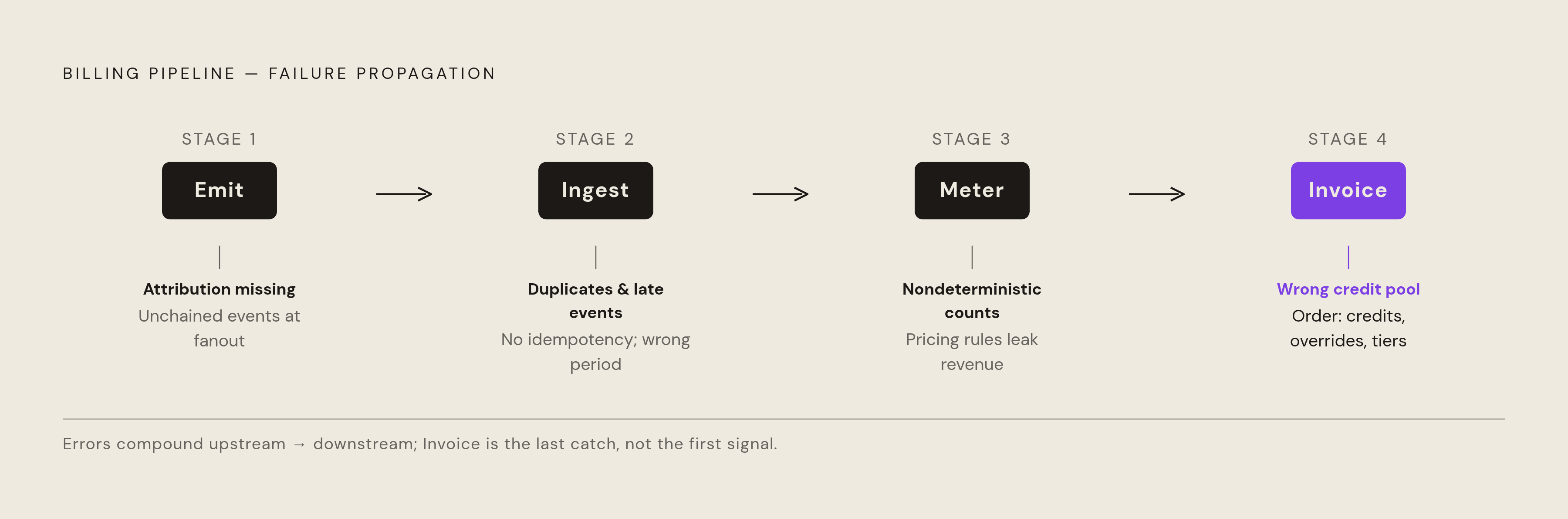
The billing pipeline runs through four stages: emit, ingest, meter, invoice. Each one has its own failure mode, and each failure compounds into the next stage rather than staying contained.
Emit is where agent fanout does the most damage. One user action can generate a long chain of billable events, and if attribution isn't defined at the event schema level, at the moment the event is created, it cannot be patched in later.
Ingest has to survive volume it wasn't necessarily sized for. An enterprise batch job can produce more usage in a few hours than the account generated in the prior two weeks combined. Deduplication isn't optional at this stage: retries and outages create duplicate events, and without idempotency keys, the same usage gets billed twice. Late-arriving events, ones that show up after a billing period has already closed, need an explicit policy, or they get attributed to the wrong period entirely.
Metering is where nondeterminism lives. The same prompt returning different token counts across runs makes deterministic testing genuinely difficult, and the metering logic has to be built to tolerate that variance rather than assume a fixed answer. Misconfigured pricing rules are a leading cause of billing disputes and revenue leakage in usage-based businesses, and PwC UK research puts 4 to 7% of ARR at risk from billing practices that haven't caught up to the pricing model.
Invoicing is where credits, overrides, and tiered thresholds get applied, and if they're applied in the wrong order, the result is a line item the customer will dispute. The Claude Code CLI case, where usage hit the wrong credit pool, is a clean example of an invoice-layer failure sitting downstream of an otherwise correct metering read.
What does a usage event need to actually hold up under a dispute months later? Sound billing engineering practice points to a consistent set of requirements: a stable, immutable customer and project identifier. A timestamp for when the action occurred. Separate quantity fields for input and output tokens unless the pricing model treats them identically. A correlation ID linking the event back to the request, session, or agent run that generated it, since that's what lets a support team trace a disputed charge back to actual application logs. A clear record of the billable determination and its basis, rather than a billing decision buried three layers down in code nobody remembers writing. And a schema version tag, so a pricing change six months from now doesn't quietly reinterpret an event from today.
The raw event store underneath all of this needs to be append-only. When something's wrong, a miscounted token, a misattributed customer, the fix is a new correction event that references the original record, never an edit to the record itself. And the system needs to be able to answer a dispute filed in June about a March invoice by replaying the exact sequence of events that produced that number. If it can't do that, the dispute resolves in the customer's favor by default, whether or not the original charge was actually correct.
What unresolved disputes cost beyond the refund
The refund is the cheapest part of a dispute. Zylo's 2026 SaaS Management Index found 78% of IT leaders reporting unexpected charges tied to consumption-based AI pricing, and McKinsey estimates that 20 to 30% of AI spend often goes unaccounted for. That gap is where disputes are born, well before anyone files a formal complaint.
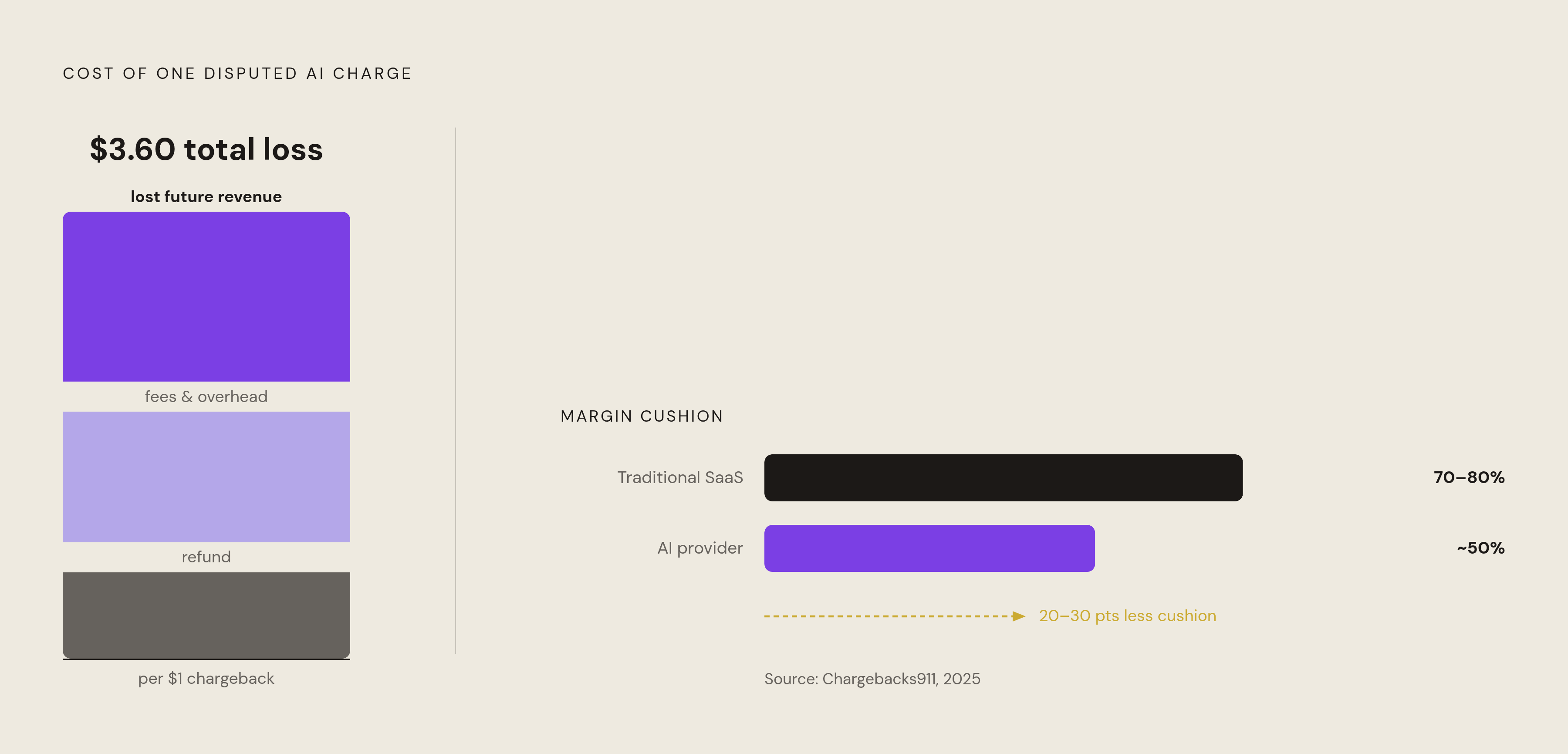
A 2025 Chargebacks911 report found SaaS and subscription companies lose an average of $3.60 for every $1 in chargebacks, once fees, operational overhead, and lost future revenue get counted. The refund itself barely registers against that total.
PwC UK's figure of 4 to 7% of ARR at risk from unsophisticated billing isn't a rounding error at any real scale. And enterprise customers are already trimming AI spend as costs shift from flat subscription rates to bills running several thousand dollars a month under usage-based pricing; a customer who can't see their own consumption coming has one obvious lever left, which is to cut the vendor.
AI margins sit around 50%, well below the 70 to 80%-plus margins SaaS companies have historically run. There's less room in that margin to absorb refunds, remediation work, and churn than the software industry's older billing playbooks were built to assume. Put the chargeback multiplier next to that margin compression and the math gets uncomfortable fast: a disputed invoice that escalates into a chargeback costs $3.60 on the dollar, on a revenue base that already has less cushion than the businesses those numbers were originally calibrated on.
Why customer-facing usage visibility is a dispute prevention mechanism, not a dashboard feature
Most billing disputes aren't fraud. They're customers who had no way to see usage accumulating until the invoice showed up and told them the number.
Real-time usage computation changes that dynamic entirely. A customer who can watch cost build as they consume can adjust behavior mid-cycle. A customer who only finds out at the end of the cycle can only dispute. That's the whole difference, and it's an architectural one, not a UX preference.
Cost containment has to sit in the execution layer itself: credit reservations, circuit breakers on agent loops, anomaly detection that fires before the usage happens rather than after the invoice does. The $16.6 million single-day incident is what the absence of that layer looks like taken to its logical extreme, where the invoice becomes the first and only signal anyone gets.
For agentic workloads specifically, where one user action can spin off hundreds of downstream calls, spend alerts and circuit breakers stop being a nice-to-have safety feature. They're the mechanism that keeps a runaway agent loop from turning into a five-figure dispute a week later.
There's a support-cost angle here too, one that's easy to underweight. Every customer who can't see their usage in-flight is a customer who will eventually call or email asking why the number looks wrong, and that support load tends to dwarf the cost of just building the visibility in the first place. It's also worth being precise about where that dashboard data comes from: if the customer-facing usage view is fed by a different pipeline than the one generating the invoice, that's a second, entirely separate category of dispute, the "my dashboard said X, my invoice says Y" complaint that no amount of customer support scripting can talk someone out of.
The billing infrastructure decisions that determine whether disputes are resolvable
An 80% refund rate across five of the largest AI providers says something specific: those companies, when pushed, frequently could not defend their own invoices to the standard a dispute demands. Refunding is the path of least resistance when the audit trail underneath the invoice is incomplete.
Append-only event stores with correction events, rather than edits to source records, are the technical baseline for a defensible audit trail. Without that immutability, nobody, not the provider and not the customer, can trust the billing record enough to resolve a dispute on the merits.
Deduplication, late-event handling, and rule versioning aren't edge-case engineering concerns tucked away in a backlog. They're the difference between a system that produces invoices people can trust and one that will, eventually, double-count something and not know it happened. Schema versioning matters here too: a dispute filed months after the fact needs the system to apply the pricing rule that was actually in effect at the time of consumption, not whatever rule is live today.
Errors cascade regardless of which stage they start in. A missed event becomes a billing dispute. A misconfigured rate becomes a revenue recognition problem finance has to untangle later. Generic automation tooling tends to fail at exactly this point, because it moves data around without capturing the commercial context, the actual contract terms, sitting behind that data.
Gartner's 2025 analysis found that 78% of SaaS companies above $50 million in ARR run on commercial billing platforms rather than homegrown systems, and the reason is straightforward: building billing in-house takes 8 to 14 engineers a minimum of 3 to 4 months, and those same engineers then spend roughly 40% of their ongoing time on maintenance instead of product work. Algolia's experience building billing in-house is the cautionary version of this: the resulting codebase got complex enough that nearly every pricing change needed cross-team coordination spanning engineering, finance, and executive leadership, CEO and CFO included.
The build-versus-buy question, for dispute resolution specifically, comes down to one capability. An in-house system that cannot replay a billing period deterministically months after the fact cannot defend a dispute when one arrives. That has to be designed in at the start. It isn't something a team bolts on afterward once the complaints start piling up.
What to look for in billing infrastructure built for AI dispute rates
The pattern across every incident in this piece points to the same root cause: measurement and visibility gaps that exist upstream of the invoice, not fraud, and not customer misunderstanding. Infrastructure built for AI's dispute rate needs to treat that as the design brief.
That means an event schema with immutable identifiers, correlation IDs, and explicit billable flags from the first line of code, not retrofitted after the first audit finds a problem. It means an append-only event store where corrections are new events, never silent edits, so a dispute filed six months out can be traced back to the exact sequence of consumption that produced the number in question. It means deduplication and late-event handling built in as core logic, not exception-handling bolted on after the second duplicate-billing incident makes the news.
It means real-time usage visibility for the customer, fed from the identical data source that generates the invoice, so there's no daylight between what the dashboard shows and what the bill says. And it means circuit breakers and anomaly detection sitting in the execution path itself, ahead of the meter, catching runaway agent loops before they turn into a support ticket, a chargeback, or a headline.
The 80% refund rate, the $1.7 million in confirmed overcharges, the $16.6 million single-day anomaly: none of these are anomalies in the statistical sense. They're what happens when metering infrastructure gets asked to do something it was never built to do at the speed AI actually generates cost. The dispute rate won't come down because providers get better at issuing refunds faster. It comes down when the measurement gap closes, before the invoice ever gets sent.


