
Late-Arriving Usage Events and Invoice Accuracy in Metered Billing
Late events silently shift usage into wrong billing periods without triggering alerts.
Metered billing only works if the invoice matches what the customer actually consumed, and that guarantee is decided event by event, long before month-end. A single usage record has to survive ingestion, deduplication, correct timing, and rating without corruption, and each of those stages can fail silently in its own particular way. This piece breaks the problem into the specific points where accuracy is won or lost, because most teams treat "billing accuracy" as one problem when it's really four or five distinct engineering decisions stacked on top of each other.
How a usage event travels from product to invoice, and where it can be lost
The path looks simple on a whiteboard. A client SDK emits an event, an ingestion tier validates and deduplicates it, a write-ahead store holds it, an aggregation step buckets it into a billing window, and a rating engine applies plan terms to produce a line item. Five steps, one direction. In production, each handoff between those steps is a place where usage can vanish or mutate without anyone noticing until a customer complains.
Between the client and ingestion, network failures and service outages drop events outright. Between ingestion and aggregation, timezone boundary mismatches and batching delays shift usage across windows that were never meant to hold it. Between aggregation and rating, stale rate cards or missed contract amendments apply the wrong price to a perfectly accurate count. None of these failures announce themselves. The invoice just comes out wrong, and figuring out where in the chain it broke requires an audit that most teams aren't set up to run quickly.
The aggregation function itself is easy to underrate. "Monthly active users" is a unique count. "Peak concurrent connections" is a maximum. "Tokens processed" is a sum. Pick the wrong function and the invoice is legally incorrect even when every single event was captured with perfect fidelity, because the arithmetic on top of good data is where the actual billable number gets produced. Timezone handling sits in the same category of quiet failure: an event logged at 11 PM Pacific on March 31 is already April 1 in UTC. Inconsistent timezone normalization moves usage across a billing period boundary with zero visible error signal. Nothing crashes. Nothing logs a warning. The number is just wrong.
It helps to be direct about a distinction that gets glossed over constantly: a metrics pipeline and a billing pipeline are not the same kind of system, even though they look alike. Metrics pipelines are built to be cheap at volume. Sampling, downsampling, dropping data points under load, these are all correct design choices when the output feeds a dashboard someone glances at once a day. Every one of those same trade-offs is unacceptable when the output is an invoice. Billing pipelines need idempotent writes, exactly-once semantics, and event retention long enough to resolve a dispute months later. Confusing the two architectures, or building one when the business actually needs the other, is a recurring and expensive mistake.
Rating is where the most complexity concentrates, and it's the layer where legacy systems most often break down. Tiered pricing, volume discounts, contractual minimums, overage charges, proration for mid-period plan changes: applying all of that correctly to a stream of already-aggregated usage is a genuinely hard problem, and rating errors are widely cited as the leading cause of billing disputes in usage-based businesses.
What makes a late event "late" and why the definition has to be explicit
Lateness isn't an edge case that shows up occasionally under unusual load. It's guaranteed. Clients buffer data before sending it. Networks fail and retry. Mobile devices go offline and sync hours or days later. Queues back up during traffic spikes and events sit waiting their turn. In any distributed system handling real usage at scale, some fraction of events will arrive after the moment they'd ideally be processed, and no amount of good engineering makes that fraction zero.
The practical sources are mundane and repeat constantly: batch jobs that report yesterday's activity today, offline mobile clients syncing on reconnect, an upstream service outage that delays emission by hours, a queue backlog during a traffic spike. None of these are exotic failure modes. They're Tuesday.
The consequence, when nobody has defined a policy for it, is predictable and it plays out the same way every cycle: a customer opens their April invoice and sees API calls from March 31 sitting on it. They dispute the charge, because their own logs show that usage in March, and now finance has to explain a discrepancy that a clear attribution rule would have prevented entirely.
"Late" only means something relative to a window boundary. An event is late when it arrives after the aggregation window for its own timestamp has already been computed and closed. Without an explicit acceptance window stated in advance, even an event that's a few minutes behind schedule gets silently misfiled into the wrong period, or dropped from the count altogether. And here's the part that gets missed most often: most teams don't set that window ahead of time. They resolve late events case by case at month-end, which quietly converts what should be an engineering guarantee into a manual finance reconciliation task, repeated every single billing cycle, forever.
The asymmetry worth sitting with is this: aggregation logic can be changed and replayed against stored events at any time. A gap in the metered events themselves cannot be recovered once it's happened. That's precisely why the acceptance window has to be decided before events start arriving, not adjusted after the fact once revenue has already been lost.
Bounded acceptance windows: how to set them and what happens when they're wrong
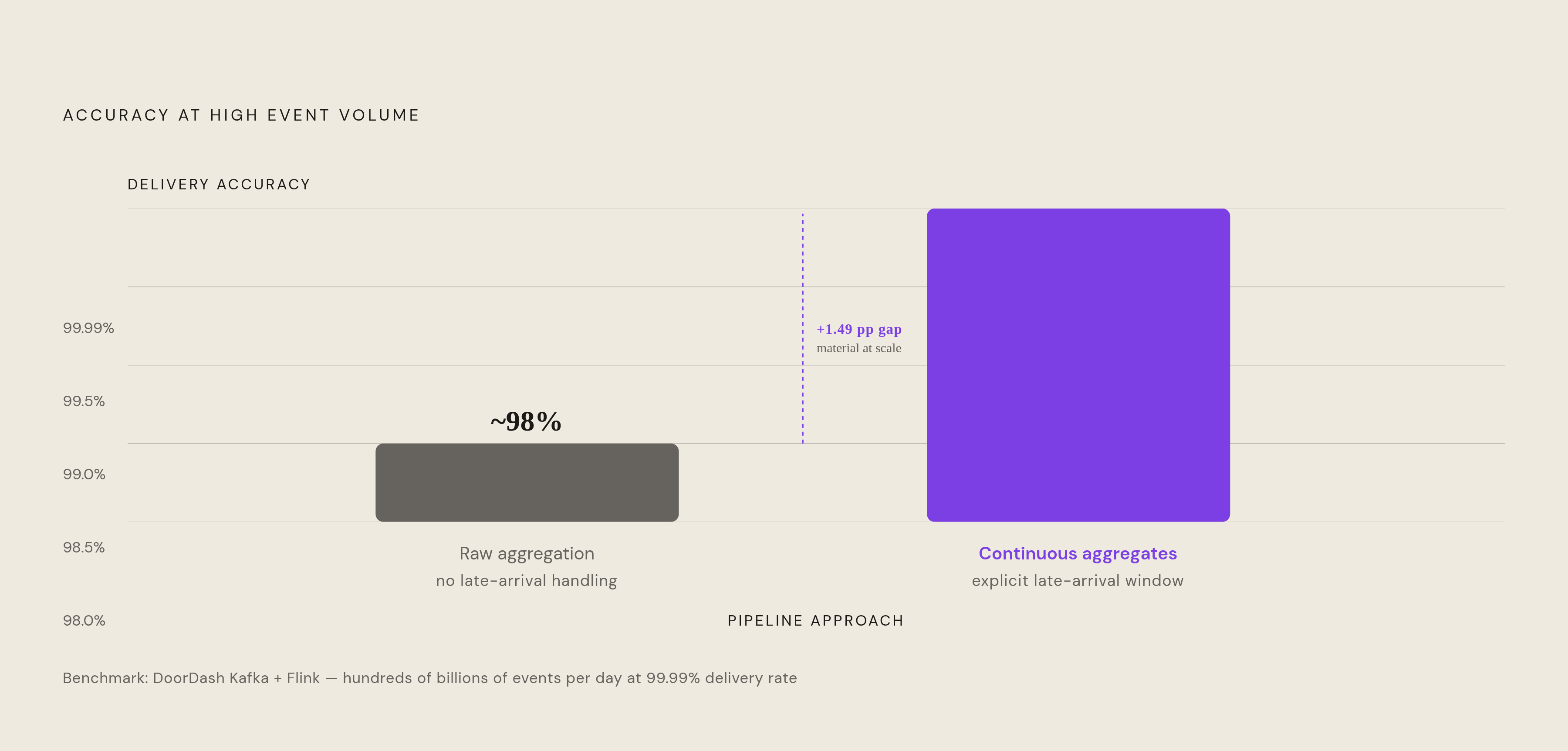
An acceptance window (sometimes called a grace period) is the system's explicit declaration of how late an event is allowed to arrive and still get attributed to its original billing period. It's a configuration decision, not an afterthought, and it has to be visible to both the engineering team and finance.
One concrete pattern comes from continuous aggregate designs used in time-series databases: a start_offset defines how far back the refresh window looks, say three hours, meaning any event that arrives within that three-hour lookback gets folded into the correct bucket the next time the aggregate refreshes. An end_offset separately controls the leading edge of the window's materialization boundary. The refresh runs on a schedule, every fifteen minutes for instance, so late events inside the window get incorporated automatically without anyone touching the pipeline by hand. The offset itself shouldn't be a round number picked because it felt reasonable. It should be tuned against the observed p99 delivery latency of the actual event stream, meaning the window is set to cover the slowest one percent of legitimate arrivals with some margin, not guessed at.
The accuracy difference between having this and not having it is not a rounding error. Raw table aggregation with no late-arrival handling tends to land somewhere in the 97 to 99 percent accuracy range at high event volumes, which sounds close to fine until the volume is large enough that one percent represents a material dollar figure every single month. Continuous aggregates with an explicit late-arrival window push accuracy up past 99.99 percent. At scale, that gap is the difference between a discrepancy finance quietly writes off and one that shows up as a pattern of monthly disputes.
Miscalibrate the window in either direction and a new problem appears. Set it too short, and legitimate late arrivals get silently dropped, which shows up as underbilling and slow, invisible revenue leakage that nobody notices until someone reconciles usage against expected revenue and finds the gap. Set it too long, and billing periods can't close on schedule, invoices go out late, and cash flow takes the hit. The window is, in the end, an engineering parameter with a direct finance consequence, which is exactly why it needs to be set jointly by both teams rather than handed down unilaterally by whichever side happened to build the pipeline first.
Idempotent ingestion as the defense against duplicate counting
Duplicates are not a bug in the sense of something going wrong that shouldn't. Network retries happen. Webhook replays happen. SDKs retry on timeout as a matter of correct client design. Every one of these behaviors is normal, expected, and correct at the layer where it originates. The billing system's job is to absorb that normal behavior without turning it into a double charge.
Without idempotency built into ingestion, a retried event becomes a second billable unit of usage that never actually happened twice. This kind of bug is nearly invisible in testing, because test environments rarely generate enough retry volume to surface it, and it only shows up once production traffic is high enough that retries are common and the resulting overcharges start appearing on real invoices.
The structural fix is a unique idempotency key attached to every event, enforced with a database-level uniqueness constraint. When a duplicate arrives, the ingestion endpoint returns success anyway, so the retrying client is satisfied, and the pipeline itself records nothing extra.
Where this goes wrong most often is in how the key gets generated. A random UUID created at the SDK layer seems like a reasonable idempotency key, until the retry comes from a different layer of the stack, say the message queue instead of the original client, and generates a brand-new UUID for what is functionally the same event. The uniqueness constraint sees two different keys and happily admits both as distinct, and the duplicate slips through the exact mechanism meant to catch it. The fix is to derive the key deterministically from the event's own natural identity: customer ID, meter name, timestamp, and request ID combined and hashed. A retry from any layer of the stack, computed from the same underlying event, converges on the identical key every time.
Idempotency and the acceptance window solve two different problems, and neither substitutes for the other. Idempotency stops the same event from being counted twice. The acceptance window stops a legitimate, singular event from being credited to the wrong billing period. A system needs both mechanisms running simultaneously, because leaving either one out reopens a distinct and separate failure mode.
Period attribution: crediting a late event to the period it belongs to, not the period it arrived in
Left unattended, a system will credit a late event to whatever period is currently open when the event arrives, rather than the period the usage actually occurred in. That's the default behavior of most naive pipelines, and it's wrong in a way that's completely avoidable: the fix is to key aggregation off the event's own timestamp, not the moment it happened to reach the ingestion pipeline.
This has to be decided at the schema level, before events start flowing. The event_timestamp field, recording when the usage actually occurred, and the ingested_at field, recording when it hit the pipeline, need to be captured as two separate values from the start. Aggregation logic then has to group by event_timestamp specifically. Get this backwards, group by ingestion time instead, and the invoice will disagree with the customer's own records even though neither side made an error. Customers track their own consumption against their own clocks. If the billing system is quietly using a different clock, the two numbers were never going to match.
Billing period closure sits in genuine tension here. Close a period before the acceptance window has fully expired, and the invoice locks in an incomplete count that misses legitimate late arrivals. Close it too late, waiting for every conceivable straggler, and invoices go out behind schedule, which creates its own cash flow problems downstream. The acceptance window set earlier is what governs, concretely, when a period can safely close without either failure mode.
Multi-region and multi-source pipelines make this worse by simple multiplication. Usage records entering from several products, several regions, and several collection points that were never normalized against each other allow billing drift to accumulate quietly, and mismatched entries can produce systematic undercounting before any late-event logic even gets a chance to run.
There's an argument worth taking seriously here for capturing events even on usage dimensions the business hasn't started billing for yet. If the raw events are stored with correct timestamps from day one, repricing a past period later, because a new plan launched or a pricing model changed, becomes a configuration change applied against existing data. Without that raw history, the same task becomes a data archaeology project with an uncertain outcome.
Auditable recalculation: what it means to replay the events that produced an invoice
A customer looking at a five-figure monthly bill is going to scrutinize every line on it. If that invoice can't be traced back to the raw events underlying it, in a form the customer can check against their own logs, payment stalls while the dispute drags out.
Auditability isn't a dashboard feature bolted on afterward. It's a property that has to be built into the data architecture from the start. A metering system that can't replay its own history back to the raw events isn't really a system of record, it's a guess that happens to have a nice chart attached to it.
Replay, in a structural sense, requires a few specific things to be true. Raw event storage has to be immutable and timestamped, meaning nothing gets overwritten or purged while a dispute window is still open. Log-based storage, the model Kafka is built around, lets any consumer replay events starting from any point in time, which is the actual technical foundation underneath the phrase "auditable recalculation." On top of that, a reconciliation layer needs to be able to diff a stored aggregate against a freshly recomputed one and surface any discrepancy automatically, rather than waiting for a customer to find it first.
The operational version of this pattern includes checksums maintained per aggregation, automatic retry with exponential backoff when a discrepancy is found, and a reconciliation dashboard that shows the actual diffs rather than a single pass or fail status. It's also worth treating any external payment processor or billing tool as a downstream sync target rather than the system of record. At meaningful event volume, the audit trail needs to live in infrastructure the billing team actually controls, because resolving a dispute by way of a third-party API's rate limits and export tools is a slow and frustrating way to answer a question that should take minutes.
Finally, there has to be a defined path for what happens when a late event falls outside the acceptance window, or when a reconciliation diff crosses some threshold. Either a correction shows up as a line item on the next invoice, or the closed invoice gets formally amended. Whichever the policy is, it needs to be decided and written down in advance, not improvised fresh every time a dispute lands on someone's desk.
How the Kafka–Flink stack handles these failure points at production scale
Apache Kafka handles the ingestion and replay layer. Its log-based storage model retains every event for a configurable retention period, and any consumer can replay the log starting from any offset, which is the actual infrastructure underneath auditable recalculation rather than a policy statement about it. Kafka, along with comparable systems like Pulsar, scales horizontally to support event throughput in the millions per second, which matters enormously for any product metering usage at fine granularity. Managed versions of this infrastructure exist through providers like Confluent Cloud and Amazon MSK, trading direct operational control for a faster path to production, a trade-off worth weighing depending on how much infrastructure a team wants to own directly.
Apache Flink handles stateful aggregation on top of that stream. Its exactly-once processing semantics mean billing aggregations survive a worker failure without either double-counting the same event or silently losing it, which is the infrastructure-level answer to the idempotency problem described earlier. Windowed aggregations in Flink produce continuously updating per-customer, per-period usage summaries, incorporating late events automatically as long as they fall inside the configured window.
DoorDash is a documented production reference for this combination at serious scale: a real-time event processing system built on Kafka and Flink, handling on the order of hundreds of billions of events per day at a delivery rate of 99.99 percent. That's a useful benchmark for what this architecture can actually sustain in a live, high-volume environment.
None of this, though, solves the whole problem by itself. Idempotency keys still have to be designed correctly at the point where events originate, because the infrastructure can only deduplicate what it actually receives, not reconstruct what should have been sent in the first place. Period attribution still depends on aggregation being grouped by event timestamp rather than ingestion timestamp, and that's a schema decision made upstream of the stream processor, not something Kafka or Flink decides on a team's behalf. And exactly-once semantics in Flink protect data that's already in flight through the system. They do nothing to recover an event that was dropped before it ever reached the broker.
Why AI and high-dimensional metering products hit these failure points harder than conventional SaaS
Conventional SaaS metering tends to track a small number of dimensions: seats, API calls, storage gigabytes. The billing surface area is narrow, and a handful of well-understood aggregation functions cover most of it.
AI products and other high-dimensional metering businesses break that assumption immediately. A single inference call can generate multiple simultaneous billable dimensions: input tokens, output tokens, model tier, latency class, cache hits versus misses, each potentially priced differently and each requiring its own aggregation logic running in parallel. Where a conventional SaaS product has one or two usage counters per customer, an AI metering system can have dozens, and every one of those counters carries its own exposure to the exact failure points described above: its own late-arrival risk, its own idempotency requirement, its own attribution boundary.
The volume compounds the problem further. Token-level metering generates orders of magnitude more events per customer than seat-based or call-based billing ever did, which means the late-arrival window, the deduplication key, and the aggregation function all have to hold up under a event rate that conventional billing infrastructure, built for a much sparser event stream, was never designed to absorb. A system operating near 99 percent accuracy may leave a material dollar gap once it's handling the event density that high-dimensional AI metering actually produces, and the failure points outlined above stop being occasional edge cases and start becoming the default operating condition unless the pipeline was built for this from the start.

