Days Sales Outstanding Inflation From Invoicing Errors
Invoicing mistakes, not slow customers, are the real driver of collection delays.
DSO (Days Sales Outstanding) measures how long it takes a company to collect cash after a sale goes out on credit, and most finance teams are chasing the wrong culprit. They treat DSO inflation as a customer problem, a function of slow payers and stingy credit terms, when a large, entirely controllable share of it comes from the seller's own invoicing mistakes. The clock starts the moment an invoice goes out and stops the moment payment clears. Nearly everything that stretches that gap, disputes, reissues, resets, is self-inflicted. That's the part worth fixing first, and it's the part most finance teams never even audit.
The formula is simple: divide accounts receivable by total credit sales, multiply by the number of days in the period. DSO sits alongside days inventory outstanding and days payable outstanding in the cash conversion cycle: CCC = DIO + DSO − DPO. Shave 10 days off DSO at a company doing $10 million in annual credit sales, and roughly $274,000 in working capital that was sitting locked in unpaid invoices comes free. Median DSO across B2B industries runs 56 days, according to Upflow's State of B2B Payments 2024 report. The seller adds days to that clock before the customer has even opened the invoice, and that's a billing-process problem far more often than it's a payment-behavior one, even though finance teams keep filing it under the wrong heading.
The causal chain: how a single invoice error becomes days of DSO inflation
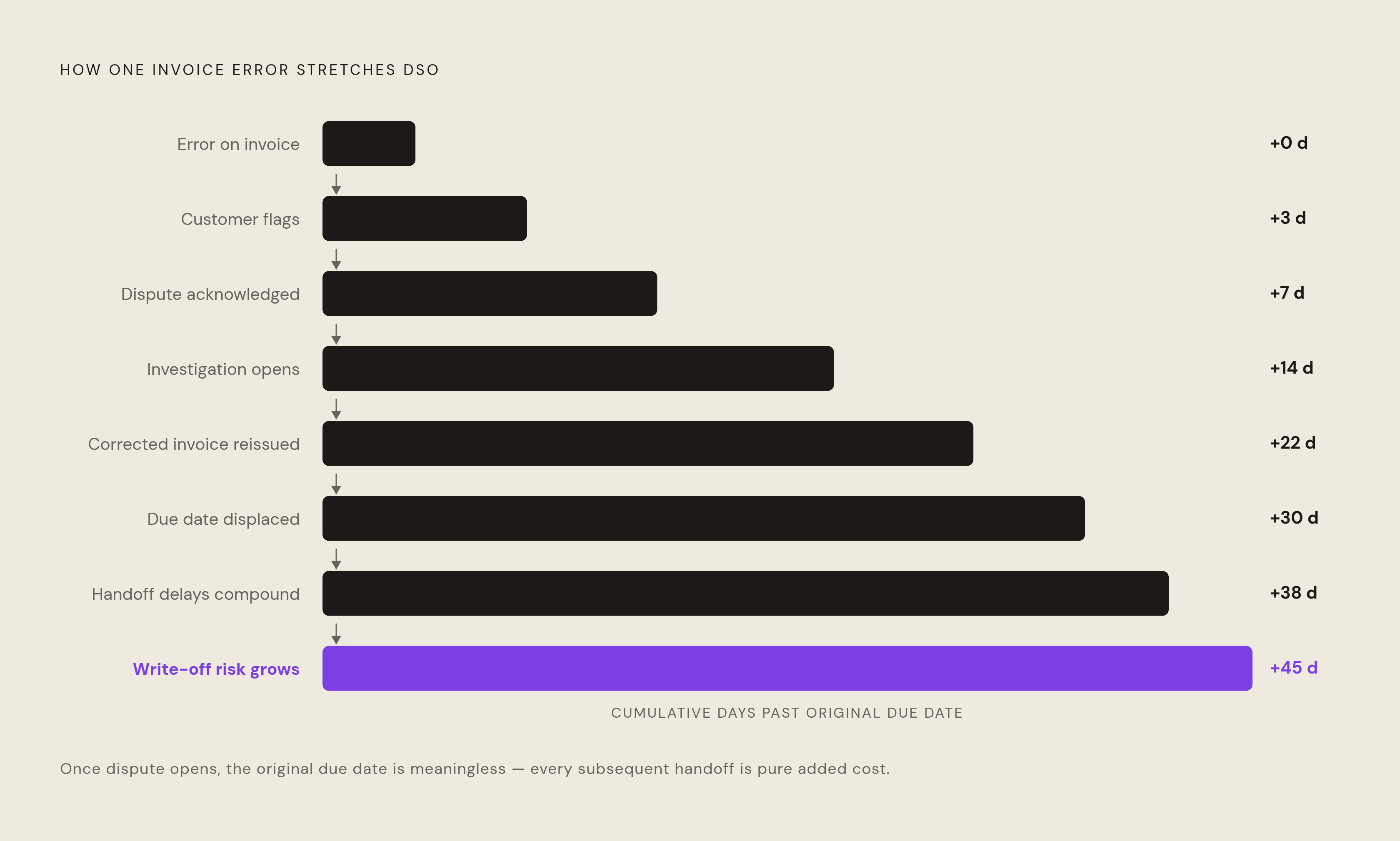
A miscalculated total, even one off by a few dollars, doesn't get quietly corrected. It triggers a full audit of every line item on the invoice, and payment halts entirely while that review runs, no matter how minor the original mistake was. Small error, disproportionate response: that mismatch is the mechanism that makes bad invoicing so expensive.
Trace the sequence and the delay compounds fast. An error lands in the invoice. The customer flags the discrepancy. The seller acknowledges the dispute. An investigation opens. A corrected invoice gets reissued, and the original due date is effectively displaced by the delay the dispute has already introduced. The original due date becomes meaningless the moment the dispute opens, and every handoff after that adds more days on top.
The damage rarely stays contained to one invoice. A dispute on one bill can prompt a customer's finance team to pull related invoices, or even prior billing periods, for the same scrutiny, multiplying the delay well past what the original error would suggest. Trust erodes, too: a customer who's been burned once starts reading every future invoice more carefully, which slows down payment cycles that would otherwise have gone through cleanly. Some sellers place credit holds on the account until the disputed balance clears, blocking new orders in the meantime, and disputes that drag on long enough turn into write-off risk.
One useful diagnostic: calculate DSO twice, once including disputed invoices and once excluding them. The gap between those two numbers tells a finance team how much of its DSO is error-driven versus how much reflects genuine customer payment behavior, and that distinction changes what gets fixed first. Projectworks has noted that small invoicing errors can delay payment by days or weeks. A five-minute mistake on one line item can cost weeks of float on the other end, and that trade is almost never worth it.
The five invoice error types that most reliably inflate DSO
Not all invoice mistakes carry equal weight. Missing or vague line item detail leads the list, cited by Projectworks as the most common trigger for disputed invoices. A customer's finance team generally can't approve a payment without some justification attached to each charge, and a vague description ("consulting services, $4,200") forces a round of back-and-forth before anyone on the other side even starts the approval process.
Math errors and miscalculated totals do double duty. They trigger the full-audit response described above, and they chip away at how much the customer trusts the invoice going forward, so future invoices from the same seller get scrutinized more closely by default, whether or not they contain any errors themselves.
Late invoice delivery is the quieter problem, and arguably the more damaging one, because nobody treats it as an error at all. Sending an invoice late signals, whatever the stated terms say, that payment isn't especially urgent, and it delays the start of the payment clock outright. DSO inflates here before the customer has made any decision at all, and manual billing cycles, spreadsheet compilation, hand-formatting, are the direct, structural causes of that lag.
Scope and amount surprises get flagged even when every charge on the invoice is legitimate. If the amount wasn't pre-approved or documented somewhere earlier in the relationship, the invoice usually has to escalate to finance for a second look, restarting the approval chain from the beginning. This problem is especially sharp in usage-based and variable billing, covered below.
Formatting, routing, or recipient errors round out the list: a PDF sent to the wrong contact, forwarded manually through two or three inboxes, or caught by a spam filter. The invoice sits unread. The seller believes it went out. The payer has never seen it. DSO inflates invisibly here, and nobody on either side notices until someone finally asks where the payment is.
Why usage-based and credit-based pricing create a structurally higher error rate
Pricing has shifted hard toward consumption, and that shift, whatever its benefits for customers who only want to pay for what they use, raises the invoicing error rate structurally, not incidentally. Flat-rate invoices are predictable: the customer knows the number before it arrives, and approval is close to automatic. Usage-based invoices change every period, and approving one means the customer has to trust that the seller's meter read correctly, a trust that never had to exist under a flat-rate model. Any gap between what a customer expected to consume and what the invoice actually shows becomes a dispute trigger, even when the meter reading itself is completely accurate.
AI workloads make this worse. Moving from pilot credits to production scale routinely produces cost estimates that turn out to be 500% to 1,000% short of the real number, and that gap shows up as invoice shock at exactly the moment a customer is deciding whether to trust the vendor with more spend. A customer who opens a bill five or ten times higher than expected doesn't pay first and ask questions later. They dispute the charge, open a support ticket, and sometimes start looking for a way out of the contract.
Credit-based pricing carries its own version of the same problem. Customers buy credits upfront and draw them down against usage, and disputes show up whenever the credit balance displayed inside the product doesn't match what the invoice charges. Multi-dimensional AI billing, tokens, API requests, compute time tracked separately, only makes reconciliation harder, since each dimension has to get aggregated on its own, and a misalignment in any single one produces an error the customer can see for themselves. Without real-time metering and automated billing behind these pricing models, delayed invoices and customer disputes aren't an edge case. They're close to the default outcome, and pricing teams that don't budget for that reality are setting their own DSO numbers up to fail. Because these disputes hinge on proving a specific event actually happened, resolving them takes longer, too: someone has to pull raw event-level data to back up the charge, a slower process than fixing a flat-fee typo.
How manual billing processes feed errors into every stage of the invoice lifecycle
Manual invoicing adds delay before the invoice even leaves the building. Data entry, formatting, internal approval routing, and transmission each take time, and each one adds days to the DSO clock before the customer has had any chance to react.
The error types that come out of manual processes are familiar to anyone who's worked in accounts receivable: typos in ship-to addresses or purchase order numbers, required fields left blank, tax and discount math done by hand and done wrong, line item descriptions that read differently invoice to invoice because someone typed them fresh from a spreadsheet each time instead of pulling from a consistent source.
When disputes do surface, manual systems make the fix slower, too. Finance teams have to reconstruct the source data by hand, a process that itself eats days, on top of the days already lost to the original error. The link between manual billing and cash flow pressure here isn't circumstantial, it's structural: manual errors produce disputes, disputes trigger reissue cycles, reissue cycles reset the payment clock, and the resulting cash flow pressure leaves finance teams with less time to prevent the next round of errors, not more. That's the loop, and it doesn't break on its own.
Automation breaks it in a measurable way. Companies using automated payment reminders collect receivables 12 to 18 days faster than companies relying on manual follow-up, and that gain isn't limited to the reminder step. It runs through the whole chain, from the moment an invoice is generated to the moment it's paid.
What accurate, automated invoicing actually changes in the DSO equation
The fix is straightforward, even if it isn't easy to build: if the invoice is right the first time, the payment clock runs from issue to settlement without interruption. No dispute, no hold, no reissue, no reset.
Getting there for usage-based pricing starts with real-time metering. Usage has to get captured the moment it happens, not reconstructed after the fact at billing time from logs nobody checked during the period. Sub-millisecond event ingestion and aggregation mean the invoice, when it finally arrives, matches what the customer's own dashboard already showed them all month, so there's no reconciliation gap left to argue about.
Customer-facing usage and credit dashboards close the expectation gap before the invoice ever lands in an inbox. Defining a clear conversion rate up front (1 credit equals 1,000 tokens, for instance), automating balance notifications, and surfacing real-time spend all mean the invoice total is never a surprise. A customer who's watched their own usage accumulate throughout the month can approve that invoice the day it arrives, not two weeks later.
Automated invoice generation removes the manual lag that delays delivery and introduces formatting mistakes in the first place: the invoice goes out the moment the billing period closes, not days afterward once someone gets around to compiling it. Companies applying AI to accounts receivable report average DSO reductions of 20% to 30% compared with manual systems. Finance teams freed from manual reconciliation close the books faster, and the first week of the month stops being a scramble to figure out what happened. It becomes a reporting exercise instead.
What billing infrastructure needs to handle if it is going to prevent DSO inflation at scale
Tracing the causal chain backward points to a specific set of technical requirements, not a vague call for "better systems." Companies that get this wrong tend to make the same mistake: they treat billing as a downstream reporting function instead of the thing that actually determines when cash arrives. Building the whole system in-house, which many still attempt, is the wrong default for most companies at this stage, and no amount of engineering confidence going in changes that math once maintenance costs show up.
Event ingestion has to be idempotent and real-time: every usage event captured exactly once, correctly, at the moment it happens. Metering has to handle multiple dimensions at once, tokens, API calls, compute time, aggregated independently rather than reconciled by hand after the fact. Credit balances need millisecond-level accuracy and need to stay visible to the customer continuously, not calculated for the first time when the invoice generates. Invoice generation itself needs to tie directly to metered usage with no manual step between period close and delivery. Entitlement enforcement needs to run in real time, so overage charges, the single biggest source of surprise invoices, get caught before they turn into a bill instead of after. And finance needs to pull revenue reporting on its own, without routing every request through engineering.
The in-house build eats significant engineering time up front, and ongoing maintenance tends to absorb a substantial share of those engineers' time indefinitely, time no longer available for product work. Research indicates that a large majority of SaaS companies above a certain ARR threshold use a commercial billing platform with custom extensions rather than building the whole system from scratch. That number reads less like a trend than a verdict on the build-it-yourself approach, and companies still weighing that decision are, in effect, arguing with the market. The DSO cost of a slow build or a brittle homegrown system isn't theoretical: every dispute cycle that accurate, real-time metering could have prevented is working capital sitting idle that didn't need to be.
The same logic extends to credit-balance tracking built specifically for AI-native consumption, where the number on the customer's dashboard and the number on the invoice match by design, not by coincidence. It extends to automated invoice generation and revenue reporting that cuts out the manual handoffs where errors and delays creep in, and to deployment options, cloud or on-premises, that meet enterprise compliance requirements without forcing a tradeoff on billing accuracy. It extends, too, to giving product and finance teams the ability to adjust pricing and inspect billing data directly, without waiting on an engineering ticket, which brings pricing agility without reintroducing the handoff errors that come from routing every change through another team.
The question worth asking when evaluating any billing system on this front: can it prove the charge, in real time, with event-level data the customer can already see before the invoice shows up? If the answer is no, disputes and DSO inflation aren't a risk to manage. They're built into the model from the start.