
Billing Error Cost as a Revenue Leakage Metric
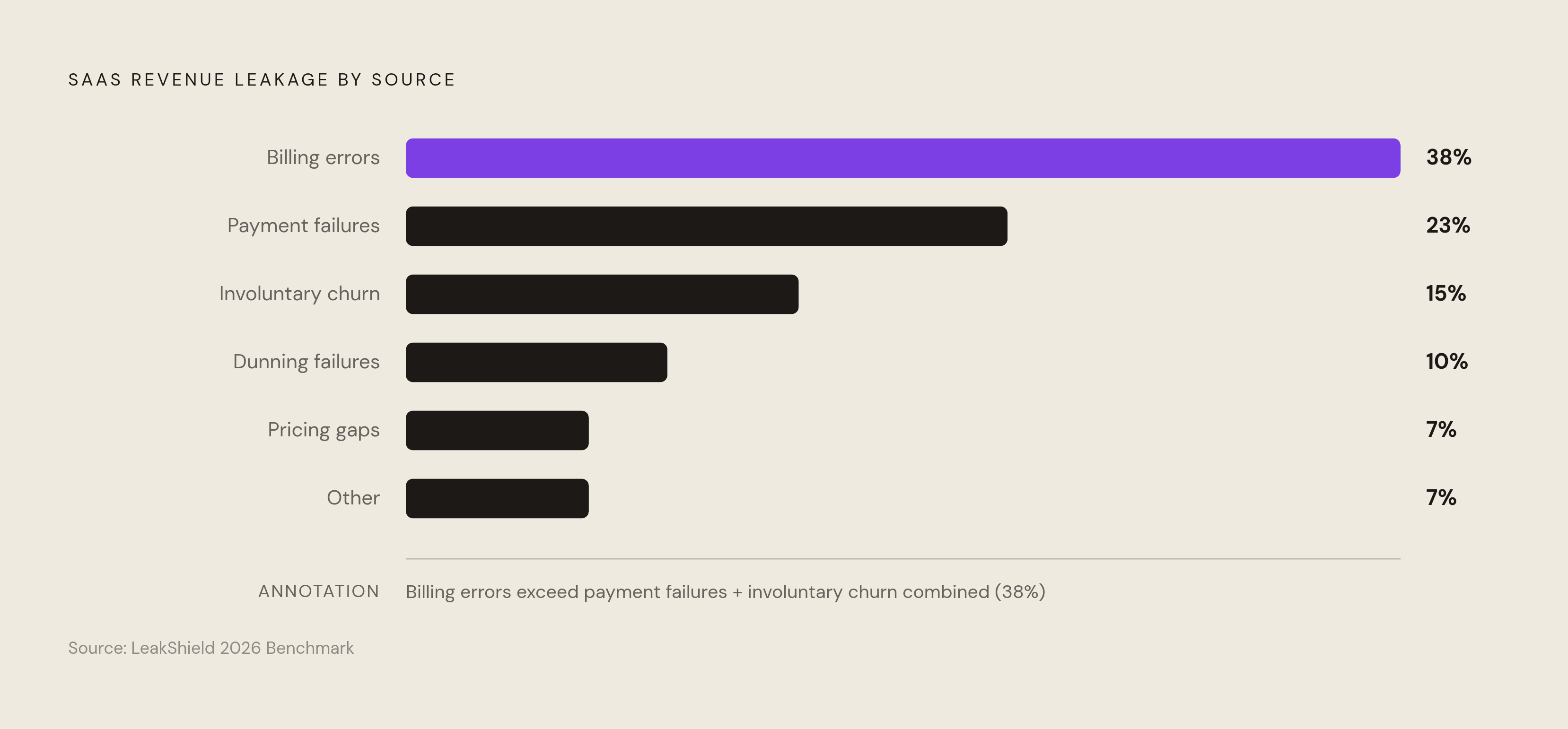
Billing errors account for 38% of SaaS revenue leakage and deserve real tracking.
Billing error cost is the dollar amount a company loses when its billing system fails to charge what a signed contract says it should. Most finance teams have no real answer for what that number is at their own company. They track churn, CAC, and net revenue retention with real discipline, but the money leaking out of the billing pipeline sits, if it's tracked at all, in a spreadsheet nobody opens between audits.
Revenue leakage is not revenue loss. A lost deal shows up in the CRM the day it's lost. Leakage is money a company already earned, under contract, that never lands on the bank statement, and it stays invisible until someone runs an audit and finds the hole. Research from MGI in 2025 put the figure at 1 to 5% of EBITDA annually. That's not a rounding error. That's a structural gap in the margin, and it deserves the same instrumentation finance already gives churn and CAC. Most companies treat it as a compliance footnote instead, and that's the wrong call.
What billing error cost actually measures, and what it doesn't
Billing error cost measures the revenue impact of billing system failures: dropped usage events, invoices priced against the wrong rate, proration math done wrong, discounts that should have expired but didn't, contract terms that were negotiated but never loaded into the billing configuration. It's a specific, countable thing, not a catch-all for "money we didn't make."
Draw a hard line around what it isn't. Voluntary churn is a customer decision, not a system failure, and it doesn't belong in this bucket. Failed payments and involuntary churn come from a breakdown in payment infrastructure, card declines, expired billing details on file, and while that's a real leakage source too, it's a different mechanism from a pricing or metering failure. Discounting, on its own, is not an error either. A negotiated price cut is a strategy. It only becomes a billing error the moment it outlives the window it was supposed to apply to and nobody catches it.
The formula: leakage rate equals leaked revenue divided by contractually due revenue, times 100. The part people get wrong is the denominator. Contractually due revenue has to come from the signed contract and its approved amendments, never from the billing system itself, because the billing system is the thing under investigation, not the source of truth about what should have happened. As the billing infrastructure firm LedgerUp has put it, revenue leakage is a systems architecture problem before it's a finance problem: contract terms live in PDFs, in email threads, in a sales rep's memory of a verbal concession, and none of that sits in a structured field a billing engine can actually read. Billing error cost is just the measurable output of that gap.
The six places billing errors actually generate losses
Leakage doesn't come from one broken thing. It comes from six distinct failure modes, each with its own mechanism and its own blast radius, and the biggest of them isn't the one most finance teams watch for.
Metering gaps. Events drop during ingestion, and no error log flags it, because the pipeline just processes whatever it happens to receive and hands back a result that looks perfectly clean. Network timeouts, buffer overflow during a traffic spike, a broken integration, a silent validation failure that discards a malformed event instead of surfacing it: a company billing $0.001 per API call, running 100 million calls a month, that drops just 0.1% of events, loses $1,200 a year from that gap alone. Metering-error leakage can be a meaningful share of total leakage for companies without a full mediation layer sitting between the application and the invoice. Product-led growth companies get hit twice: bad metering costs revenue directly, and it also breaks the usage thresholds meant to trigger the upgrade prompt.
Pricing enforcement failures. The rate actually charged doesn't match the contract. Cledara's 2024 research found 42% of SaaS companies have at least one active subscription billing at a rate that doesn't match the current list price or the negotiated price. The LeakShield benchmark from 2026 goes further: up to 40% of SaaS accounts keep running on expired promotional pricing because nobody rolled the rate back when the promotion ended, and fewer than 35% of billing systems correctly apply every contracted price escalator on their own. The sneakiest version shows up at tier boundaries, where a rounding error, an off-by-one bug, or a timezone misalignment underbills the same way every cycle, invisible in the aggregate because it never spikes.
Proration errors. Apply a flat 30-day denominator to a calendar month and every mid-cycle plan change bills systematically wrong, over or under. Credit notes for upgrades get calculated against the wrong base, list price instead of discounted price, pre-tax instead of post-tax, and the error compounds across however many mid-cycle changes a company processes in a quarter. It is a pattern of repeated mistakes. It's the same mistake, repeated hundreds of times.
Late-arriving events. Distributed systems don't deliver everything in real time. An event generated on the last day of a billing period can arrive days after that period closes, and if the rating engine shuts the books at midnight sharp, that event either drops entirely or lands in the wrong period. At small scale this barely registers. At the scale of telecom call-detail records, IoT sensor streams, or high-frequency SaaS usage metrics, it turns material fast.
Mid-period contract changes applied incorrectly. Without a system that can split one billing period into rate segments, a new rate gets applied retroactively across the whole month, discounting usage that should've billed at the old rate or overcharging usage from before the amendment even took effect. Enterprise SaaS runs on dynamic contracts as a matter of course, so this hits on nearly every amendment.
Contract-to-invoice mismatches. Custom tiers, negotiated escalators, committed minimums, all the terms sales actually agreed to, never make it into the billing configuration correctly. A contract might define usage as "monthly peak," while the billing system quietly calculates a rolling 30-day average instead, producing a number that is, contractually, simply wrong.
Per the LeakShield 2026 benchmark, billing errors account for 38% of total SaaS revenue leakage, the single largest driver of the whole problem, larger than payment failures and involuntary churn combined. That's the number that puts this taxonomy at the center of the argument rather than as a footnote to churn.
How to calculate your billing error cost as a dollar figure
Start with the master formula: billing error cost in dollars equals contractually due revenue minus what actually got billed and collected for that period. Divide by contractually due revenue, multiply by 100, and that's the leakage rate.
Get the denominator right or the whole number is fiction. Contractually due revenue comes from signed contracts and approved amendments, full stop, never from the billing system's own output, since the billing system is exactly what's under audit here.
The measurement work looks different for each category. For metering gaps, reconcile event counts between the application and the billing system over the same window; a persistent gap between the two is a signal worth investigating. For pricing enforcement, pull a sample of enterprise invoices, compare the billed rate line by line against the signed agreement, then extrapolate the error rate across the customer base. For proration, find every mid-cycle plan change from the last quarter and recalculate the correct proration by hand, using actual calendar days, then compare against what got billed. For aggregation windows, take a contract with a peak or high-water-mark clause, pull the raw usage data, calculate the actual peak, and compare it to what ended up on the invoice. For contract mismatches, audit whether every custom term negotiated into an enterprise contract has a matching configuration field in the billing system; if the field doesn't exist, the term never got enforced, no matter what the sales team promised.
The benchmarks give a sense of scale. MGI Research and LeakShield both put average SaaS revenue leakage at 3 to 5% of ARR. At $10 million ARR, that's $300,000 to $500,000 a year. At $50 million ARR, it's $1.5 million to $2.5 million. Apply LeakShield's 38% figure to isolate the billing-error share of that total, and a company has a specific number to put on a board slide instead of a shrug.
None of this works as a once-a-year audit exercise. Run the calculation monthly, and it behaves like a real dashboard metric instead of a compliance chore someone does under duress every March.
Why hybrid and usage-based pricing dramatically widens the leakage surface
A flat subscription has exactly one rate that can go wrong. A hybrid model, seat fee plus per-token charge plus committed minimum plus overage rate, has at least four, and each one fails independently of the others.
AI inference pricing multiplies this further. Per-token charges, per-GPU-minute charges, per-API-call charges, and per-outcome charges can all apply to the same customer at once, each running through its own metering stream, each capable of dropping events or misapplying a rate on its own schedule.
Even mature subscription products are adding consumption layers now. GitHub's April 2026 move to usage-based billing for Copilot, announced on the GitHub Blog, signals where the whole market is heading: products that used to bill on seats alone now have to meter usage they never had to touch before. Outcome-based pricing stacks another layer on top. Intercom charges $0.99 per resolved customer interaction, on top of a seat-based platform fee, so the billing system has to track an outcome, not just raw consumption, and errors in how that outcome gets attributed are their own leakage category.
More pricing dimensions produce more leakage points, full stop, and most billing infrastructure running in production today was built for the simpler, single-rate world it's no longer serving. AI agent workloads make the strain worse still. An agent running a multi-step workflow can throw off thousands of events a minute, fast enough that the metering pipeline falls behind, enforcement logic reads stale state, and overages pile up before the metering layer even catches up to what actually happened.
Detection lag: why billing errors compound before anyone notices
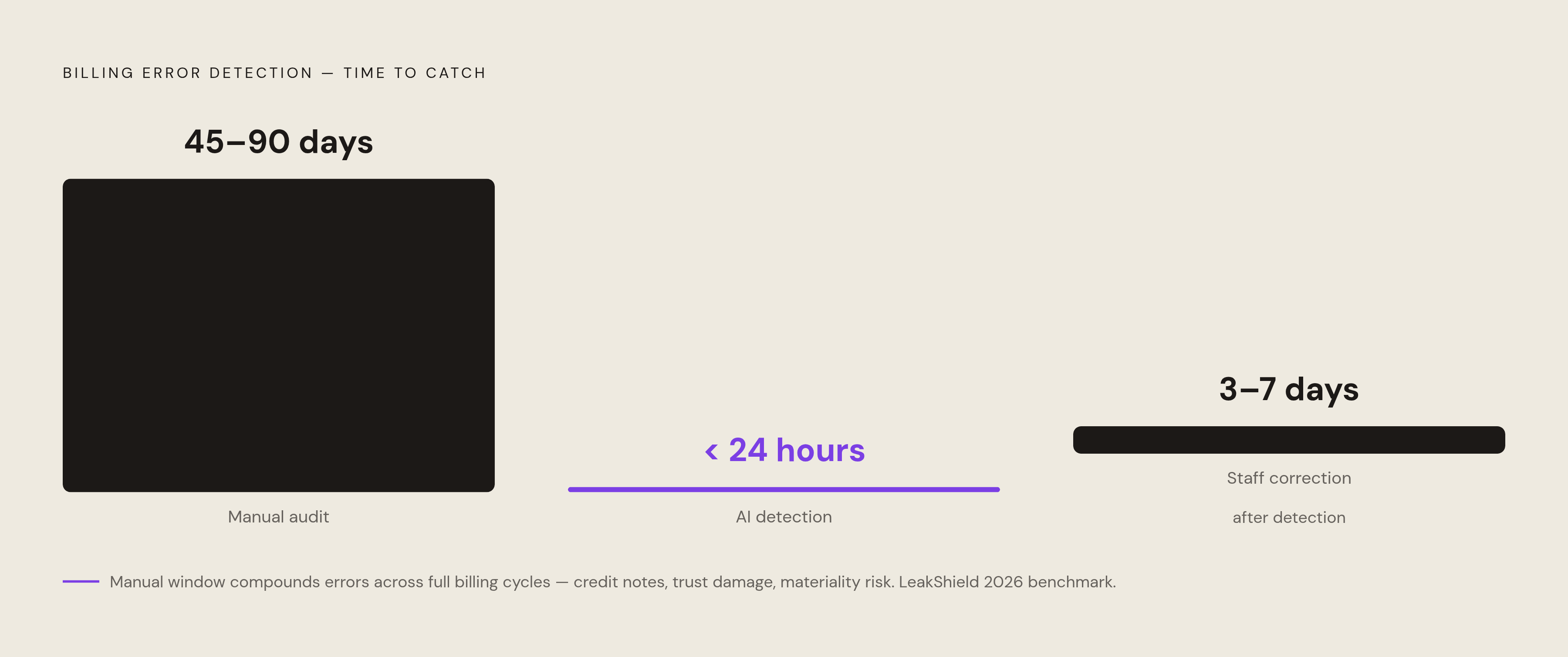
Manual audit processes take 45 to 90 days to catch a billing error, per the LeakShield 2026 benchmark. AI-powered detection platforms cut that to under 24 hours. That gap is a major efficiency difference. It's the entire reason billing errors compound instead of getting fixed on day one.
Run the math on the slow end of that range. Even a modest metering gap left in place for 60 days is not a small correction anyone waves off at quarter close. Manual detection lags this badly for a specific reason: billing errors don't throw an error message. The system produces output that looks entirely correct, because from the system's own point of view it is correct. It's just wrong relative to the contract. Once someone starts looking, industry data suggests it takes staff 3 to 7 days just to identify and correct the error, and the 45-to-90-day detection window usually means the mistake has already run through a full billing cycle before anyone thinks to compare an invoice against a contract line by line.
The compounding is mechanical. A promotional rate that expired months ago and never got rolled back has already generated multiple wrong invoices, and fixing it means credit notes, an awkward call with the customer, and probably a wider audit of every other account riding that same promotion.
There's a reputational cost sitting underneath the financial one, too. Enterprise procurement teams tend to catch overcharges during renewal negotiations before the billing team ever does, and that discovery costs a company more in trust than the credit note costs in dollars.
Past a certain point, this stops being an operational headache and turns into something else. Materiality thresholds under SAB 99 are commonly approximated, informally, at around 5% of net or pre-tax income, and accumulated leakage that crosses that line can amount to a material misstatement. If it traces back to a genuine deficiency in internal controls, it can escalate into a serious internal-controls conversation. At that point detection lag has become a compliance event, and that's a very different conversation to have with an audit committee than a quarterly variance note.
How to instrument billing error cost as an ongoing operational metric
The goal is continuous reconciliation, the same way SaaS teams already track payment failure rates: a number that updates on its own and triggers action the moment it moves, not a fire drill that happens once a quarter.
A few checkpoints make this tractable, and skipping any one of them reopens the leak somewhere else. Every event source needs delivery confirmation, an acknowledgment for every batch sent, because without that there's no way to know whether events are getting dropped somewhere in the pipeline. It's worth checking whether a billing platform actually tracks "event acknowledged and stored" rather than just "event received," since those are not the same guarantee. Every event needs a unique identifier, and the ingestion layer needs to reject anything carrying a key it's already processed, because duplicate inflation is the kind of error a customer spots before the billing team ever does. Rate-versus-contract reconciliation should run automatically on every invoice before it goes out, flagging any deviation between the applied rate and the contracted one. Every aggregation function, sum, count, peak, average, percentile, needs to be mapped explicitly back to the actual contract language at setup, and reviewed there, not assumed later. Late events need a defined grace period after period close during which they still get accepted and rated retroactively into the correct period, which means the rating engine has to support retroactive rating as a real capability, not an afterthought. And mid-cycle amendments need split-period rating, the ability to apply different rate plans to different date ranges inside one billing period, because without it, every contract amendment is a fresh leakage event waiting to happen.
Calculate the metric monthly. A quarterly number only tells a company what already happened, three months too late to fix cheaply.
The denominator deserves its own investment, separate from everything above. Build a contract data store that holds every pricing term in a structured, queryable form, so contractually due revenue gets pulled from that store directly, rather than reconstructed from whatever the billing system happened to output.
Analysis tracking 500 SaaS companies found more than 1,800 pricing and packaging changes in a single year, an average of 3.6 per company, and every one of those changes is a fresh leakage risk if the billing system can't apply it automatically. OpenView's 2025 research found 55% of SaaS companies say they can't efficiently accommodate pricing changes with their current billing stack. That's not a finance problem alone. Product teams setting pricing need visibility into billing error cost too, because the number tells them, directly, whether their infrastructure can actually enforce the pricing decisions they're making.
What billing infrastructure needs to make this metric tractable
None of the six leakage categories above get fixed by hiring more finance analysts to run bigger spreadsheets. That's the wrong instinct, and it's the one most companies reach for first. They get fixed by infrastructure that treats contract terms as structured data from the moment a deal closes, not as a PDF someone references manually once a customer complains.
That means an event pipeline built with delivery acknowledgment and idempotency as defaults, not optional configuration. It means a rating engine that supports retroactive rating and split-period billing natively, because mid-cycle change is the normal state of an enterprise contract book, not the exception. And it means a contract data store that sits upstream of the billing system and feeds it structured pricing terms directly, so the two systems reconcile against each other automatically instead of by hand once a quarter.
Billing error cost turns tractable the moment a company stops treating it as an audit finding and starts treating it as a number the infrastructure produces on its own, the same way uptime or latency gets produced. Once it's instrumented that way, it belongs on the same dashboard as churn and CAC. It's just as real a threat to the margin, and a great deal harder to notice, until someone finally builds the system that makes it visible.

