
Dispute Resolution Time as a Close Risk Factor
How complex billing models are turning invoice disputes into sales obstacles.
Open invoice disputes give a prospect or a renewing customer a legitimate reason to stall, and in usage-based and AI billing, that stall has gotten easier to justify. Dispute resolution time has quietly become a close risk factor, because the invoice itself stopped being a fixed, easily verified object. It's now a reconstruction of thousands of events, and reconstructions can be argued with, line by line, in ways a flat monthly fee never could be.
Flat-rate SaaS never had this problem in the same way. An invoice was either right or wrong, and the whole dispute lived in one binary: did the customer agree to pay the quoted monthly fee. There wasn't much room to argue about what "a month" meant or whether the vendor's clock and the customer's clock agreed on when the billing period started. Usage-based billing replaces that binary with a chain of independent judgment calls: when metering starts counting, what counts as a unit, what happens when a plan changes mid-cycle, which overage threshold applies, how multiple pricing dimensions interact when they overlap. Every link in that chain is a place where two parties can look at the same invoice and disagree in good faith.
AI workloads make the chain longer. A single customer-facing workflow might touch a prompt, several model calls, token counts on both the input and output side, API requests, retries after a timeout, and a final output object. Each of those is arguably its own billable event, and each needs a customer ID, timestamp, unit, and quantity attached correctly. Outcome-based pricing stacks one more layer on top, and it's the hardest one: both sides have to agree, contractually, on what "resolved" or "completed" actually means before either signs anything. Most procurement teams never finish that conversation before the deal closes. That gap, between what a vendor bills for and what a customer believes they agreed to pay for, is what turns dispute resolution time from an operations metric into a sales risk.
How adoption of usage and credit models has expanded the at-risk population
The population exposed to this risk is growing fast, and usage-based pricing is no longer the experiment it was a few years ago. As of 2026, a large majority of suppliers had adopted some form of usage-based pricing, and more than half expected usage-based revenue to keep growing through 2027. That's close to becoming the default architecture for how software gets sold.
AI credit models are moving even faster, and this is where most of the near-term risk actually sits. AI credit pricing grew 126% year-on-year in 2025. Overall adoption sits at 29%, with another 33% of companies planning to introduce AI credits within six to twelve months. Within a year or two, credit-based pricing for AI products will likely be closer to the majority behavior than the outlier.
Credit models carry a specific kind of opacity that flat usage metering doesn't, and it's worse for the buyer than most vendors admit. A credit abstracts away the underlying compute cost, which simplifies a price sheet but makes benchmarking and forecasting materially harder on the other side of the contract. A customer who can't map credits back to actual consumption has no clean way to sanity-check an invoice against expectation, and that gap is a precondition for dispute. Credits don't cause disputes directly. They remove the customer's ability to self-verify, which pushes verification into the dispute process itself, after the invoice has already landed.
Margins make the whole situation worse, not better. The 2026 State of B2B Monetization report found AI products running at roughly 50% margins, against 70% to 80% for traditional SaaS. Vendors at those thinner margins have far less room to absorb dispute costs or quietly concede on contested invoices the way a legacy SaaS company could. The at-risk population is growing at the exact moment the cost of getting a dispute wrong is rising with it.
Zendesk's outcome-based pricing launch and the newest dispute frontier
Zendesk's August 2024 launch of outcome-based pricing for AI agents shows where the next generation of billing disputes will come from. The model charges $1.50 per committed Automated Resolution or $2.00 on a pay-as-you-go basis, with a resolution confirmed after 72 hours of customer inactivity and an AI evaluation step that checks whether the response was actually relevant.
That's a clever mechanism, and it's also a dispute waiting to happen if the definition it depends on isn't settled before the contract is signed. Most buyers miss the real trigger point: what counts as "resolved" has to be agreed contractually up front, not discovered later when the first invoice arrives. Call it the Outcome Measurement Agreement. It's the prerequisite most procurement teams haven't actually worked through by the time they're ready to close, and it's the single most common blind spot in outcome-based deals right now.
Outcome-based billing also demands different architecture than a monthly subscription does. A success event has to trigger a billing action directly, and the system behind it has to support irregular, one-off charges that don't line up with a calendar cycle. If the logic that decides what counts as a success event is ambiguous, or runs somewhere the customer can't see it, every invoice becomes contestable. No one had agreed to the measurement baseline the whole invoice depends on.
The Cursor $7,225 invoice and what "technically correct" billing costs
In July 2025, a Cursor developer generated a $7,225 invoice in a single day after a team member exhausted 500 requests on an annually-billed plan. A post documenting the incident on X reached 797,000 views within a week, which says something about how many people recognized the shape of the problem on sight.
The billing wasn't wrong. The pricing architecture was the actual failure: uncapped usage sitting inside an annually-billed plan, with no warning system, no spend alert, and no hard cap anywhere between normal use and a five-figure charge. Nobody miscounted a request or mis-metered a token. The system did what it was built to do, and what it was built to do turned out to be indefensible at scale.
That distinction matters because it reframes what the dispute actually was. This wasn't an argument about an error, it was an argument about opacity. The customer had no visibility into how close they sat to a threshold that would trigger a charge that size, and no vendor should expect a customer to accept a bill they had no way of seeing coming. Bill shock like this is a pricing design failure, and the fix for a design failure is engineering. Spend caps, live usage dashboards, and alert thresholds aren't UX polish sitting on top of the pricing model. They're load-bearing parts of it, and treating them as optional is how a vendor ends up defending a five-figure invoice on X instead of collecting it.
How metering latency and pipeline failures turn event gaps into invoice disputes
Timing failures create disputes just as reliably as pricing design failures do. A billing event that arrives even 30 seconds late can produce under-billing, and once that gap exists, it becomes a source of both revenue leakage and eroded trust, because the invoice and the customer's own internal logs no longer agree.
This isn't a rare edge case. 68% of SaaS companies experienced billing errors in the past year due to data pipeline failures, not human error or pricing miscalculation. Pipelines drop events, duplicate them, or deliver them out of order, and every one of those failure modes appears on an invoice eventually.
When a customer's activity logs don't match the vendor's invoice, the customer has an immediate, concrete basis to contest the charge, and the burden shifts to the vendor to prove the timestamp chain is intact from first event to final line item. That's a hard thing to prove after the fact if the system wasn't built to preserve the chain from the start.
Delivery guarantees decide how bad this gets. At-least-once delivery requires retrying an event after any failure, which is necessary for reliability but creates real risk of double-billing if a retried event isn't recognized as a duplicate. Exactly-once accounting closes that gap: a retried event never appears twice on the same invoice. Without it, every retry is a potential dispute sitting quietly in the ledger, waiting for someone on the customer's side to notice.
The timelines, windows, and leverage a dispute creates once it opens
B2B invoice disputes don't run on the same rails as consumer card disputes. There are no standardized reason codes and no single external deadline, but the process is still sequential: identify the discrepancy, verify it against source data, negotiate a position, adjust the invoice if warranted, document the resolution. Every step adds days, and often weeks, to a sales cycle that may be sitting on invoice clearance the whole time.
Enterprise agreements typically give a customer 15 to 30 days to formally contest an invoice. Consumer credit card law allows 60 days for reporting a billing error, a longer window than the typical enterprise agreement affords.
An internal SLA determines how long a flagged invoice sits unresolved and whether software access stays uninterrupted in the meantime. A flagged invoice ought to get reviewed within two business days, with access kept uninterrupted while reconciliation happens in the background. Most vendors don't have an SLA like this at all, so the dispute sits in limbo for exactly as long as it takes someone internally to notice it.
Where card-network rules apply, the windows are unforgiving. Response times run from 7 to 21 days depending on the reason code. One network's code allows as few as 20 days, another allows up to 45. If the window is missed, the dispute is forfeited automatically, regardless of whether the underlying charge was correct. Merit stops mattering the moment the clock runs out.
The financial and deal cost of slow resolution, what the $3.60 figure measures
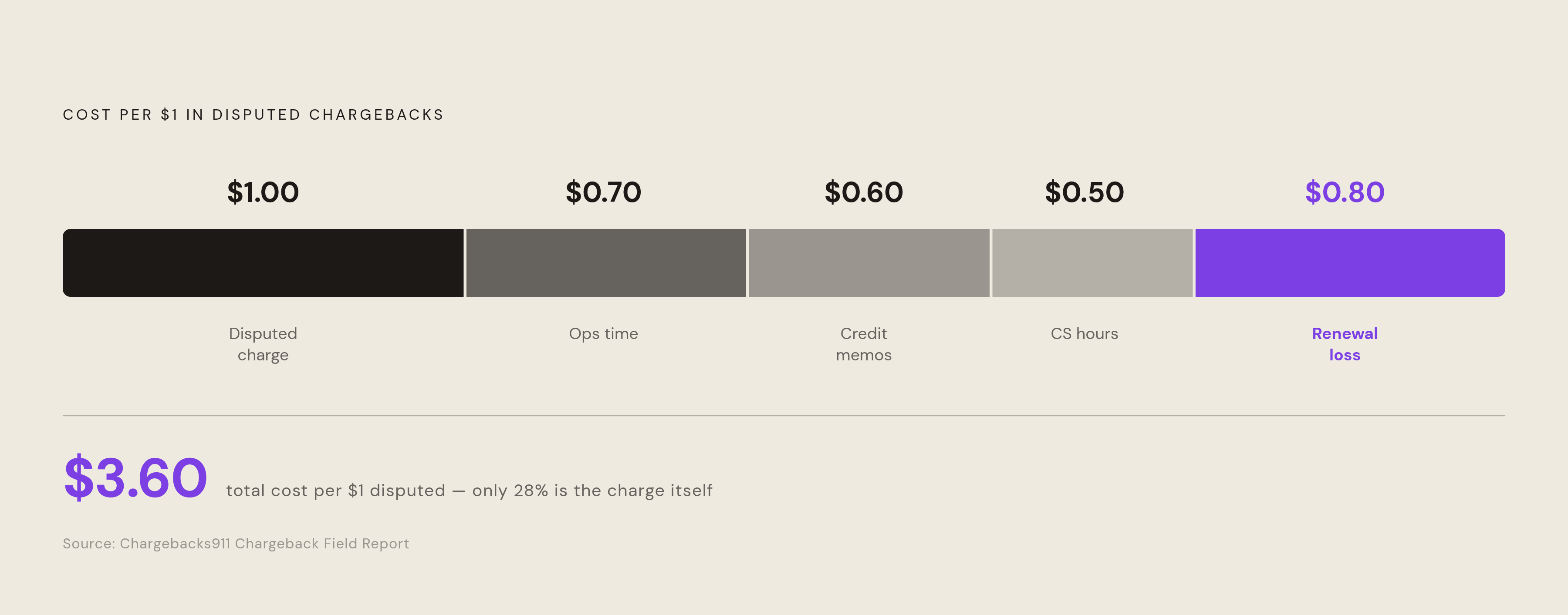
A Chargebacks911 Chargeback Field Report found that merchants lose an average of $3.60 for every $1 in disputed chargebacks, once fees, operational overhead, and lost future revenue are counted. That multiplier deserves more scrutiny than a passing citation usually gets, because most of it isn't the chargeback itself.
The $3.60 is the ops time spent reconstructing what actually happened. It's the credit memos issued as a goodwill gesture just to keep the relationship intact, and the customer success hours burned de-escalating a customer who's already annoyed. The last piece actually threatens revenue: the renewal that stalls or dies because the dispute never got resolved in time to keep the deal moving.
Speed predicts outcome almost as strongly as merit does. Responding to a dispute within 24 hours substantially improves outcomes. A merchant handling the same dispute without that kind of readiness wins far less often. That gap has almost nothing to do with who was actually right. It comes down to documentation being ready and submitted fast, before the clock closes the question for good.
The pattern holds at scale, too. Responding within the card-network response window with strong documentation can stop a dispute from escalating entirely. Same readiness gap, just automated instead of manual. Winning a dispute is mostly a function of how fast the record gets produced, not how strong the case looks on paper.
Three infrastructure gaps that give customers dispute leverage at close
Metering opacity is the first gap, and it's the one that starts the clock. Without a customer-facing usage dashboard or real-time spend visibility, a customer discovers a discrepancy only when the invoice arrives, and by then the dispute is already motivated. The customer is reacting to a surprise, not checking a number against an expectation they held all month. They're reacting to a surprise, and surprises invite pushback almost by default.
Event traceability is the second gap. If a billing system can't reconstruct the exact sequence of events behind a specific line item, the vendor can't prove a charge is correct without days or weeks of manual reconciliation. That delay is itself a form of leverage the customer now holds: every day the vendor spends reconstructing the invoice is a day the customer's finance team can point to as justification for holding payment, or holding a signature, until the question gets resolved.
Slow reconciliation is the third gap. It tends to be structural rather than incidental. Running a metering tool and a billing tool as two separate systems, stitched together manually at month-end, turns the first week of every month into a predictable stretch of dispute activity. Deals scheduled to close during that window slip because the invoice behind it wasn't ready to withstand scrutiny.
None of these three gaps are purely technical problems sitting quietly in an engineering backlog. Each is a commercial lever a customer's finance or procurement team can pull to delay a signature or reopen a price negotiation. The technical debt and the sales risk are the same debt, just measured in different currencies.
What billing infrastructure must do to remove dispute leverage before it affects close
The fix starts with real-time event ingestion built on exactly-once accounting, and there's no substitute for it. Every billable event needs to be captured at millisecond speed with deduplication guaranteed, so a retried event never doubles up on an invoice, and the audit trail behind any given charge has to be reconstructable on demand, not after a reconciliation run that takes a week.
Customer-facing spend visibility comes second, and it isn't UX polish, it's dispute-prevention infrastructure in its own right. A live usage dashboard paired with in-flight budget alerts gives a customer the chance to see consumption approaching a threshold before the invoice generates. That kind of visibility is precisely what was absent in the Cursor incident, and its absence is what made a five-figure charge arrive without warning.e Cursor incident outright, and it removes the entire category of surprise-charge dispute that incident illustrated.
A single metering and billing engine is the third piece, and splitting the two into separate tools is a mistake vendors keep making anyway. Treating metering and billing as adjacent systems that get manually stitched together at month-end is precisely what produces the reconciliation gap described above. They're one problem that happens to touch. They're one problem, and the delay gets built in the moment they're split apart.
Outcome metric attachment is the fourth piece, specific to where AI pricing is headed. Billing infrastructure for AI products has to attach arbitrary outcome metrics to an invoice, not just raw token counts, so an outcome-based charge stays traceable end-to-end and defensible against the contract terms both sides actually signed. Zendesk's model only holds up long-term if the infrastructure behind it can prove what happened at the same granularity the pricing model promises.
Dispute resolution time looks like an operations metric until a renewal sits on the other side of it. At that point, it's a close risk, measured in the same currency as every other reason a deal slips: days, trust, and the vendor's ability to prove, quickly and completely, that the number on the invoice is the number that was actually earned.


