
Credit Memo Frequency as a Billing Health Signal
How to spot billing system failures before they show up in board decks.
Credit memo rate tells you where a billing system is bleeding, and most finance teams don't watch it closely enough to notice until the bleeding shows up in a board deck. This piece breaks down how to read that signal, what patterns point to which failures, and what a billing system needs to look like so the rate stays low in the first place.
Why usage-based and hybrid pricing models make credit memo rate a more urgent metric than it was under flat subscriptions
Flat subscriptions kept the failure list short. Wrong seat count, wrong tier, a missed renewal date. Someone in finance could enumerate every way a flat-fee invoice goes wrong on one hand, and the fix was usually a phone call, not a system change.
Usage-based pricing has erased that simplicity. As of 2025, it shows up in 43% of SaaS pricing models, up 8 percentage points from the year before, and hybrid pricing (subscription plus usage components on the same invoice) has climbed to 61% adoption, up 12 points year over year. Every one of those percentage points represents more surface area for something to go wrong between the moment a customer uses a product and the moment they get billed for it.
The new failure modes look nothing like the old ones. Metering data shows up late, incomplete, or not at all before the invoice closes. A customer crosses a tier boundary mid-cycle and the pricing engine keeps charging the old rate. Overage alerts were never configured, so nobody catches the threshold breach until the customer complains. An outage drops metering events and nobody backfills them into the right billing period. Each of these produces one of two outcomes: a credit memo, when the error overcharged someone and got caught, or silent leakage, when it undercharged and nobody noticed. Credit memo rate only shows the visible half of that problem, which is exactly why it needs watching, not despite the fact that it's incomplete but because of it.
Hybrid invoices stack the risk. A single bill might carry a subscription base, a usage overage, a proration adjustment from a mid-cycle upgrade, and a draw against a prepaid credit balance, and each of those four components can fail independently. Layer in AI monetization, where a large share of SaaS companies now charge for AI-powered features, and the event volume gets brutal: token counts, GPU-minutes, per-call charges generate far more metering events per customer per day than a traditional usage meter ever did. And a substantial majority of SaaS companies running usage-based pricing say they're actively forecasting variable revenue off these numbers, which means every credit memo issued after the fact quietly corrupts a forecast that already went out the door.
The three distinct failure origins that credit memo patterns reveal
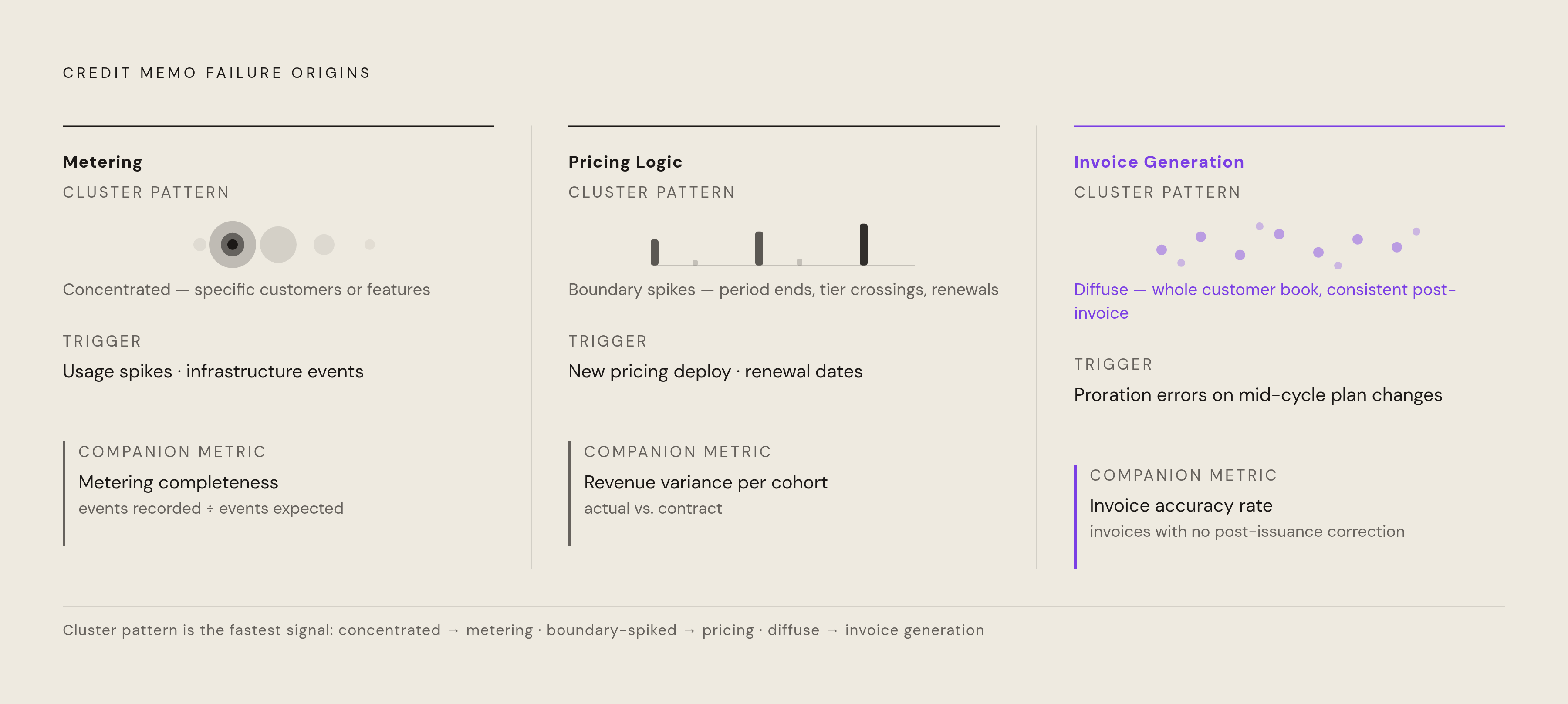
Not every spike in credit memos means the same thing. The pattern in the data tells you which team needs to fix it and what the fix actually looks like, and treating all spikes as the same problem is how companies end up patching the wrong system for two quarters running.
Metering failures cluster around specific customers or specific product features rather than spreading evenly across the customer base. They tend to show up right after usage spikes or infrastructure events, an outage, a slow data pipeline, a deployment that changed something upstream. The mechanism is straightforward: metering events get dropped, delayed, or duplicated before they ever reach the billing system. Picture an AI agent firing off thousands of events a minute; the metering pipeline falls behind, enforcement logic reads stale usage state, the customer gets overcharged, and an hour later somebody issues a credit to fix it. The confirming metric here is metering completeness rate, events recorded divided by events expected, and it should move in the opposite direction of credit memo rate when this is the root cause.
Pricing logic failures cluster at different points entirely: billing period boundaries, tier-crossing moments, renewal dates, the day a new pricing structure goes live. If credits spike right after a pricing update deploys, the new logic probably applied to the wrong accounts, or the wrong billing periods, or didn't apply consistently at all. Plan tier misalignment, a customer getting charged for a feature they can't access, or hitting a usage limit that isn't actually enforced, is the textbook version of this failure. Revenue variance measured per customer cohort, actual revenue against what the contract says should have been billed, is the diagnostic companion metric to run alongside credit memo rate.
Invoice generation failures look different again: diffuse, spread across the whole customer book rather than clustered around one feature or one event type, but consistent in timing relative to when invoices go out. Proration errors on mid-cycle plan changes are the most common version, and they frequently trace back to billing infrastructure that issues a credit memo because the correct prorated amount wasn't computed at the moment the change happened. Bundled offerings, where several performance obligations land on one invoice, make this worse, since a proration miss in one line item forces a reconciliation across everything else on the bill. Invoice accuracy rate, the share of invoices that go out clean with no post-issuance correction, is the metric to track here.
In practice these origins don't stay separate. A metering gap causes an undercharge nobody catches. The next billing cycle corrects for it and overcharges instead. A credit memo goes out. Then the credit gets applied to the wrong invoice. What started as one metering failure has now touched all three categories inside a single incident, and untangling it after the fact costs far more than catching it at the metering layer would have.
How to measure credit memo rate and which thresholds suggest a systemic problem
The base calculation is simple: credit memos issued in a period divided by total invoices issued in that same period, tracked as a percentage, month over month. Simple, but not sufficient on its own. A rate with no segmentation tells you something is happening without telling you what.
Cut it by customer cohort first, usage-based against subscription against hybrid, since these populations fail in different ways and blending them hides the signal. Cut it by reason code, SLA remediation against billing correction against proration adjustment against plain customer goodwill, because without that split a rising rate is impossible to interpret. A batch of proactive SLA credits looks, in the aggregate number, identical to a batch of credits caused by a broken pricing engine. Cut it by product line or pricing dimension too: credits piling up on one feature or one tier point straight at a localized failure rather than a systemic one. And cut it by invoice size band, since a handful of large-invoice corrections can carry more revenue impact than a hundred small ones combined.
Reason codes aren't optional bookkeeping, they're the difference between a metric and noise. Pair credit memo rate with a small panel of companion numbers: metering completeness rate, invoice accuracy rate, revenue variance against contract, collection rate (amount collected over amount invoiced), and AR aging mismatches between what the contract says and what billing actually recorded.
Alert design matters more than any single threshold. A credit memo rate that ticks up on its own might be nothing. A credit memo rate that ticks up at the same time metering completeness drops and support tickets spike is a strong indicator of a billing failure, not a coincidence, and the alert logic should be built to catch the correlation, not just the one number crossing a line. For any company running usage-based pricing, the gap between what the product logs as consumption and what billing actually charged deserves frequent review. Quarterly reconciliation gives leakage a full season to compound before anyone notices.
None of this works without the basic credit control plumbing underneath it: approval workflows for credits above a set dollar threshold, automatic checks that a credit never exceeds the original charge, an audit trail linking every credit to a specific reason code, and separation of duties so the person issuing a credit isn't the same person approving it.
What the revenue leakage literature reveals about the financial stakes of an unmonitored credit memo rate
Revenue leakage is the gap between what a signed contract says a company should collect and what it actually bills and collects. Credit memos are the visible symptom. Uninvoiced usage is the invisible one, and it's the more dangerous half.
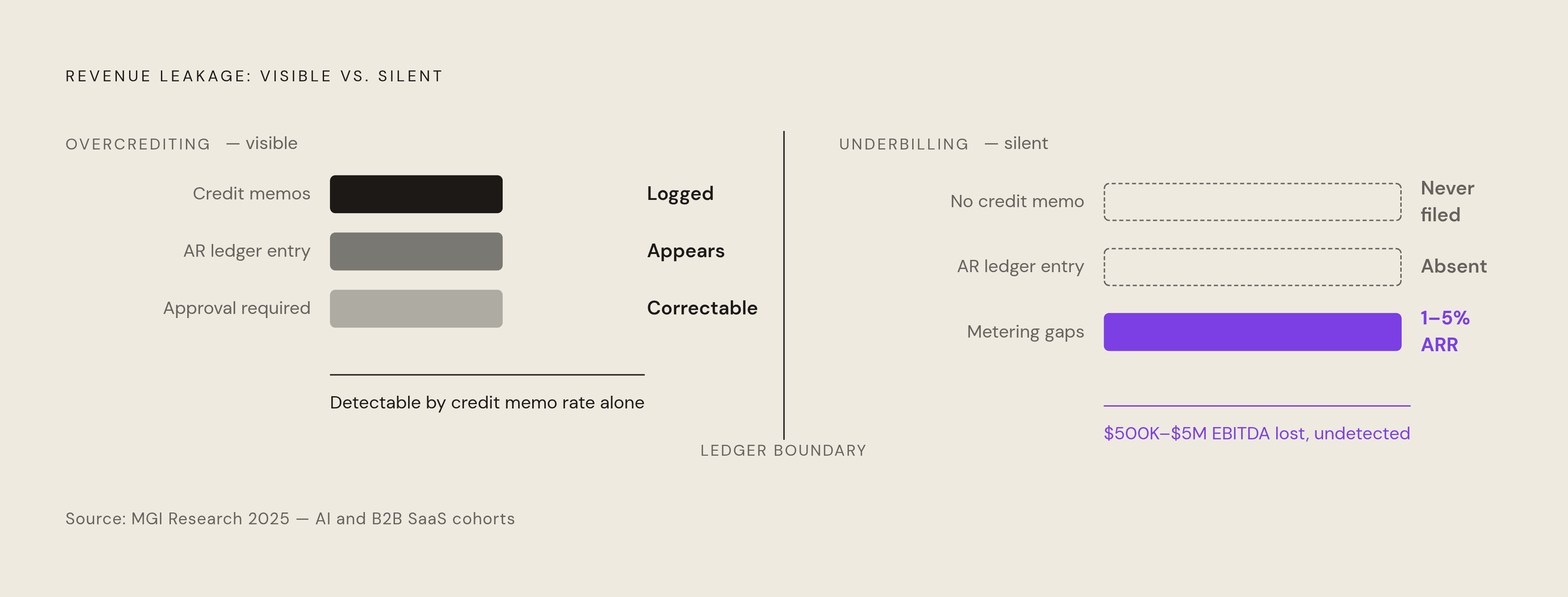
MGI Research's 2025 figures put the scale in concrete terms: leakage quietly eats up to 1 to 5% of EBITDA a year, somewhere between $500,000 and $5 million, depending on company size, slipping out through billing gaps, outdated contract terms, and manual processes that nobody's re-checked in a while. Separately, AI and B2B SaaS companies are estimated to lose 1 to 5% of ARR annually to the same kind of silent leakage, billing gaps, expired discounts that never got pulled, usage that happened but was never captured, even in businesses where the headline churn number looks perfectly healthy.
Here's the asymmetry that makes credit memo rate worth watching closely: overcrediting shows up immediately in the accounts receivable ledger, since somebody has to issue the memo and somebody has to approve it. Underbilling shows up nowhere. A billing system that consistently undercounts usage never generates a credit memo for it, because there's nothing to correct from the customer's side. Which means a low credit memo rate, taken on its own, without a metering completeness check sitting next to it, can just as easily mean quiet leakage as it can mean a clean billing system. Low doesn't mean healthy by default.
Credits and refunds become their own leakage vectors once controls are thin: an account credited twice for the same issue, a refund applied to the wrong invoice, a refund issued against a charge that was never supposed to be refundable in the first place. None of these show up as churn. All of them show up eventually, usually in a reconciliation that takes three times longer than it should.
And the failures compound over time. A metering gap in month one produces an undercharge nobody catches. It surfaces in month three as an overcorrection, a credit gets issued, the credit gets applied to the wrong invoice, and by the time quarter-end close rolls around, what began as a small metering hiccup has turned into an incomplete audit trail and a revenue recognition question nobody wants to answer under time pressure.
The metering architecture properties that structurally prevent the failures credit memos are correcting
Trace most usage-billing credit memos back far enough and they land in the same place: the metering layer didn't get complete, accurate, timely event data to the billing system before the invoice window closed. Everything downstream, the wrong charge, the correction, the customer email, is a symptom of that one upstream gap.
High-throughput ingestion is the baseline requirement, not a nice-to-have. AI product billing events arrive at millisecond speed, and a metering layer built for a slower era will drop events under that load. Dropped events become one of two things: silent underbilling, or a credit memo issued later once someone notices the overcharge.
A metering architecture built to prevent this runs on three layers. A high-throughput ingestion pipeline that accepts events without blocking the application itself. A low-latency read layer that enforcement logic can query without waiting for a full aggregation job to finish. And a fallback path with local caching, so an entitlement check resolves without a network round-trip on every single request, which stops upstream latency from turning into either a broken app or stale enforcement state that overcharges a customer.
Decoupling matters just as much as speed. Isolating usage collection from the main application, routing it through a message queue or a dedicated ingestion service, means a usage spike or a billing hiccup doesn't take down the product itself, and it closes off the class of event loss that turns into retroactive credit memos weeks later.
Modern metering systems also split fast-path from slow-path aggregation: an approximate, real-time number for customer dashboards and in-flight enforcement, and a separate, exact number reserved for final invoice settlement. That separation is what prevents both bill shock and the overcharge-then-credit cycle that comes from treating an approximate number as if it were invoice-final. Buffering usage data before it writes to the billing system smooths out traffic spikes and cuts down on write failures, since an unbuffered system's individual write failures are a direct, traceable cause of metering completeness gaps. And when an outage does happen, and it will, the system needs a way to replay those events back into the correct billing period rather than dropping them for good. Without that backfill capability, every outage quietly becomes next month's credit memo.
How billing infrastructure design, not just operational controls, determines baseline credit memo rate
Proration credit memos are, in a lot of cases, an admission about the infrastructure rather than a correction of customer error. Legacy billing systems issue a credit for a mid-cycle plan change because they can't calculate the correct proration dynamically at the moment the change happens. Modern billing infrastructure handles that math automatically, and the credit memo simply has no reason to exist in the first place.
Plan tier misalignment works the same way. A customer billed for a feature they can't access, or for usage limits they haven't come close to hitting, is a pricing logic enforcement failure, and it usually traces back to pricing rules in the billing system falling out of sync with the commercial terms in the contract, or a pricing change that required an engineering deploy and only got applied to part of the customer base.
That deploy dependency is a bigger problem than it looks. SaaS companies change their pricing regularly, yet many find their billing infrastructure struggling to keep pace with those changes efficiently. Every partial or failed pricing rollout sitting inside that struggling majority is a future credit memo waiting to be issued. Billing infrastructure that lets product and finance teams update pricing rules directly, without waiting on an engineering deploy cycle, closes off the lag that produces tier misalignment in the first place.
Prepaid credit wallets add their own failure surface. When prepaid balances and postpaid invoicing live on separate systems, reconciliation errors between the two generate credits that are genuinely hard to trace back to a root cause, since the error could be sitting on either side of the ledger. Running both on the same engine removes that reconciliation gap entirely, rather than just managing it better.
The pattern across all of this: a company that leans heavily on credit memos to handle routine mid-cycle changes is using a financial correction tool as a substitute for something the billing system should just do on its own. Credit memo rate, read this way, isn't only diagnosing individual errors. It's grading whether the underlying billing system is actually fit for the pricing model the company is trying to run on top of it. Companies with strong billing infrastructure keep credit memo volume down through automated proration and real-time pricing enforcement built into the system itself. Companies leaning on credits for routine adjustments usually don't have a training problem or a process problem. They have a billing system that needs replacing.
Customer-facing spend visibility as a mechanism that reduces the credit memos billing systems generate
A meaningful share of credit memos exist because a customer got surprised by an invoice and disputed it, not because the underlying charge was wrong. If a customer could see their usage accumulating in real time, the tier they're approaching, the overage they're about to trigger, a lot of those disputes never happen, because the invoice arrives with no surprise left in it.
Customer-facing dashboards showing live usage against plan limits shift the correction earlier in the cycle. Instead of a customer discovering an overage on the invoice and calling to dispute it, they see the threshold coming and either adjust their usage or upgrade before the billing period closes. That's a credit memo that never gets issued, not because the billing system got smarter, but because the customer had the information to act before the charge ever landed.
This also cuts against the asymmetry described earlier. Spend visibility doesn't just reduce disputes over legitimate charges, it surfaces metering errors faster, because a customer watching their own usage in near real time is the fastest anomaly detector a billing system has access to. A customer who sees a number that doesn't match their own internal tracking flags it days before a finance team would ever catch it in a monthly reconciliation. That earlier signal shortens the entire failure-to-fix cycle, whether the root cause turns out to be metering, pricing logic, or invoice generation.
None of this replaces the internal instrumentation, the completeness rates, the reason codes, the segmented credit memo tracking. But it closes the loop from the other direction, putting a second set of eyes, the customer's own, on the same data the billing system is using to generate the charge in the first place.

