
Invoice Error Rates by Pricing Model in SaaS
Usage-based pricing requires counting, and most billing systems weren't built to count.
Invoice error rates in SaaS don't move randomly, and they don't move because some finance teams are careful and others are sloppy. They climb in a fairly predictable line as pricing shifts from flat-rate subscriptions toward usage-based and hybrid models, and the cause is infrastructure, not discipline. Systems built to bill a flat monthly fee were never built to count anything, and counting is exactly what usage-based pricing demands. That's the whole argument. The rest of this piece traces where the counting breaks, and makes the case for the one conclusion that actually matters: you fix this by rebuilding the billing stack before you change the pricing model, not after.
A commonly cited cross-industry figure puts the share of invoices with at least one error at 39%. Treat that as a floor, because it hides how much error depends on what's actually being billed, and Tesorio's research found that 60% of late payments trace back to billing errors in the first place, which makes an invoice mistake a cash-flow problem before it's ever an accounting one.
Pricing complexity is most of the answer for why some companies sit well above that 39% floor and others sit well below it. Most billing teams treat adding usage-based or hybrid pricing as a manageable tradeoff against an existing billing stack. That's the wrong read. Layering new pricing logic onto old billing infrastructure isn't a tradeoff, it's the single most reliable way to manufacture a permanent leak, and a company that skips rebuilding the stack first has chosen the leak in advance, whether it would put it that way or not.
Three categories carry the argument: flat-rate subscription, usage-based (or consumption) pricing, and hybrid models that combine both. "Error" itself covers a lot of ground. A wrong rate on an account is a different failure mode from an unrecorded usage event, which is different again from a proration miscalculation or a contract term that never made it into the billing config. Different pricing models don't just produce more errors as complexity rises, they produce structurally different kinds of errors, and that distinction is the spine of everything below.
Where flat-rate subscriptions keep error rates low, and what still leaks
Flat-rate billing is the simplest case, and revenue leakage for these companies typically runs 0.5 to 1%, mostly from gaps in failed-payment recovery, the lowest range in the research. The reason is structural. The billing system only has to apply one rate to one customer for one period. No metering, no aggregation across events, no logic for a usage tier boundary. Less for the system to do means less for it to get wrong.
That doesn't make flat-rate billing clean, though. Grandfathered pricing is the classic leak: a customer's rate should have expired on schedule, but nobody updated the billing config, so the discount just keeps running. Promotional rates behave the same way, quietly outliving the promotion. Proration on plan changes deserves its own mention, because the error there is mechanical, not random. Many billing systems apply a fixed 30-day denominator to every month, including the ones with 31 days. On a typical monthly subscription, that mismatch creates a small but consistent discrepancy every time a customer changes plans mid-cycle, and it repeats at scale, invoice after invoice, account after account.
A Cledara analysis found that 42% of SaaS companies had at least one active subscription where the billed rate didn't match the current list price or contracted rate. Even the simplest pricing structure drifts out of sync with what's actually configured to bill, and manual processing adds its own floor on top of that: Ascend Software's 2025 benchmarking put the error rate for manual invoice processing at roughly 2%, even inside well-run accounts payable workflows, before usage or hybrid complexity enters the picture at all. That's just the cost of a person keying in numbers by hand.
Failed payments compound even the invoices that were calculated correctly. Eleven percent of payment delays happen simply because the customer never received the invoice, a delivery failure rather than a calculation one, and once an error surfaces, staff typically spend three to seven days tracking it down and fixing it. For flat-rate billing, the calculation surface stays small, so the errors that do occur are bounded and recoverable. The infrastructure needed to avoid them is, genuinely, simple. There's no excuse for a flat-rate company to be bleeding more than 1%.
How usage-based pricing multiplies the places where errors can enter
Usage-based pricing isn't a niche anymore. The 2025 Monetization Monitor found that 59% of software companies expected usage-based approaches to grow as a share of revenue in 2025, up 18% from 2023. Every one of those companies inherited a billing problem flat-rate pricing never had to solve: counting things correctly, in real time, at scale. Most of them are running that count on infrastructure that was never designed to do it, and that's the part worth sitting with, because the pricing decision usually gets made in a product meeting, and the infrastructure question doesn't get asked until the first invoice looks wrong.
Dropped events are the most direct entry point for error. A company billing per API call that loses even a small fraction of events at high volume is losing real revenue every year, and the loss compounds silently, because no single invoice looks obviously wrong. Silent discard sits right next to it: events fail validation somewhere in the pipeline and get dropped without anyone on the billing side getting so much as a notification.
Timezone mismatches are a quieter failure. If the metering system and the billing system don't agree on which timezone defines a billing period's boundary, usage gets counted in the wrong period entirely, not lost, just misplaced. Aggregation errors show up when raw events roll up into billable totals and the rollup undercounts. Graduated pricing makes all of this worse: when the first batch of units costs a higher per-unit rate and everything above that costs a lower rate, the system has to split usage precisely at that seam, and rounding errors or off-by-one bugs there create underbilling that's consistent and, worse, invisible in aggregate reporting, because the totals still look roughly right.
Late-arriving events round out the list. An event that shows up after a billing period has already closed needs a policy: include it, exclude it, or hold it in a grace window for some defined period. Systems without an explicit answer either overcharge customers for usage counted twice or quietly miss revenue that never gets billed at all.
Detection is harder than prevention here, and that gap says something on its own. The basic diagnostic is comparing metering system counts against billing system totals on a regular schedule, but most billing tools built around subscriptions don't expose that comparison natively, because nobody designed them to need it. Real-time ingestion at millisecond speed needs a purpose-built event pipeline, which is the gap flexprice.io was built to close. Subscription billing tools were built to close the books at the end of a period, not to watch a continuous stream of events as they happen, and that mismatch is the whole story in one sentence.
One mistake deserves its own callout, because unlike the others, it can't be undone. Discarding raw events to save on storage sounds like a reasonable engineering call in the moment. But once those events are gone, any aggregation bug found later can't be reprocessed against the original data. A storage optimization becomes a permanent revenue problem, and no amount of downstream fixing brings the lost events back. Don't do it. There is no version of this tradeoff that favors the storage savings.
Hybrid models: where error rates from both structures compound
Hybrid pricing, subscription plus usage on the same account, comes with real upside. Industry research found hybrid companies posting a median growth rate of 21%, ahead of both pure subscription and pure usage-based models. That's exactly why retreating to something simpler is the wrong move. A company backing away from hybrid pricing to dodge the billing headache is trading real revenue for a problem infrastructure fixes, not a problem caution fixes, and caution alone won't close a gap that only better systems can close.
The seam between the two pricing structures is where hybrid-specific errors live. Credit notes on upgrades are a common one: when a customer moves plans mid-cycle, the credit has to be calculated against the correct base, list price or discounted rate, pre-tax or post-tax, and getting the base wrong turns every upgrade into a systematic over-credit. Volume discount tiers misbehave in a similar way, particularly when the usage component crosses a tier boundary at a different point in the cycle than the subscription component renews.
Prepaid credit wallets sitting alongside postpaid invoices on the same account are another failure point. If the billing engine treats the wallet and the invoice as two separate systems instead of one reconciled ledger, consumption against the wallet may never line up correctly with what shows up on the bill. Enterprise hybrid contracts often carry negotiated usage caps, committed minimums, or custom overage rates, and someone has to translate those terms by hand into billing configuration. For a company with hundreds of customers on negotiated pricing, that translation step doesn't just risk error. At scale, it's closer to a certainty.
Industry research puts annual revenue leakage at 1 to 5% of EBITDA, somewhere between $500,000 and $5 million depending on company size. Hybrid models face leakage from both pricing structures landing on the same invoice at the same time, and most finance teams don't realize it's happening until someone goes looking. The three-to-seven-day fix window applies here too, and the error surface in hybrid models is substantial given the compounding of two distinct pricing structures.
Outcome-based and per-event AI pricing at the frontier of billing complexity
AI-native pricing has brought in metering units that barely existed a few years ago: tokens priced separately for input and output, GPU-minutes, voice minutes, API calls broken down per step of an agent's task. GPT-5.5, for instance, prices standard-tier usage at $5 per million input tokens and $30 per million output tokens below 272,000 input tokens, with a long-context surcharge above that threshold. That's a lot more dimensions to track correctly than a single per-seat rate, and it's a different kind of tracking problem than usage-based pricing already presented.
Outcome-based billing pushes further, because the thing being billed stops being a discrete, verifiable event and turns into a judgment call. It isn't "an API call happened," it's "a resolution was achieved," and someone has to define what that means before a single dollar changes hands. Salesforce Agentforce launched in late 2024 at $2 per AI conversation, positioned against a human agent interaction that typically runs $30 to $50. Intercom Fin takes the opposite approach: $0.99 per resolved customer interaction, billed only when resolution actually happens, not on attempt. Pick a lane. Billing on attempt and billing on outcome produce different incentives and different audit trails, and a company that hasn't decided which one it's selling hasn't finished designing its pricing model, no matter how finished the pricing page looks.
That distinction changes where errors show up. It's no longer just dropped events, it's disputed definitions: did the interaction actually resolve, who determines that, and is there an audit trail a customer could read and accept if they challenged the charge?
The Cursor incident from July 2025 is worth sitting with, because it wasn't a metering bug at all. A developer received a $7,225 invoice, the result of usage that accumulated far beyond what the customer anticipated under the plan's design. Nothing was miscounted. The billing architecture simply made an overcharge of that size invisible until the invoice arrived, a decision made months before the customer ever saw the bill, not a mistake caught in the moment it happened. That's the distinction worth holding onto: not every billing disaster is a bug. Some of them are the system working exactly as designed, against the customer's interest.
This isn't a fringe category anymore, either. Industry research found 44% of SaaS companies already charging for AI-powered features, and Gartner projected that by 2025, more than 30% of enterprise SaaS offerings would include outcome-based pricing components, up from roughly 15% in 2022. Billing infrastructure built for a flat monthly subscription was never built for any of this, and treating it as a light patch on the old system is exactly how a Cursor-style surprise invoice happens.
What the error gradient reveals about billing infrastructure choices
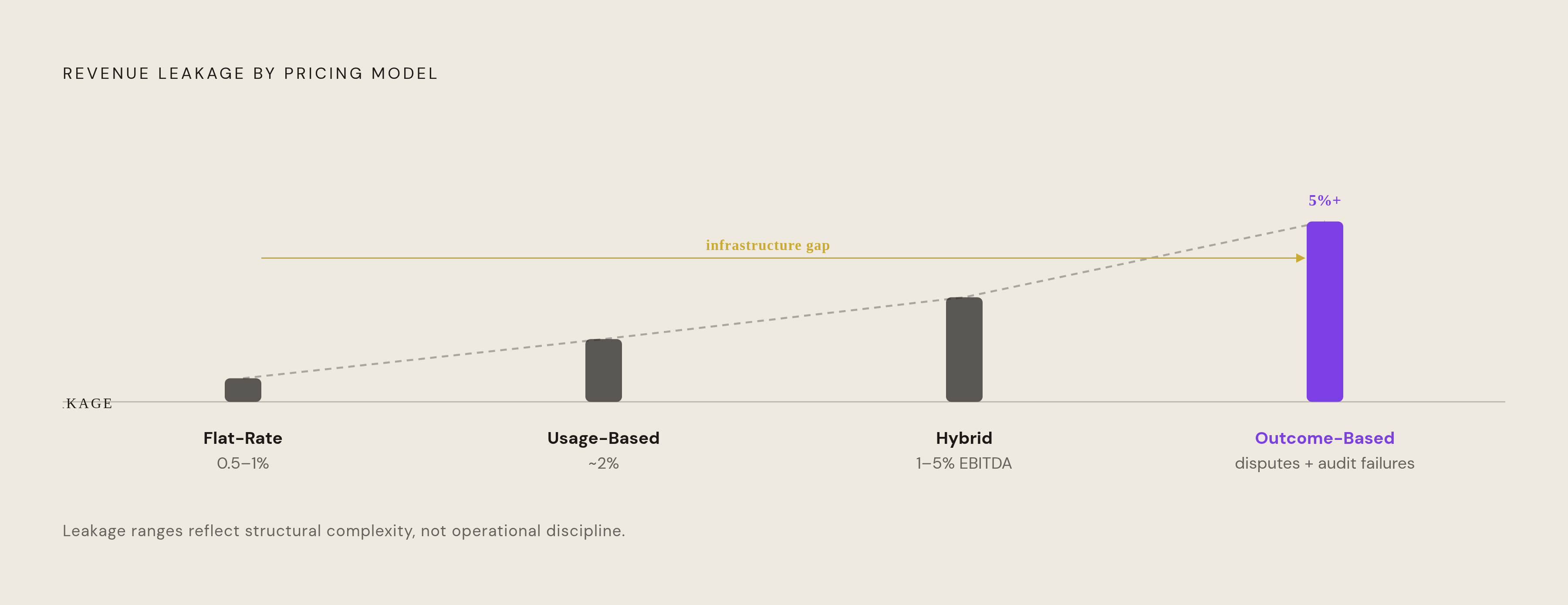
Error rates don't rise because teams get careless as pricing gets more complicated. They rise because the underlying infrastructure requirement changes completely, and most companies keep running the old infrastructure after they've already changed the pricing model sitting on top of it. That points to a specific, avoidable decision: choosing a pricing model before choosing the system that has to support it. Doing it in that order almost guarantees the leak shows up later, on someone else's desk, usually finance's, usually months after the product team has moved on to the next launch.
Three specific mismatches produce most of the leakage described above. A subscription billing tool asked to run usage-based pricing has no native event pipeline, no real-time aggregation, and often no raw event storage, so metering gets bolted on as a separate system that has to be reconciled by hand. A two-vendor setup, a metering tool paired with a separate billing tool, swaps that gap for a manual integration seam that has to be maintained forever, since any schema change, rate change, or new usage dimension needs coordinated updates on both sides. In-house billing infrastructure carries its own tax: the initial build takes months, the maintenance never really ends, and if raw events get discarded early to save on storage, any aggregation bug found later becomes permanently unrecoverable.
Automation helps, but only within its limits, and the limits matter more than the headline number. Ardent Partners' 2025 research put the industry average for touchless invoice processing at 32.6%, with best-in-class performers reaching 49.2%. Those numbers only hold where the underlying billing calculation was correct to begin with. Automating a wrong invoice just processes the error faster, and a team that reaches for automation before fixing the calculation is solving the wrong layer of the problem entirely.
Revenue leakage below 1% of ARR is achievable, and it's the realistic benchmark for a well-run SaaS billing operation. Getting to zero isn't, because contract amendments, mid-cycle changes, and genuinely ambiguous terms will always need a person to make a judgment call somewhere. The real question is whether the billing infrastructure models the same dimensions the pricing model actually uses. If it can't count tokens, can't split usage across a tier boundary in real time, can't hold a prepaid wallet next to a postpaid invoice on the same account, the resulting error rate is a structural output of that gap, not a discipline problem, and more reconciliation won't close it. Only infrastructure that ingests events at the speed the product generates them, keeps raw data around for reprocessing, and handles tier logic and prepaid/postpaid mechanics natively can hold error rates near the low end of the range as pricing complexity climbs.
How finance and product teams use this gradient to locate and reduce leakage
Start by placing the current pricing model somewhere on the gradient: flat-rate, usage-based, hybrid, or outcome-based. Each position carries a characteristic error profile and a characteristic way to go looking for it, and skipping this step is why so many audits start in the wrong place, poking at reconciliation processes when the real gap is upstream in the metering layer.
The diagnostics differ by model from there. Flat-rate teams should audit every active subscription for a match between the billed rate and the actual contract; the 2024 Cledara finding put the odds of finding at least one mismatch at 42%, meaning the likely outcome of that audit is finding something before anyone's even looked closely. Usage-based teams should compare metering system counts against billing system totals on a regular schedule, treating any systematic gap as leakage, and check validation logs for silent event discard. Hybrid teams should reconcile every upgrade credit note from the most recent quarter against the correct base amount and confirm tier resets fire correctly at period boundaries. Outcome-based teams need to audit the definition of a billable outcome against what the billing system actually triggers on, and confirm there's a human-readable audit trail that would hold up if a customer disputed a charge.
Set the leakage benchmark to match the model, and don't borrow one model's target for another. Getting to 0.5-1% ARR leakage is realistic for flat-rate billing. Getting below 1% for hybrid or usage-based pricing takes infrastructure that can actually model the pricing, not infrastructure that just processes invoices faster.
The single most common origin of a new leakage problem is a pricing change made without a matching infrastructure change. A team bolts a usage component onto an existing subscription product without touching the billing stack underneath it. The pricing model moved up the gradient. The infrastructure stayed exactly where it was.
Finance teams shouldn't spend the first week of every month reconciling billing errors. If that's the routine, the reconciliation burden is a symptom of infrastructure that doesn't match the pricing model, not a workload to absorb quietly and call normal. The three to seven days typically spent correcting errors should go toward analysis, not reconstruction, and automation only buys that time back where the underlying calculation was right in the first place.
The gradient described here isn't only a map of where risk sits today. It's a readiness test. Any company planning to layer usage-based or AI pricing onto a subscription foundation should stress-test its billing infrastructure against the next tier's error types before launch, not after the first invoice cycle closes and a customer is the one who finds the problem first.
Sources
- Subscription Facts: 55 SaaS and B2B Payment Statistics for 2025 - The Kaplan Group
- What "Good" Looks Like: AP Benchmarks Every Modern Team Should Know in 2025
- AI Invoice Processing Benchmarks 2026 | Parseur®
- Accounts Receivable & Payable Automation in 2025: How to Cut DSO by 33 Days and Triple Productivity
- Invoice Management Statistics 2026: Latest Data & Trends
- zenskar.com
- digitalapplied.com
- getmonetizely.com

