
Invoice Accuracy Self-Audit for Usage-Based Businesses
Prevent predictable billing failures by auditing four failure points in your usage-based system.
Invoice inaccuracy in usage-based businesses is not an edge case or a bug waiting for the next software patch. It follows the same predictable sequence of failures across companies. That means it can be mapped, tested, and closed with a structured audit rather than hoped away with a new vendor contract. The move toward usage-based and hybrid pricing has changed what billing systems have to do: products now throw off high volumes of usage signals, tokens consumed, API calls made, compute minutes burned, steps an autonomous agent takes, and every one of those signals has to be captured, checked for duplicates, priced, and placed on an invoice without a single event getting lost or counted twice. The consequences of getting this wrong reach well past a line item a customer disputes. Billing inaccuracy throws off cash-flow forecasting, generates the kind of customer disputes that eat support and sales time, and creates audit exposure under ASC 606, which by 2026 is not a transitional accounting standard companies are easing into but the baseline condition for audits, M&A diligence, and IPO readiness. If you do a self-audit properly, you treat billing accuracy as an engineering and finance discipline with known failure points.
The four-layer failure chain where billing inaccuracy originates
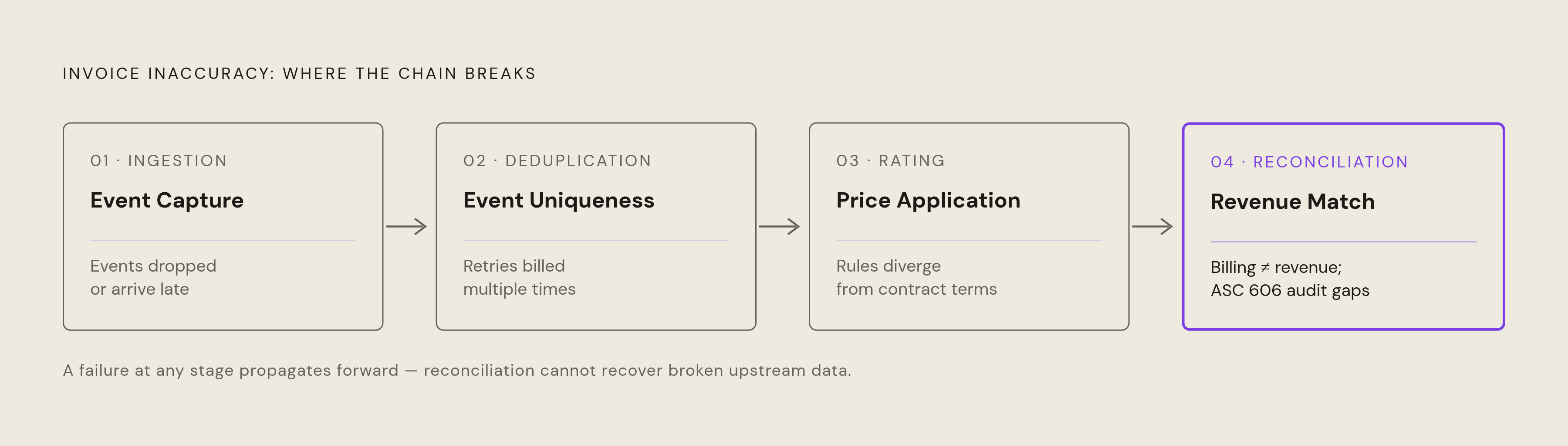
Every invoice accuracy failure in a usage-based system can be traced back to one of four layers: event ingestion, deduplication, rating, or reconciliation, and each layer breaks in its own distinct way. That is why a self-audit has to examine each one on its own terms rather than treat billing as a single black box. Event ingestion is the layer where you find out whether the system captures every billable event in real time, handles events that arrive late from distributed systems, and backfills data without losing anything or duplicating it. Late-arriving events are a specific failure vector, and AI and distributed systems make it worse, because data can arrive after a billing period has already closed.
Deduplication sits above ingestion and governs whether the same event gets counted and billed more than once, a risk that grows sharply under retry logic, webhook re-delivery, and parallel ingestion paths. Rating is the layer where the pricing logic applied to a raw event either matches or fails to match the terms a customer actually signed, covering tiers, volume breaks, credits, minimum commits, and plan changes that land mid-cycle. A spreadsheet can carry a company through its first 50 customers, but it breaks down when hybrid billing models combine credits, minimum commitments, and mid-cycle plan changes at any real scale. Reconciliation closes the chain: it checks whether billed usage matches recognized revenue, and whether the audit trail connecting billing events back to the original contract is complete and generated by the system itself rather than pieced together by hand after the fact. When the logic governing ASC 606 recognition lives mainly in spreadsheets, manual journal entries, or procedures nobody wrote down, you have measurable audit risk no matter how advanced the systems feeding into it look. The four sections that follow take each layer in turn and lay out what to test.
Auditing event ingestion
The ingestion audit asks one question with several parts: is every billable action your product takes reaching the billing system completely, on time, and in a form the rating engine can actually use?
Start with coverage. List every usage signal your product generates and confirm that each one has a matching event stream flowing into the billing system. The common gap appears when AI products add new model calls, new agent steps, or new compute tiers without updating the billing event schema to match, so new activity runs unmetered and unbilled from day one. The practical test is straightforward: pull the list of product features that carry a cost, cross-reference it against the active meter definitions inside the billing platform, and treat any feature without a corresponding meter as a confirmed leak.
Next, check timeliness. Check whether events reach the billing system in real time or in batches, and whether that batch window creates a stretch of time where usage has already happened but billing has no record of it yet. Real-time usage rating closes the gap between product systems and the ERP, but if ingestion runs in batches, usage exists in the product but nowhere in billing. For AI products, where token or compute consumption can spike inside a single session, a batch window that only closes hourly or daily means a customer can blow past a usage limit well before the system has any chance to enforce it.
Third, test late-event handling directly. Submit an event after its billing period has already closed and observe what happens: does the system support a backfill, produce an amended invoice, or simply drop the event without telling anyone? Distributed AI systems carry particular exposure here, because inference calls, agent steps, and webhook responses can arrive seconds or minutes after the billing period boundary has already passed.
Fourth, check schema validation. Confirm that the billing system rejects or flags a malformed event rather than silently dropping it or, worse, ingesting it with null fields that quietly corrupt the rating step downstream. The practical test is to submit a deliberately malformed event and watch for the system's response: an error, a warning, or nothing at all shows how much you can trust the pipeline under real-world conditions.
Auditing deduplication: finding and closing the double-billing seam
Deduplication failures produce invoices that look correct on the surface but are factually wrong underneath, and only a test built specifically to surface them will catch that.
Deduplication failures happen because event pipelines rely on retry logic, webhook re-delivery, and parallel ingestion paths that can, under entirely normal operating conditions and not just during outages, submit the same event to the billing system more than once. If a system has no real idempotency guarantee, it won't bill for every unique event. It bills for every submission, counting a retried event as new revenue each time it arrives. Idempotency, the guarantee that the same event submitted twice produces exactly one billing record, is the architectural property that stops this from happening, and its absence is a structural defect in the system rather than a setting someone forgot to flip. Billing platforms that build deduplication into event ingestion handle this automatically, but teams running their own in-house pipelines, or using developer-first metering tools, may be handling deduplication in application code nobody has actually audited.
The first check is an idempotency key audit: confirm that every event submitted to the billing system carries a unique, stable identifier, and that submitting the same identifier a second time still produces only one billing record. The practical test replays a known set of events from a past billing period and compares the resulting usage totals against what was originally invoiced. Any difference between the two indicates a failure to prevent the same event from being counted and billed twice.
The second check maps every path usage events can take from the product to the billing system and flags any path that lacks idempotency enforcement. The common gap occurs when the primary event pipeline is properly idempotent but a secondary path, a fallback webhook, a manual reprocessing job, a sync job feeding a data warehouse, submits events without any idempotency key attached.
The third check is a spot check on a known high-volume period: pull usage totals for that window and verify them against product-side logs, because deduplication failures occur specifically under load, when retry rates climb. AI products with inference loads that swing wildly carry particular exposure here. A model call that times out and retries might get logged once in the product and twice in the billing system, and nothing about the resulting invoice will look obviously wrong unless someone checks.
Auditing the rating engine: verifying that the right price is applied to every event
The rating audit starts not inside the billing system but with the contract. For every active pricing term in a customer's contract, confirm there is a corresponding, correctly configured rule inside the billing system that enforces it. A rating engine that applies its own internal rules with perfect consistency has not passed this audit if those rules don't actually match what the customer agreed to pay. The common gap in hybrid pricing models occurs when the subscription component is configured correctly but the usage overage tier, the minimum commit, or the credit drawdown logic attached to it is missing or set up wrong. Hybrid contracts stack recurring subscriptions on top of usage-based components, minimum commits, prepaid credits, and milestone payments, each requiring its own rating rule, and those rules all have to interact correctly the moment a customer crosses a tier boundary partway through a billing cycle.
The first check is a tier boundary test. Calculate by hand what invoice a customer should get when their usage crosses a pricing tier boundary mid-cycle, then compare that figure against what the system actually generated. Tier boundary calculations are a frequent source of rating errors precisely because the logic governing whether usage gets billed at the old rate or the new one, and whether any events get retroactively re-rated, is often undocumented anywhere a finance team can check it.
The second check reconciles credits and commits. Confirm that prepaid credit drawdowns and minimum commit true-ups are both computed correctly and reflected accurately on the invoice. If credit wallets draw down at the wrong rate, applying a flat credit per event rather than the contracted credit-per-unit price, for example, they can silently undercharge a company's highest-volume customers without tripping any alarm. Vercel's pricing model illustrates why this kind of rating logic has to be audited as a whole system rather than component by component: a monthly base charge per seat sits alongside flat-rate CDN capacity covering bandwidth and edge requests, alongside metered serverless compute, with a credit buffer smoothing the transition from fixed to variable charges. Each piece interacts with the others, and testing them in isolation would miss the errors that occur at the seams.
The third check is a pricing rule change audit. For any pricing change made recently, confirm it was applied to the correct cohort of customers on the correct effective date, and confirm that customers who were grandfathered onto old pricing are in fact still being billed at the old rate.
The fourth check covers multi-dimensional pricing. For products billing across several dimensions at once, tokens, GPU-minutes, model tier, region, confirm that each dimension is rated independently and that the combination of all of them produces the correct total on the invoice. Cursor's pricing model is a useful illustration of why this has to be tested end-to-end rather than one dimension at a time: a monthly subscription comes with credit pools tied to actual model API costs, manually selecting a premium model deducts from those credits based on that specific model's real API pricing and token usage, and Auto mode usage doesn't draw from the credit pool at all. A rating engine could get each of those rules individually correct and still produce a wrong total if it fails to apply them together properly.
Auditing reconciliation and ASC 606 alignment
Most billing systems are built to produce an accurate invoice, but they don't apply variable consideration constraint logic or adjust transaction price allocations when actual usage patterns diverge from what was originally estimated. That gap between billing architecture and revenue recognition architecture is where reconciliation failures live, and it's the highest-stakes layer in the whole audit because it connects day-to-day billing accuracy directly to financial reporting integrity. When the logic governing that reconciliation lives in a spreadsheet one person maintains, it functions as an undocumented manual control, and undocumented manual controls do not survive an audit, an M&A process, or the departure of the one finance team member who understood how the spreadsheet worked.
The first check is performance obligation mapping. For every active contract, confirm that each distinct deliverable has been identified and separately accounted for under the applicable revenue recognition rules. This matters specifically in hybrid pricing models, where a single contract might bundle a subscription obligation, a usage-based obligation, and a one-time setup fee into one agreement, each of which can require different recognition treatment under ASC 606. If a reconciliation process treats the whole contract as a single revenue stream, it will misstate recognized revenue even when every invoice sent to the customer is dollar-for-dollar accurate.
From there, the audit has to confirm that the trail connecting a billing event back to its originating contract term is both complete and generated automatically by the system, not reconstructed by a finance analyst piecing together invoices, usage reports, and contract amendments after the fact. A system-generated audit trail gives an auditor, an acquirer's diligence team, or an IPO underwriter a direct line from a dollar recognized on the income statement back to the contract clause and the usage event that produced it. A reconstructed one gives them a narrative that has to be taken on faith, and faith is not a control. The standard an organization is actually being measured against by 2026 is whether that link exists without anyone having to build it by hand under deadline pressure, because that is the condition auditors, acquirers, and public-market investors now treat as the baseline, not the exception.

