
Change Control Requirements for Pricing Rule Modifications
Pricing rule changes need formal review gates to prevent retroactive re-rating errors.
A pricing rule change in a metered or hybrid billing system is not the same event as a price increase on a flat subscription, and treating it that way is how companies end up issuing public apologies and refunds. In a usage-based system, a rule change that is not bounded by a precise effective timestamp can reach backward and change how events that already happened get rated, which is a different and much larger kind of mistake.
Cursor's pricing change in 2025 shows what that mistake looks like in production. The failure wasn't a messaging problem that better copy could have fixed. It was a pricing rule deployed without customer notice, without usage visibility, and without a grace period for customers to see the new rate before it started drawing down their money.
If you edit a live pricing rule without a review gate, that's functionally the same as editing production code without one. A company would never let a single engineer push a change to a payments system without review; a pricing rule deserves the same treatment, because its blast radius, touching every invoice generated after deployment, is just as wide.
The four risk domains a pricing rule modification touches at once
A single edit to a pricing rule creates exposure in four separate domains at once: contractual validity, revenue recognition, live billing integrity, and customer trust.
On contractual validity, a pricing change clause has to explicitly grant the vendor the right to modify pricing. State law adds another layer: New York, Massachusetts, and Arkansas enacted or amended subscription and auto-renewal laws effective in 2025, Connecticut and Maryland passed similar laws in 2025 that take effect in 2026, and California's Automatic Renewal Law can make an auto-renewal unenforceable and entitle a customer to a refund if a material change wasn't disclosed before it took effect.
On revenue recognition, ASC 606 treats upgrades, downgrades, mid-term add-ons, and renegotiations as contract modifications, each one capable of shifting revenue timing, allocation, and the shape of deferred revenue on the books. Cornerstone Research's review of FY 2024 SEC enforcement actions found revenue recognition among the most common categories of allegation, frequently paired with internal accounting controls violations. Controllers working through the first year of a usage-based pricing model should recognize only committed minimums plus variable amounts actually supported by usage data, writing down the constraint rationale and updating it every reporting period.
On live billing integrity, a mid-cycle pricing change is an accounts-receivable control problem as much as it is a billing-math problem. In a metered system specifically, a rule change without a precise effective timestamp can re-rate events that already happened, and that failure mode doesn't exist in flat-subscription billing.
On customer trust, the fix is largely preventive: proactive usage alerts, spending cap options, and pre-invoice usage summaries are what keep a pricing change from turning into bill shock and, from there, into churn.
What "The Pricing Rule" Encompasses in a Metered Billing System
Before any of this can be governed, it helps to be precise about what a "pricing rule" actually is in a metered system, because it is a bundle of distinct definitions, not a single number on a rate card. At minimum, it includes the billing metric definition (what counts as a billable unit, whether that's tokens, GPU-minutes, API calls, or resolved outcomes), the rate or rate schedule applied to that metric, any tiering or volume breakpoints, how committed minimums are treated relative to overages, the mechanics of any prepaid credit wallet, and the effective date logic that decides whether an event gets rated under the old rule or the new one.
In hybrid pricing, a change to the usage layer can quietly change the value of the subscription layer too. Outcome-based pricing adds one more wrinkle: Salesforce Agentforce prices pay-per-resolution at $2.00 or 400 Flex Credits, and HubSpot's Breeze Customer Agent charges $0.50 per resolved conversation. In both cases, the definition of "resolved" is itself a billing rule, and changing that definition mid-contract changes what the customer is being billed for even if the stated rate never changes.
The notice and contract amendment requirements that shape the change control timeline
Legal and contractual notice requirements set a floor under any change control timeline, and that floor sits higher in 2026 than most internal processes assume. Most state subscription laws require 30 days of notice at minimum, but 30 days now reads as the floor rather than the standard in a well-drafted enterprise SaaS agreement. For annual subscriptions or enterprise contracts, 60 to 90 days is closer to the current commercial norm, because enterprise customers run on budget cycles, board approvals, and procurement timelines that need that much runway.
The notice period starts when the customer receives the notice, not when it's sent, so the internal process needs enough lead time built in to absorb however long delivery takes. For enterprise agreements where pricing lives on an Order Form, the change control process needs a contract amendment step built into it, synchronized with the billing system change. The notice period for a pricing change inside an auto-renewal agreement should match or exceed whatever notice period is required to stop that auto-renewal, so a customer who gets the pricing notice still has time to decide before they're locked into another term.
The roles that must participate in a pricing rule change
No single team can safely own a pricing rule change, because each of the four risk domains belongs to a different function, and the process has to assign that accountability explicitly before any modification moves forward.
Product and pricing propose the change. They also have to answer whether the change hits only new customers, all customers at their next renewal, or all customers immediately, a decision with legal and revenue recognition consequences that product can't make on its own.
Guard against sequencing these as a relay, where each function waits for the one before it to finish. A pricing change that moves through product, then legal, then finance, then engineering, then customer success in strict sequence will rarely fit inside a 60 to 90 day notice window. These functions need to work in parallel, with defined checkpoints, not as a chain of handoffs.
The change control workflow: from proposal to production deployment
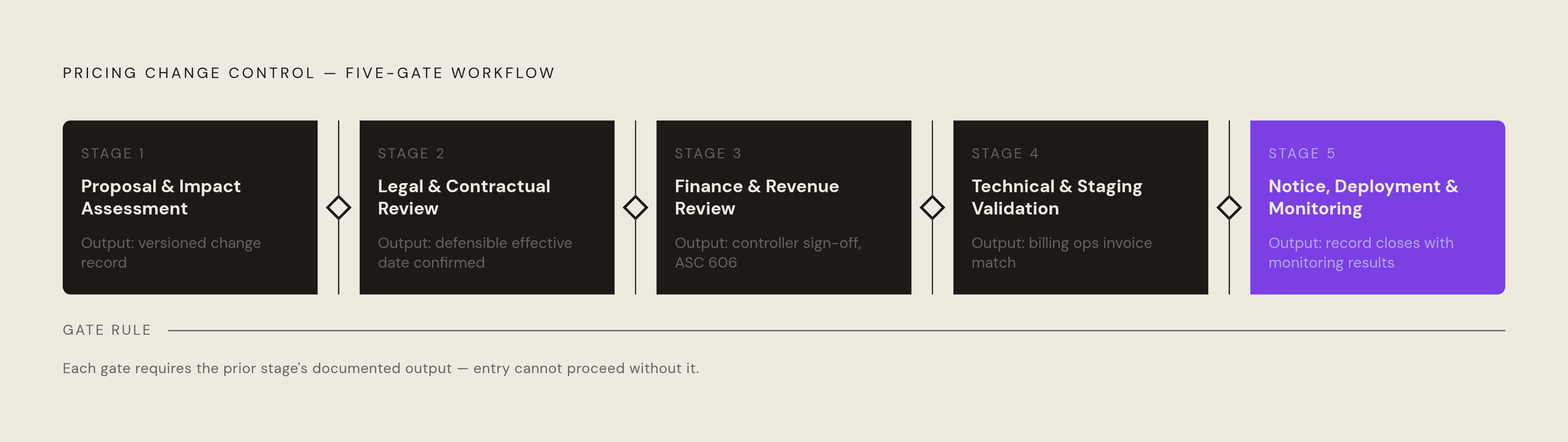
A structured change control workflow needs five stages, and each one needs defined entry and exit criteria. These are gates: a gate can't be passed without a documented output attached to it.
Stage 1 is proposal and impact assessment. Billing operations then runs an impact query against the customer base: how many active contracts are affected, how many carry Order Form pricing that needs an amendment, and what the estimated revenue delta looks like under the new rule. This stage produces the change record, a versioned document that follows the modification through every later stage, and it becomes the audit artifact.
Stage 2 is legal and contractual review. The exit criterion is written confirmation that the proposed effective date is legally defensible for every customer in the automated path.
Stage 3 is finance and revenue recognition review. The exit criterion is written sign-off from the controller or revenue accounting lead, stored in the change record.
Stage 4 is technical implementation and staging validation. Billing operations signs off once staging output matches expected invoices for that sample.
Stage 5 is customer notice, deployment, and monitoring. The rule goes to production on the agreed date, not earlier or later, and not rolled out unevenly across customer segments unless the change record explicitly documents a phased schedule. The change record closes with the monitoring results attached, including any corrections made and why.
The migration monday.com ran is a useful illustration of what Stage 1 discipline and Stage 5 execution look like together. The company spent a year instrumenting usage before changing anything, and when it did change pricing, it bundled credits at $10 to $30 per tier offset by a matching monthly discount, so no customer's bill went up on the day the new model took effect. That's the kind of design decision that belongs in Stage 1 and gets proven out in Stage 5.
What the audit trail record must contain
The change record is what a company hands to an auditor, a customer disputing an invoice, or a regulator asking about notice compliance, and it has to answer whatever question each of them is going to ask.
It needs to capture the exact rule definition before and after the change, as literal configuration values rather than a description of them, the effective timestamp with its timezone, which customer segments the new rule applies to, the outcome of the legal authority review, finance's sign-off on ASC 606 treatment, and the results of staging validation. Monitoring period results, including invoice exception counts, dispute counts, and any corrections issued, get appended before the record closes.
The record also has to be immutable once signed off. And the ASC 606 analysis from Stage 3 belongs inside the change record itself, not only in the accounting system, because an auditor examining a pricing change wants to see the analysis as it was made at the time, not a reconstruction built after the question gets asked.
How effective date logic protects historical invoices
Process discipline only holds up if the billing infrastructure can actually enforce an effective date. If the system can't isolate new-rule rating to events after a precise timestamp, the entire governance structure has no technical backstop, no matter how carefully the five stages were followed on paper.
Every usage event needs a timestamp captured at ingestion, not at invoicing, because effective date logic works by comparing that event timestamp against the rule's timestamp to decide which rate applies. The deduplication and at-least-once delivery guarantees that high-volume metering already requires turn out to matter here too: an event that gets counted twice under two different rate rules is both a billing error and a revenue recognition error at the same time.
A billing platform built around configuration rather than code lets the effective date be set as a parameter, enforced by the system without an engineering deployment, which is the architectural property that lets a pricing team move in days instead of waiting on a sprint. The staging validation in Stage 4 exists specifically to catch that gap, but it can only do so if the staging environment actually mirrors the production data pipeline, timestamps included.
Pricing change velocity and the tension between governance and speed
The objection that change control slows down pricing iteration is correct about the wrong kind of process, the kind that routes every pricing change through an engineering sprint. It doesn't hold against a well-designed process paired with the right infrastructure.
The real bottleneck in most teams is the engineering work needed to implement a change when pricing logic lives in code. A platform that treats the rate card as configuration lets the five stages run in parallel with engineering preparation instead of waiting on it: legal and finance review can finish while staging validation is still running, rather than only starting once engineering work is done.
That also means the rigor of review should scale with the risk of the change, and that distinction should be set in advance. The goal isn't to slow pricing iteration down, it's to make sure every change that reaches customers is one the team built on purpose, and the right infrastructure combined with a tiered process gets both outcomes at once.
Applying the process to a migration: moving existing customers to a new pricing model
Migrating existing customers onto a new pricing model is a compounding version of everything above: every element of the standard process still applies, plus additional requirements for sequencing cohorts, running two systems at once, and enforcing a hard cutoff.
A migration isn't one pricing rule change, it's a sequence of changes applied to different customer cohorts on different schedules, and each one needs its own change record and its own effective date. The Stage 4 staging validation requirement applies to both rule sets, not just the new one.
A hard cutoff with staged reminders, at 90, 60, and 30 days before the migration deadline, is what actually closes a migration out. The two approaches are different points on the same trade-off: standardized, cost-neutral bundling versus negotiated, rep-assisted estimation, and each changes how much governance weight falls on the customer success and sales motions versus the pricing design itself.
Finance's variable consideration constraint matters most in the first reporting period after a cohort migrates, when actual usage data under the new model is still thin. You can't migrate customer segments locked into Order Form pricing through a multi-year term on the standard timeline at all, so you need to exclude them explicitly from the migration cohort, track them instead through a separate amendment process, and document that exclusion list in the migration's change control record.
Building the change control process into billing infrastructure, not around it
A change control process that lives in shared documents and email threads is fragile, because nothing stops someone from skipping a step when the deadline is tight. The more durable version is billing infrastructure that enforces the process structurally, so a pricing rule simply cannot be activated without its effective date, approval metadata, and customer scope already attached to it.
Real-time usage visibility for customers closes the loop downstream. A customer who can watch consumption build against their plan limit in real time doesn't get a surprise invoice, which keeps the customer trust risk from Stage 1 managed continuously rather than only at the moment the pricing change goes live. The process described here is within reach for any team with the right functions in the room and the right infrastructure underneath them, and the point of building it is to make sure every pricing change that reaches production is one the company can defend to a customer, an auditor, and a regulator on the same day.