Audit Trail Standards for Metered Invoice Line Items
Metered charges demand complete audit trails that subscription billing never required.
A subscription invoice line item is a fixed contractual commitment: the customer agreed to pay a set amount, and the line item simply restates that agreement. A metered invoice line item is something else entirely. It's a derived number: it is the end product of a calculation that pulls from raw usage data, runs it through an aggregation method, and applies a pricing rule to produce a charge. That difference is structural, and it means a metered line item has to be reconstructable from evidence at any point in the future, long after the invoice was sent.
This shift is not a niche experiment confined to a handful of infrastructure companies. As AI products move to this model, a single customer invoice can represent the output of millions of discrete events, aggregated, rated, and transformed across several layers, with each transformation a point where something could go wrong or get disputed.
The consequences of that complexity are not theoretical. In one documented case, a multinational software company investigated a billing adjustment of $275,000 during a quarterly financial review. And it has to do this for an invoice that may have been generated months earlier, using pricing logic and usage data that have since been overwritten, archived, or forgotten by everyone involved except the system itself.
Most billing platforms were never built for this. They were built to store a final invoice amount, because in a subscription world, the final amount was the only thing that mattered. Metered billing demands something a flat-rate invoice never needed: a preserved record of the reasoning that produced the number, not just the number.
The four-layer chain every metered invoice line item must trace
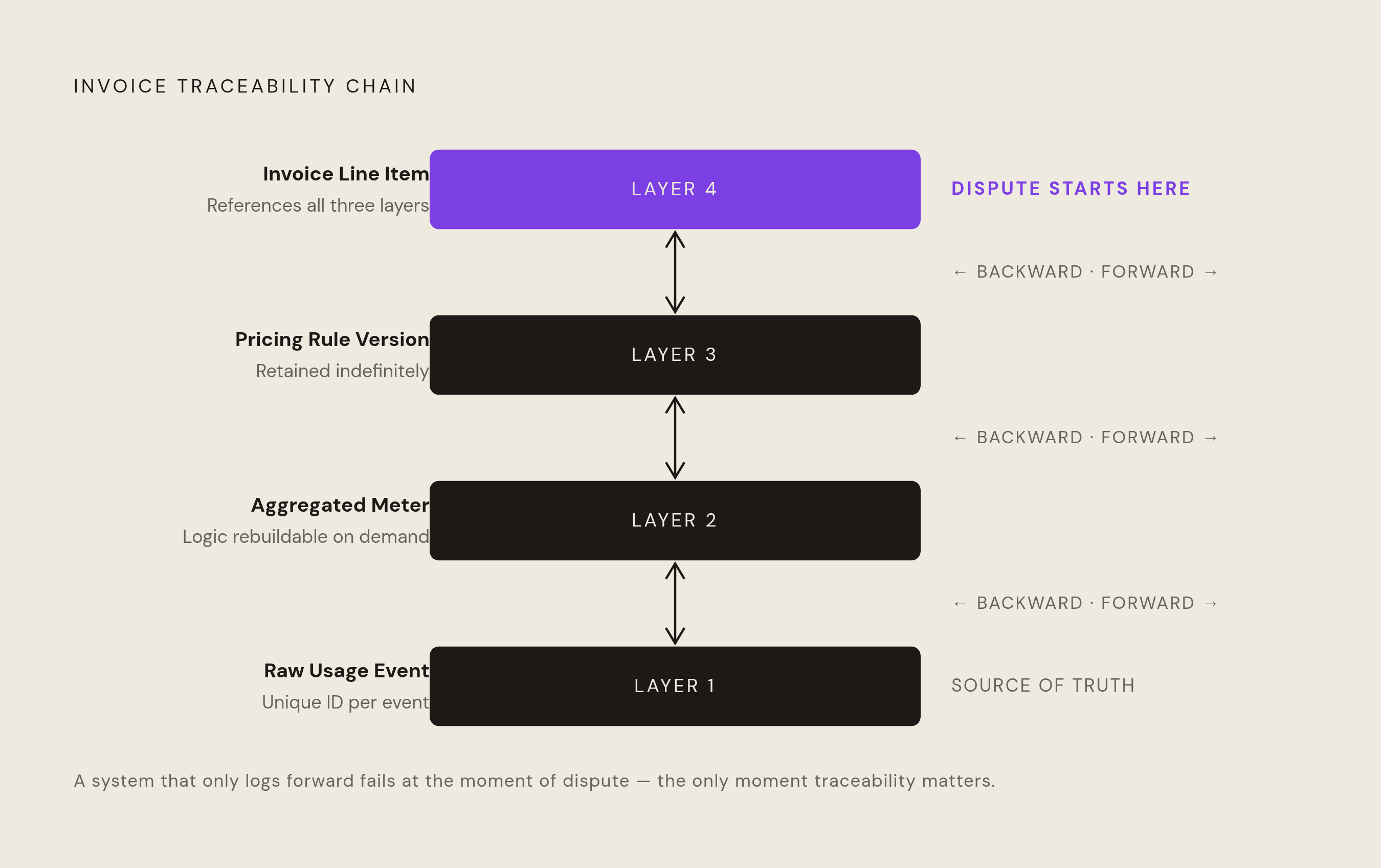
A defensible audit trail for metered billing is a chain of four layers, each one referencing the layer beneath it, so that any charge can be traced down to the raw data that produced it and any raw event can be traced up to the charge it eventually produced.
The first layer is the raw usage event. If an event has no ID, you can't retrieve it later, and a log you can't retrieve later isn't an audit trail; it's just a pile of numbers. Everything else in the chain depends on accurate, real-time usage data, and it's also the single biggest lever you have for reducing disputes before they start.
The second layer is the aggregated meter. The aggregation logic itself has to match how customers actually perceive the value they're getting, and the system has to be able to rebuild the meter value from the underlying events on demand, not just display a cached total.
The third layer is the pricing rule that got applied. Pricing configurations have to stay around indefinitely, because a customer disputing a January invoice in October needs the system to reconstruct the January pricing state precisely.
The fourth layer is the invoice line item itself, and it has to reference all three layers beneath it: the aggregated meter value it was calculated from, the pricing rule version that was applied, and the aggregation period the charge covers. A line item that shows only the resulting dollar amount, with no path back to the meter and the rule behind it, fails the standard regardless of how accurate the number happens to be.
The chain has to run in both directions. Forward traceability means you follow an event through to the charge it produced. Backward traceability means starting from a disputed charge and working back to the event. A system that only logs forward, recording what happened without preserving a path back to it, fails during a dispute, when tracing the charge back to its source matters most.
Immutability, idempotency, and late-arrival handling, the three technical floors
The four-layer chain only holds up if the event log underneath it meets three technical requirements. These aren't optional refinements to add once the basics work. A log that fails any one of them breaks the entire chain above it, no matter how well-designed the aggregation, pricing, and invoicing layers are.
The first requirement is immutability. Every billable event has to be written to a log that can't be altered after the fact. Corrections don't get made by editing the original record; they get made by appending a new, compensating event that references the one it's correcting. Financial records generally need to be retained for three to seven years depending on the applicable regulation and document type, and an append-only structure is what makes that retention meaningful as a compliance safeguard, not just a storage policy.
The second requirement is idempotency. If you skip this, you get customer disputes and a slow erosion of trust in every invoice the system produces afterward.
The third requirement is handling events that arrive late. If events arrive after that buffer window, they should be carried forward to the next billing period with a visible audit reference attached, never dropped silently.
All three properties have to hold at the same time. If a system is immutable but not idempotent, it will produce a perfectly tamper-evident record of a customer being billed twice for the same action. It satisfies the letter of an audit trail while it defeats its purpose. A well-documented case involving a single-day invoice spike at an AI coding tool illustrates the point where metering correctness and metering governance start to diverge. Both matter, but they are separate problems, and the governance side gets its own treatment later in this piece.
Why most billing platforms fail this standard
Billing platforms built for subscriptions were designed to store a final invoice total. They weren't designed to preserve the reasoning that produced a metered charge, because under a flat-rate model there was no reasoning to preserve beyond "the contract says $500 a month," a consequence of the architecture those platforms were built on, before consumption-based pricing existed as a mainstream requirement.
If usage billing gets bolted onto infrastructure that was never built for it, the failures that follow are predictable. Finance teams hit reconciliation walls where they cannot trace an invoice amount back to the source events that produced it, because the intermediate layers were never stored.
The market's typical answer pairs a dedicated metering tool with a separate billing tool, but that doesn't close this gap so much as relocate it. A complete audit trail has to establish who performed an action, when it happened, what changed, and how it affected the financial record. Generic billing logs capture only a final state, so they can't answer any of those questions for a metered line item.
ASC 606 and SOX add to the audit requirement for metered revenue
Metered billing carries a regulatory obligation that subscription billing mostly avoided. Under ASC 606, revenue tied to metered usage gets recognized as consumption happens, not when the invoice goes out. That rule turns every metered invoice line item into two records at once: a billing record and a revenue recognition record, and the audit trail behind it has to hold up for both.
The practical consequence is specific. If a customer makes 500 API calls on a given day, the company recognizes that revenue in the accounting period the consumption occurred in, not whenever the invoice happens to get cut. The audit trail supporting that line item has to be precise enough to support the recognition entry on the books, not merely precise enough to justify the number printed on the invoice.
Enterprises operating under SOX face a higher bar still. The trail needs to show who approved a given change, when they approved it, and why, because that evidence is what internal controls and external audits under SOX, IFRS, and GAAP actually run on.
When billing operates outside the ERP system entirely, you have to reconcile the billing platform and the revenue ledger by hand to stay ASC 606 compliant. The audit trail is a controller and CFO concern as much as it is a compliance team's problem.
Outcome-based and multi-dimensional pricing add a fifth audit layer most systems ignore
The four-layer chain described earlier is the floor for AI products, not the ceiling. When a product charges for delivered outcomes rather than raw consumption, a resolved customer interaction rather than a raw token count, the audit trail needs a fifth layer: the outcome measurement logic that establishes whether the billable threshold was actually met. That logic itself becomes something a customer can dispute, and defending the charge when they do requires logging it with the same rigor as the usage event underneath it.
Multi-dimensional pricing compounds the problem further. A product billing across tokens, GPU-minutes, audio minutes, megapixels, and hardware tiers simultaneously is running a separate audit chain for each dimension: its own event log, its own aggregation method, its own pricing rule version. The audit trail has to reconstruct the charge for each dimension independently, because a dispute over the GPU-minute charge has nothing to do with whether the token charge was calculated correctly, and treating them as a single blended number destroys the ability to investigate either one.
Rating logic for these products also has to account for mid-cycle plan changes, prepaid credits, and minimum commitments, each of which introduces a branching point in the chain that needs its own timestamp and reference. A dispute over a wallet balance requires reconstructing every debit against that wallet in the order it occurred, and a system that treats the wallet balance as a single mutable number rather than a sequence of logged events cannot do that reconstruction when asked.
Enterprise governance requirements that extend the audit trail beyond the invoice
Enterprise buyers now expect billing infrastructure to support governance reporting that has nothing directly to do with the invoice itself: per-agent cost caps, cost allocation by business unit, and spend visibility in real time. If a vendor's billing infrastructure can't produce this data, it gets excluded from procurement before anyone evaluates the product on its merits.
For AI products specifically, the audit trail has to extend down to the level of the individual agent. That metadata can't be reconstructed after the fact if it was never recorded in the first place, so the ingest layer is the only point where this requirement can actually be met.
Real-time spend dashboards prevent bill shock and cut down support volume, but an enterprise buyer doesn't see them as a convenience sitting on top of the product. They run the mechanism the buyer's own governance framework depends on, so when they're missing, you have a compliance gap, not a missing UX feature. The audit trail has to be queryable while usage is happening, during the billing cycle, not only after it closes.
Procurement and category management teams use this same audit trail to monitor how a supplier is invoicing them and to confirm that contracted terms, payment milestones, negotiated discounts, volume-based rebates, are being applied correctly. The compliance argument and the revenue argument converge here: weak governance data doesn't just create audit risk, it closes off enterprise deals before the sales conversation starts.
Criteria for billing infrastructure that meets this standard
Everything in the preceding sections points toward a single conclusion: a subscription billing platform with a metering feature bolted on afterward cannot meet this standard, because the standard requires infrastructure built from the start to ingest events quickly, preserve the complete chain from event to invoice, and keep that chain queryable indefinitely.
A few criteria follow directly from the argument made above. Event ingestion needs to happen at millisecond speed with idempotency guarantees enforced at the point of ingest, not patched in downstream after duplicates have already entered the system. Pricing version control needs to retain every past configuration indefinitely, so a dispute surfacing months later lets you reconstruct the historical pricing state on demand. Metering and billing need to run on one unified engine rather than two integrated vendors, because the seam between separate systems is exactly where chain of custody breaks down; when usage data, contract terms, and revenue recognition live in three different places, finance loses the thread connecting source events to invoices to the general ledger.
Prepaid credit wallets and postpaid invoicing need to run on that same engine, with credit drawdown events logged to the same standard as usage events rather than treated as a simpler, less-audited parallel system. Spend data needs to be queryable in real time for enterprise governance, not locked inside a dashboard that only refreshes after the billing cycle closes. If an enterprise has data residency requirements, it needs on-premises or sovereign cloud deployment to be available, because a hosted-only platform disqualifies itself from a meaningful share of enterprise procurement before evaluation even starts. And the audit trail needs to reach all the way to the general ledger: modern revenue automation should hand off invoices directly into ASC 606-compliant revenue recognition without someone manually rebuilding the connection in a spreadsheet every month.
Building this kind of infrastructure in-house is a permanent maintenance commitment, not a one-time engineering project. The team that builds it owns every edge case that follows: late-arriving events, duplicate retries, pricing versions drifting out of sync with what was actually charged, indefinitely, for as long as the billing system runs. For a company whose core product is something other than billing itself, that ongoing ownership is a cost with no corresponding strategic return. Purpose-built metering and billing infrastructure exists precisely to carry that weight, so that the company whose product is an AI agent, an API, or a compute platform can spend its engineering time on that product instead of on the permanent upkeep of an audit trail.