Invoice Record Retention Requirements by Jurisdiction
Compliance rules vary by country, clock start, and storage format.
Invoice retention appears, at first glance, to be a straightforward question with a straightforward answer: keep invoices for some specified number of years. The reality is that no single number answers the question correctly. Retention obligations are layered, jurisdiction-specific, and contingent on three distinct variables that each require separate answers: how long, starting when, and in what form.
The "how long" question is the one most businesses answer first, and it is the one that misleads most often. Tax law and commercial or civil law frequently run parallel retention clocks at different lengths within the same country. An invoice may satisfy the tax authority's clock while still falling under a longer civil obligation that continues to apply for years afterward. Reading the headline figure from a compliance guide, without checking whether a second clock runs alongside it, produces a policy that is correct for one regulator and incorrect for another.
The "starting when" question compounds the problem. The retention clock does not begin on the invoice date in most jurisdictions. It typically starts at the end of the tax year, on the filing date, or on the date of the last entry, depending on where the record sits. The gap between invoice date and clock-start date can add more than a year to effective retention, which means a policy built around the invoice date is systematically under-retaining from the first day it operates.
The "in what form" question is the third variable, and it is the one most likely to catch a digitally native business by surprise. Some jurisdictions impose immutability requirements, qualified signature mandates, or format-specific rules that go well beyond simple storage. A business that retains everything for the correct period but in the wrong format has not complied. It has merely organized its non-compliance.
The practical consequence is asymmetric. Retaining too short, or in an invalid form, exposes the business to penalties, lost audit defenses, and destroyed evidence in disputes. A multinational that applies one country's rule globally is almost certainly under-retaining somewhere, because no jurisdiction's rules apply everywhere without modification. The sections that follow walk through the major markets, the clocks that operate within them, and the storage conditions that determine whether a retained file counts as a record at all.
How the United States layers federal, state, and industry retention clocks on top of each other
The United States has no single federal invoice retention standard. A business operating there must identify which of several overlapping federal and state clocks applies to each invoice and follow the longest one. The federal tax agency provides the baseline, but it is a baseline with exceptions that reach well beyond the commonly cited three-year figure.
The IRS rule is three years from the date the return is filed for standard cases. That is the key structural point: the clock runs from filing, not from the invoice date and not from the end of the calendar year. A policy that counts three years from the invoice itself destroys records nearly a year early.
The extended IRS periods apply in specific, identifiable circumstances. Where no return is filed, or a fraudulent return is filed, there is no limitation at all. A multi-year asset, a piece of equipment or a building, easily stretches a standard invoice into a decade or more of retention because the clock resets at disposal rather than purchase.
Federal contracting and securities law add further clocks on top of the tax baseline. Ordinary invoices generally carry a five-year SOX retention period, with only those forming part of the audit evidence trail subject to the seven-year rule. The statute also criminalizes alteration or destruction of records with intent to impede investigations, which makes retention under this framework a legal exposure question as much as a compliance question.
State requirements add another layer, and they do not necessarily align with federal clocks. When federal and state requirements differ, the longer period governs. The practical policy most US businesses adopt, given this layering, is to retain everything for seven years. That single rule covers the three-, six-, and seven-year IRS windows without tracking which case applies to which invoice. It is a blunt instrument, but it is the only simple rule that survives contact with the full federal and state stack.
United Kingdom and Germany: how two major European markets set their retention floors, and how Germany's floor just moved
The UK also demonstrates the same clock-start subtlety that appears in US rules. HMRC requires VAT records, including invoices, to be kept for six years. For VAT invoices, the clock starts from the date of issue of the invoice. Capital assets may require retention for up to ten years under the Capital Goods Scheme, which extends the obligation well beyond the standard six-year figure. Self-employed individuals must keep records at least five years after the January 31 submission deadline of the relevant tax year. Limited companies follow six years from the end of the company's financial year.
The UK penalty structure makes this consequential rather than academic. HMRC can impose a fixed penalty of £3,000 for failure to maintain adequate records. Where inadequate records lead to an inaccurate return, penalties can reach up to the full amount of tax due, scaled by whether the failure was careless or deliberate. And HMRC can extend retention periods in cases of suspected fraud or careless error, up to twenty years in the most serious cases. A six-year rule that can become a twenty-year obligation under investigation is not a fixed horizon. It is a floor with enforcement discretion above it.
Germany's situation is the section's sharpest point because the floor moved on January 1, 2025, and not every part of the obligation moved with it. The Fourth Bureaucracy Relief Act, effective that date, shortened the retention period for invoices and other booking vouchers from ten to eight years under §14b UStG and §147 AO. However, the underlying accounting books, the Handelsbücher, still carry a ten-year period under §257 HGB. The dual-clock problem therefore applies within Germany itself: invoices now run on an eight-year clock while the books that record them run on ten. Further, financial-sector firms must still retain booking vouchers for ten years under the 2025 Schwarzarbeitsbekämpfung Modernisation Act, which reversed the reduction for banks, insurers, and securities institutions. The eight-year figure is not universal even after the reform.
The practical implication is that a compliance policy updated to "ten years" for Germany before 2025 is now over-retaining on invoices, a storage cost issue. But a policy that has not been updated at all may be under-retaining on the books question, because the ten-year requirement for Handelsbücher did not change. Retention rules changed in Germany in 2025, and that fact alone should reset the compliance review cadence for every business operating there.
France, Italy, Spain, and the Netherlands: where civil and tax clocks diverge most sharply
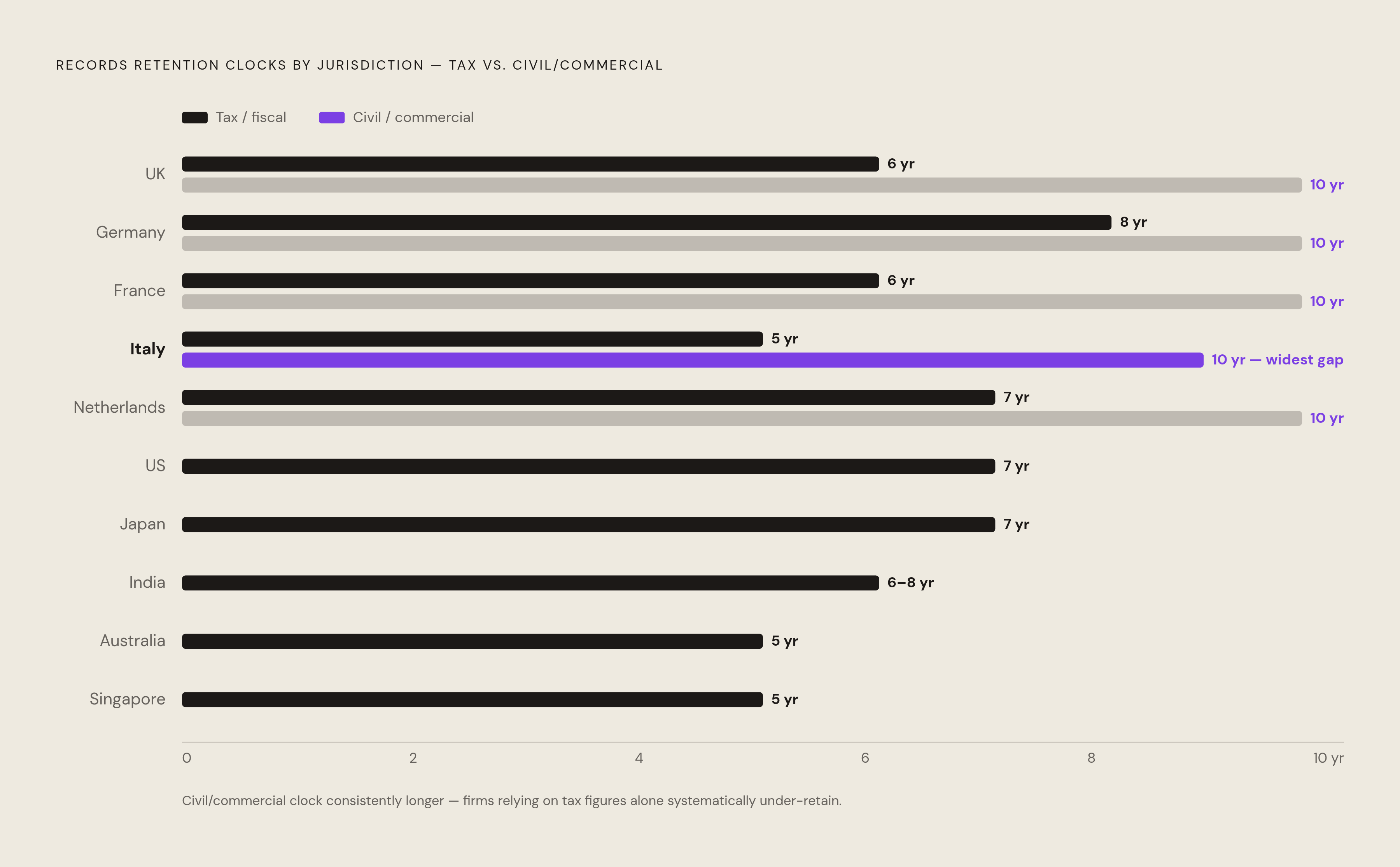
In France, Italy, Spain, and the Netherlands, the headline retention period understates the true obligation because civil or commercial law imposes a longer clock that runs alongside the tax clock. A business that reads only the fiscal figure will systematically under-retain against the private-law requirement that a counterparty or a court can invoke. France runs a six-year fiscal clock and a ten-year commercial clock in parallel. Fiscal records must be kept for six years under LPF art. L102 B. Commercial and accounting records require ten years under Code de commerce art. Documents whose retention period expires after January 1, 2027 are subject to the ten-year requirement. The e-invoicing mandate adds a further dimension. Since September 1, 2026, every business covered by the reform must be able to receive e-invoices. Electronic invoices must be stored in their original format, and the mandate introduces platform-specific archiving requirements through those approved platforms.
Italy's divergence is the most pronounced in the set. Italy's Sistema di Interscambio, the SdI platform, retains copies for fifteen years, but businesses are independently responsible for maintaining their own ten-year archive. An invoice stored outside the required channel may be treated as legally nonexistent regardless of its content.
Spain and the Netherlands are supporting examples that confirm the pattern rather than extend it. Invoices related to assets subject to amortization must be kept for four years following the end of the amortization period. The Netherlands requires seven years minimum retention, ten years for real estate-related records. Electronic invoices may be stored outside the Netherlands provided the Dutch tax authority retains access. That is an explicit cross-border storage permission that several other EU jurisdictions do not grant as directly.
Belgium closes the section as a live example of a rule that changed twice in three years. A 2022 reform briefly extended retention to ten years. A rule that changed twice in three years cannot be captured by a policy written once and filed.
Asia-Pacific and emerging markets: Australia, Singapore, Japan, India, and Brazil
Asia-Pacific and Brazilian jurisdictions have shorter headline retention periods than most of Europe, but each attaches conditions on clock-start dates, digital format, or parallel fiscal systems that determine the true obligation. The shorter headline figures do not simplify compliance. They relocate the complexity.
Australia's rule is five years, but the clock-start language deserves attention. The Australian Taxation Office requires business records to be kept for five years from when the record was prepared or obtained, or when the transaction or act it relates to was completed, whichever is later. The "whichever is later" construction means the effective period extends beyond five years in any case where preparation and completion are separated by time, which is most cases involving capital assets.
Singapore's requirement is five years from the relevant Year of Assessment, and electronic storage is accepted. Japan runs under the Electronic Books Preservation Act, amended in 2022 with full mandatory compliance taking effect from January 2024. Electronic invoices must be retained for seven years as a general rule. The clock starts from the end of the fiscal year containing the transaction.
India requires registered taxpayers under the GST framework to retain records for 72 months, six years, from the due date of the annual return. Electronic storage conditions are mixed across GST and income tax obligations, which means a single invoice may face different format expectations depending on which authority examines it. India's GST period is also subject to a contested interpretation: some authorities read the obligation as extending to eight years, and where authorities differ, the longer interpretation is the safer position.
Brazil's SPED records follow their own separate timetables, independent of the NF-e clock, which creates a parallel-system structure similar to Germany's books-versus-vouchers split. All VAT-registered businesses in Poland must be able to receive KSeF invoices from February 1, 2026, using the proprietary FA(3) XML format, not the EU standard EN 16931, under a clearance model. A business that assumes one standard applies uniformly will fail this requirement on format grounds while being perfectly compliant on period grounds.
Digital storage rules: when a file on a server is not a legally valid record
Accepting electronic records and accepting any electronic record are different things. Most jurisdictions permit digital storage, but they attach conditions on immutability, format, accessibility, and signature that determine whether a file counts as a valid record at all. A file on a server is not a record until it satisfies the jurisdiction's conditions for being one.
The US E-Sign Act establishes that electronic records have the same legal effect as paper if they remain accurate, accessible, and reproducible. That is a functional standard focused on readability and retrievability. The German requirement shifts the question from "can we read it" to "can we prove it has never changed," which is a fundamentally different evidentiary bar.
Italy mandates transmission through the SdI platform, and format compliance is a condition of legal validity, not a storage preference. The Netherlands permits storage abroad provided the Dutch tax authority retains access. That explicit permission implicitly signals how other jurisdictions without such a provision may treat offshore storage: as a default position of non-compliance.
Practical guidance across jurisdictions resolves into a few concrete rules. Where format mandates are jurisdiction-specific, as with SdI, KSeF FA(3) XML, or GoBD, a generic cloud storage system does not substitute for the mandated channel or format. Format compliance is a parallel obligation, not a storage preference, and it runs alongside the period question for the entire retention window.
How usage-based and AI billing create a new retention dimension: the event log behind the invoice
For businesses billing by token, API call, GPU-minute, or any consumption metric, the invoice is not the primary evidence. The usage event log that generated it is, and retention policy must cover both. Traditional invoicing documents a transaction after the fact. Usage-based billing generates an invoice as the output of a metering process, and the invoice cannot be verified or disputed without access to the underlying event data.
This has a direct legal consequence. If usage event logs are the only way to reconstruct billing, they become legally required records under the same retention obligations that apply to the invoice itself. A business that retains the invoice PDF for seven years but purges the event log after ninety days has technically kept the invoice and practically destroyed the evidence behind it. The invoice remains in the archive. The substantiation for every line on it is gone.
The billing infrastructure's own data model determines whether this problem is even addressable. The events are not merely hard to retrieve. They no longer exist. Any retention policy written for such a system is operating on a document that its own platform cannot substantiate.
The scale question makes this an architecture problem rather than a policy problem. The retention architecture must be designed for that volume from the start, not retrofitted onto a document management system built for PDF storage. The event log is the invoice's evidence, and the retention obligation follows it wherever it sits.
Building a retention policy that survives operating in multiple jurisdictions simultaneously
The only safe cross-border retention policy is one that identifies the longest applicable period for every market a business operates in and treats that period as the floor for all records from that market, and that is reviewed whenever any jurisdiction in scope changes its rules. The alternative, the multinational default error, is applying one country's rules globally. A US-headquartered company that applies the standard three-year IRS period to its German subsidiary's invoices destroys records five years too early under Germany's eight-year requirement, which was itself reduced from ten years in 2025.
The longest-period principle applies with three specific rules. Where a single jurisdiction runs parallel tax and civil clocks, default to the longer: Italy's ten-year civil code period, not the five-year tax period. France's ten-year accounting period, not the six-year fiscal period. Where multiple jurisdictions apply to the same invoice, as in cross-border transactions or subsidiary filings, retain for the longest period any of them requires. Where a period is contested or interpreted differently by different authorities, as with India's GST interpretation, the longer interpretation is the safer position.
Policy structure by document type follows from that principle. Records under active audit, litigation, or dispute are placed on legal hold, and standard retention periods are suspended until the matter resolves. Usage event logs supporting usage-based invoices are retained for the same period as the invoice they generated, because they are the invoice's evidence.
Ongoing monitoring is not optional, and it is not an annual exercise. Belgium's 2025 reversion from ten to seven years and Germany's 2025 reduction from ten to eight years both demonstrate that retention rules change faster than annual compliance reviews catch. A correctly-timed retention of an improperly-formatted record is non-compliant, because the retention period and the format requirement must both be met for the record to be valid. For businesses running billing across multiple jurisdictions from a single platform, the infrastructure must be capable of tagging events and invoices by jurisdiction, applying different retention periods per market, and surfacing usage-level data alongside invoice documents. A document management layer bolted onto a billing system built for flat-rate subscriptions does not meet this standard, because it cannot answer the question that the compliance review will ask: not just "how long did you keep the invoice," but "how long did you keep the events that made the invoice true."