Sales Tax Compliance Obligations for SaaS Invoices Across US States
States tax SaaS under three incompatible frameworks, requiring invoice-level compliance.
There is no federal sales tax, and that single fact makes SaaS taxation a different species of compliance problem. Each of the 45 states with a sales tax sets its own rules for whether SaaS is taxable, what it is taxable as, at what rate, and under what conditions. The result is not one system to learn but several overlapping ones that must resolve correctly on every invoice.
The structural difficulty begins with how sales tax law was built. Every foundational principle assumes a tangible object moving from a seller to a buyer at a known address. SaaS violates all of those assumptions at once. States cannot simply apply the settled rules for goods, so each has had to invent its own classification framework from scratch. That is the root cause of the divergence: not legislative carelessness, but a genuine gap between a legal structure designed around physical property and a product that has no physical form.
That gap compounds operationally. A physical-goods company ships to known addresses and accumulates obligations one state at a time as it expands. A SaaS company can trigger obligations in dozens of states simultaneously, often without knowing it, because users are everywhere from the first sale. Sphere's SaaS tax guide notes that states were initially slow to adapt when business went digital but have since updated their tax law to capture revenue from virtual transactions. That catch-up is still uneven, which is why the map keeps changing, and why the first requirement for any finance team is understanding how states classify the product before anything else.
The three classification frameworks states use to decide whether SaaS is taxable
States do not choose taxable or exempt at random. They apply one of three underlying legal frameworks, and the framework determines not just taxability but sourcing rules, exemptions, and audit risk. Knowing which framework a state uses tells a finance team what analytical questions to ask about every transaction in that state.
The first framework treats SaaS as tangible personal property, or TPP. Kentucky classifies SaaS as a "prewritten computer software access service," a taxable enumerated service under KRS 139.200. In these states, the legal fiction is that the customer is renting software even though no physical software exists.
The second framework reaches the same destination through a different route. These states do not call SaaS software at all. Instead, they fit it into a named taxable service category, usually data processing or information services. Texas is the canonical example. Washington D.C. does much the same, taxing SaaS mainly as a data processing service and, for certain subscriptions, as an information service or digital good.
The third framework is the newest and most deliberate. These states created a purpose-built category for cloud software. Washington state established the "digital automated services" category under RCW 82.04.192 to broadly tax electronically delivered digital products and services, including cloud-based software. Across all three frameworks, states apply a tiebreaker called the "true object" test when a transaction mixes taxable and nontaxable elements: if the dominant purpose is using software functionality, the whole transaction may be taxable. That test matters especially for products bundled with consulting or implementation, and it becomes decisive in the bundling scenarios examined later.
The current state-by-state map: where SaaS is taxable, exempt, or conditional
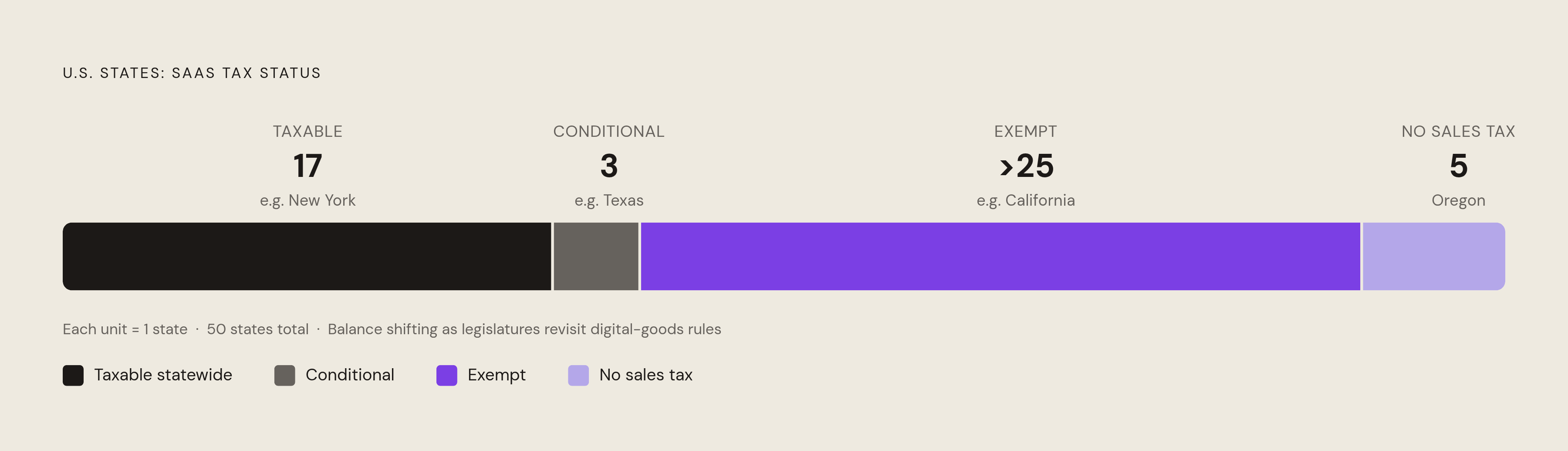
The fifty states do not split evenly. Roughly 17 clearly tax SaaS statewide, a smaller group applies conditional rules that depend on the buyer or the use, local-only taxation applies in a few jurisdictions, and more than two dozen clearly exempt it. That majority-exempt picture is changing, and changing fast.
The conditional states are where invoice-level classification becomes unavoidable. Ohio taxes SaaS for business use but exempts personal use, the reverse of the pattern that dominates elsewhere. Connecticut taxes SaaS for personal use at the full state rate but only 1% for business use, so if you misclassify a B2B customer as B2C, you over-collect and owe refunds. Texas occupies its own category: SaaS is taxable as a data processing service but only on 80% of the charge, and whether a specific product qualifies as data processing or as a professional service is a fact-specific determination that analytics, automation, bookkeeping, and AI-enabled products frequently get wrong.
Local-only taxation creates a different complication. Colorado exempts SaaS statewide through December 31, 2026, after which HB 26-1223 makes it taxable statewide, while Denver, Boulder, Aurora, Colorado Springs, and other home-rule cities may tax it independently, each requiring separate registration. No statewide sales tax applies in Oregon, Montana, New Hampshire, Delaware, and Alaska, though some Alaska localities tax SaaS under the Alaska Remote Seller Sales Tax Code.
How economic nexus works and when the obligation actually begins
Knowing a state taxes SaaS is only half the problem. The 2018 Supreme Court decision in South Dakota v. After Wayfair, states can make out-of-state sellers collect sales tax if their economic activity crosses a line, even with no physical presence.
Most states set that economic nexus line at $100,000 in annual sales. Illinois eliminated its transaction threshold on January 1, 2026, moving to a revenue-only $100,000 standard, a change that increases exposure for lower-volume, higher-ticket SaaS companies that previously stayed under the transaction count. Utah made the same move on July 1, 2025. The trend is toward simpler, revenue-only triggers that catch more sellers.
The timing risk is severe and asymmetric. If you exceed a threshold in March but do not register until October, you owe the full period of uncollected tax from March forward. You owe retroactively once you cross it, and New York's higher $500,000 threshold works the same way. Monitoring revenue against thresholds is the only way to know when an obligation begins, and monitoring cannot wait for a quarterly review.
How sourcing rules determine which state's tax applies when users are in multiple places
After establishing that a state taxes SaaS and that nexus exists, companies face a third question: which specific sale is subject to which state's tax. For enterprise customers with users across many states, the answer is rarely the bill-to address. Most states source remotely accessed software to where the purchaser uses or directs use of the software, not simply where the invoice is sent. New York is explicit on this point: a business with employees in multiple states may require user-location or employee-location data, not just billing address. The data quality issue is a billing infrastructure problem as much as a tax problem: a company that cannot record where its users actually consume the product cannot source its SaaS revenue correctly, regardless of how well it understands the rules.
The Multiple Points of Use certificate is the primary tool for enterprise customers with multistate user bases. It lets the customer apportion the SaaS charge across states, so less tax is owed in high-rate states and none in exempt states. Billing systems need to capture at minimum the bill-to address for default sourcing, the primary use location where the state uses that rule, and user locations by state where MPU apportionment applies.
California SB 122 adds a new wrinkle: it sources sales to the purchaser's known California address using a priority order that begins with billing address and proceeds through shipping address, payment instrument address, and mailing address. Unlike New York and Texas, it provides no allocation mechanism for multistate subscriptions, so sellers have no statutory guidance on how to apportion a subscription used across multiple states. That gap, pending CDTFA regulatory action, is the most significant unresolved sourcing question entering 2027.
For usage-based pricing, sourcing becomes even more dynamic. In states where tax follows where use occurs, the taxable amount for a customer can shift month over month as employees relocate or accounts add and remove users in different states. You need dynamic tax calculation at each billing event, not a fixed rate set at contract start.
California SB 122 and what changes on January 1, 2027
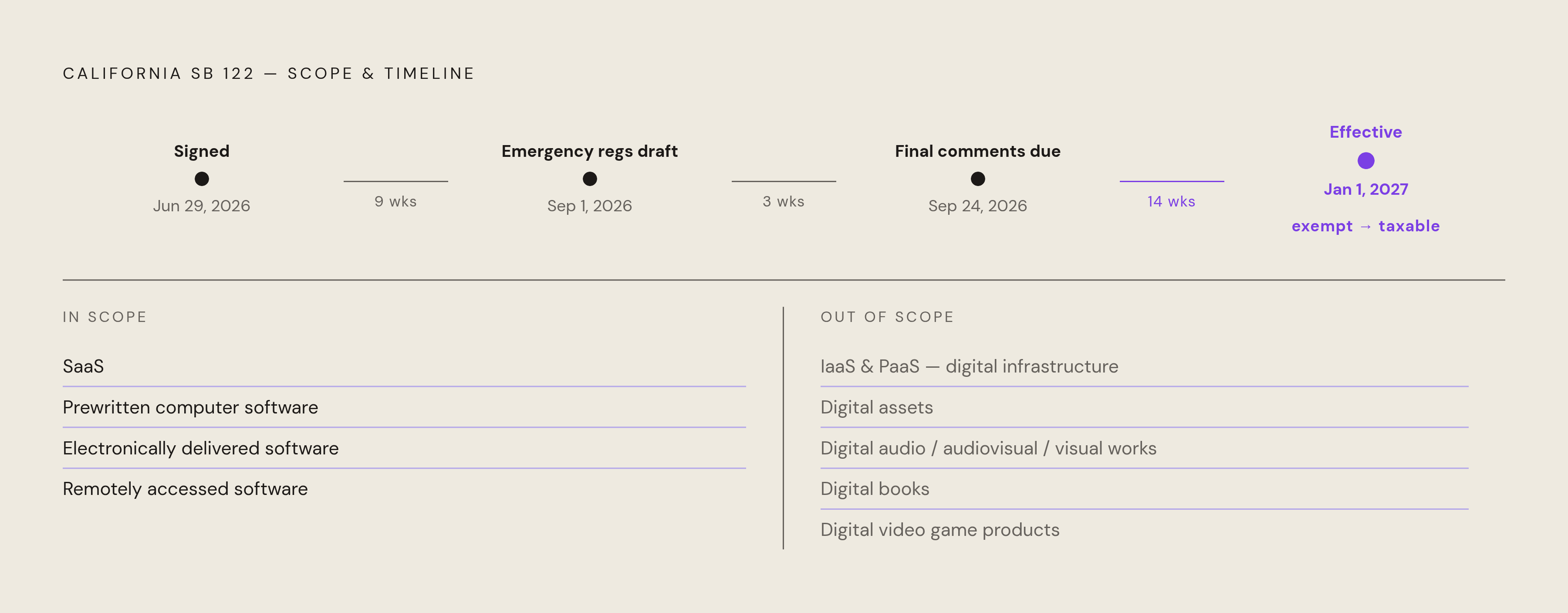
California's SB 122, signed June 29, 2026, will tax SaaS and prewritten computer software starting January 1, 2027. The largest U.S. economy is converting from an exempt state to a taxable one, and the conversion creates a deadline that finance and billing teams cannot defer. The law covers SaaS and prewritten computer software sold to California customers, whether delivered electronically or accessed remotely. It explicitly excludes digital assets, digital audio works, digital audiovisual works, digital visual works, digital books, digital infrastructure, and digital video game products. IaaS and PaaS are excluded as digital infrastructure under the statute itself, and proposed CDTFA Regulation 1600 elaborates on that exclusion by defining digital infrastructure as cloud-based IaaS and PaaS.
SB 122 sources first to billing address, then shipping or delivery address, then the payment instrument's mailing address, then mailing address. If the seller has no California address on record, the sale is sourced outside the state. The result is a compliance split for large enterprise accounts that most billing systems are not designed to handle.
The allocation gap is the most serious unresolved issue. SB 122 has no multistate allocation mechanism, but New York and Texas provide frameworks for apportioning a subscription price based on where use occurs. The CDTFA released an initial draft of emergency regulations on September 1, 2026, with final comments due September 24, 2026, and those regulations may be revised before implementation. The practical tasks are clear: review California customer accounts and identify which products fall within scope, determine whether any accounts approach the $5 million per-purchaser threshold, and update invoicing and tax calculation logic before the effective date.
How B2B vs. B2C buyer classification changes the tax owed on the same product
In several states, the same SaaS product sold to a business and to an individual consumer produces a different tax result, and not just a different rate. Sometimes whether a sale is taxable at all changes, so you must classify at the transaction level before you invoice. Connecticut taxes SaaS for personal use at the full state rate and for business use at 1%. Maryland taxes personal use at the full rate and business use at 3%. Ohio runs the reverse pattern: SaaS is taxable for business use and exempt for personal use, so getting it wrong in Ohio means collecting tax on personal-use customers who owe none.
The operational requirement is the same across all these states. The billing system must capture the buyer's use type and apply the correct rate, or collect the correct exemption certificate, at the time of invoicing, not retroactively. A B2B SaaS company that sells only to businesses may still need to verify that classification, because a state auditor will not take the seller's word for it without documentation.
Bundled pricing and the predominant-purpose test
A SaaS company that bundles its software with implementation, consulting, support, or API access may make an otherwise-exempt transaction fully taxable in states that apply the predominant-purpose test, because the test looks at the transaction as a whole, not at its components. When a transaction mixes taxable and nontaxable elements, the state determines whether the primary purpose is the taxable or nontaxable element, and that determination controls the taxability of the entire bundle. If the primary purpose is accessing a service or data, the software component may escape tax even in a state that would otherwise tax it.
A company that invoices software plus implementation as a single line item is exposed in any state that applies the predominant-purpose test, because the state may treat the entire invoice as taxable. Texas adds its own wrinkle. The 80%-taxable, 20%-exempt rule for data processing services does not apply when a service is also taxable under a different category, so the carve-out can disappear depending on how the product is classified.
Usage-based pricing compounds the bundling problem. It may need to be re-evaluated each billing period. AI-enabled products that bundle software functionality with data transformation, analysis, or consulting-like outputs face the highest bundle exposure, because in Texas and New York AI tools that transform or analyze data may fall under data processing or information service categories that carry different tax treatment than baseline SaaS.
Exemption certificates and resale: what they do and what they require operationally
In every state where SaaS is taxable, certain buyers can claim exemption from tax: resellers, nonprofits, government entities, and in some states B2B buyers. Certificate management is therefore not a passive process. It requires active validation at the time of collection and periodic re-validation as certificates expire.
Resale certificates occupy their own category. A B2B SaaS company may sell to a customer who will incorporate the SaaS into their own product or service for resale, and that purchase may qualify as a nontaxable resale, but only with a valid resale certificate on file. The Streamlined Sales Tax program helps here: several states participate in a harmonized exemption certificate framework that simplifies multi-state certificate management for sellers registered in SST states, which matters for SaaS companies with large multi-state customer bases.
Why usage-based and AI product pricing creates compliance problems that flat-rate SaaS does not
With usage-based pricing, the amount invoiced changes with consumption, so it has a compliance dimension that static subscription pricing does not have. The taxable amount, the sourcing rule that applies, and even the taxability decision can each shift from one billing period to the next. In states where tax follows where use occurs, a customer's tax profile can change monthly as employees relocate, accounts add or remove users in different locations, or usage spikes in a particular state. You calculate tax at each billing event, not with a static configuration. Most AI agent and inference products fit the SaaS category and are taxable in states that tax SaaS broadly, but in Texas and New York AI tools that transform or analyze data may fall under data processing or information service categories with different rates or rules.
Prepaid credit wallets, common in AI products where customers purchase credits in advance and draw them down against consumption, introduce a timing question that states have not uniformly answered: is the taxable event the purchase of credits, the consumption of credits, or the underlying service delivered? Billing infrastructure for usage-based and AI products must apply tax logic dynamically at the event or invoice level, capturing user locations, applying correct sourcing rules, handling changing rates, and producing an accurate invoice each billing cycle without manual reconciliation. If a billing platform cannot model consumption-based pricing across multiple dimensions, it cannot apply the correct tax logic to those dimensions, because the metering problem and the tax compliance problem are the same architectural problem.
The practical compliance workflow: registration, calculation, filing, and monitoring
Sales tax compliance for SaaS is not a one-time setup. It is a continuous operational process, because the map changes through new legislation, rate changes, and nexus threshold changes, while the company's footprint changes through new customers and new states, and the product changes through new features and new pricing dimensions. Each change can alter the compliance posture.
The workflow begins with nexus monitoring. The Illinois and Utah threshold changes of 2025 and 2026 illustrate why the rules themselves must be monitored, not just the revenue: a company that knew its revenue but not the rule change was exposed. Then comes registration before collection, followed by invoice and billing configuration that applies the correct tax rate, sourcing rule, and B2B/B2C classification for each transaction, with exemption certificate workflows and MPU certificate acceptance where applicable.
Filing and remittance follow on each state's schedule, monthly, quarterly, or annually depending on volume, and late or incorrect filings produce penalties. The final step is ongoing monitoring, because Washington D.C.'s rate increase on digital goods and services from 6% to 7% effective October 1, 2026 required billing system updates before that date, and the next changes are already scheduled. They are the ones that completed a review once and did not build a process for tracking what changed after it, and the January 1, 2027 effective date for SB 122 is the next change that will test whether the process exists.