
Net Revenue Retention Impact of Billing Experience Improvements
Better billing experiences drive expansion revenue without requiring account renegotiations.
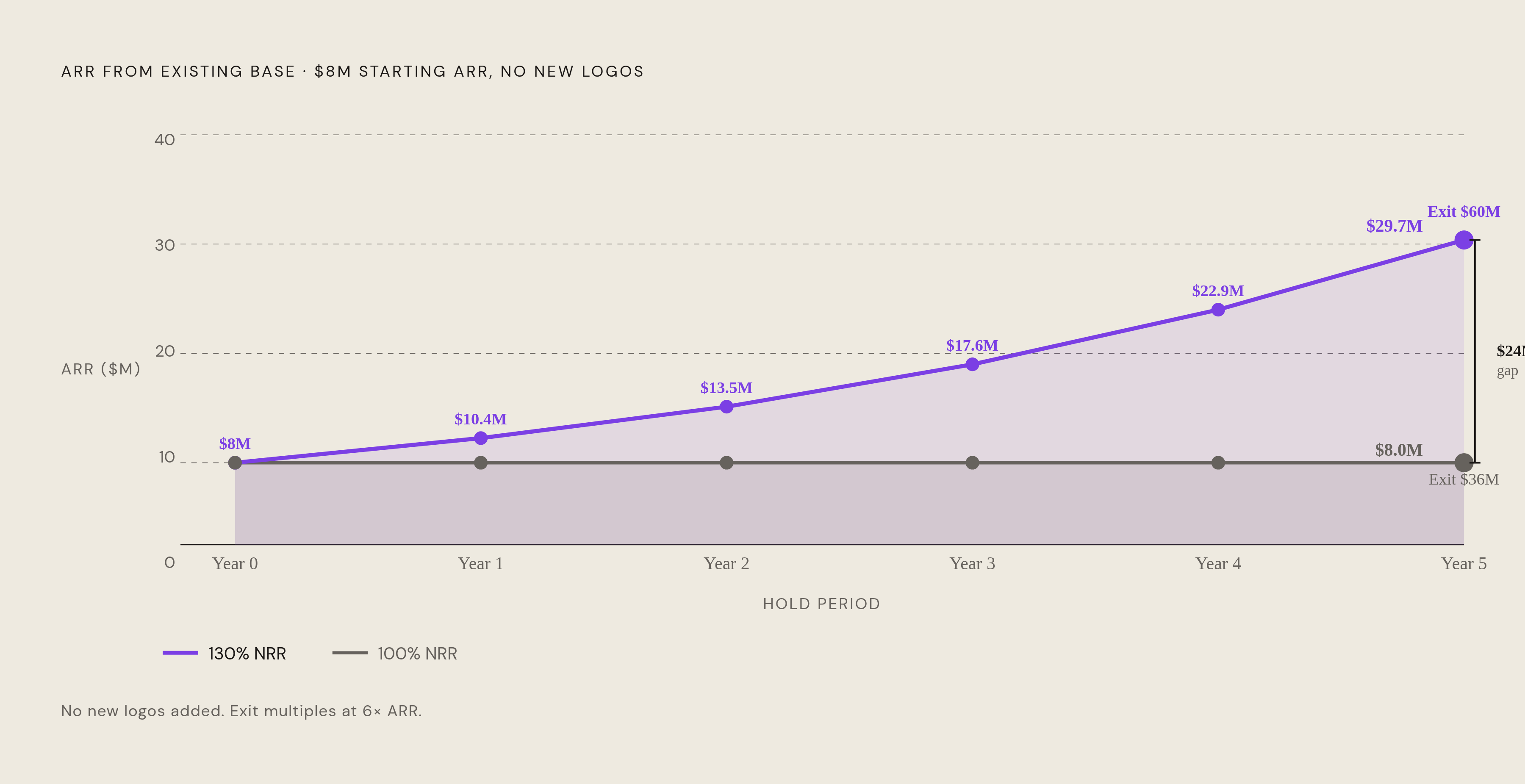
Two SaaS companies can carry identical revenue, $8 million in ARR, and identical growth rates, and still sell for radically different prices: one for $36 million, the other for $60 million. The gap comes from a single number, net revenue retention, and understanding why that number carries so much weight in a valuation conversation requires understanding what it actually measures and, increasingly, what builds it.
The structural metric of the AI SaaS era
Net revenue retention tells investors whether a company can grow without going out and finding a new customer. That distinction separates a business with a durable revenue engine from one that simply has a bigger sales team, and it is why NRR has displaced raw growth rate as the number serious buyers and investors anchor to first. The formula is straightforward: starting ARR, plus expansion, minus churn, minus contraction, divided by starting ARR. Anything above 100% means the existing customer base is worth more this year than it was last year, before a single new logo gets signed.
NRR needs to be read alongside its quieter counterpart, gross revenue retention, because the two answer different questions. GRR strips expansion out entirely, so it isolates whether customers are leaving, while NRR (which includes expansion) tells you whether the customers who stay are spending more. A company can report a healthy NRR number while its GRR erodes underneath it, and that combination is a warning sign rather than a comfort. Heavy churn masked by expansion from a handful of large accounts is a fragile position: it depends on those accounts staying put, and it unravels the moment one of them leaves.
The valuation math attached to NRR is not linear. A 2026 valuation analysis of NRR benchmarks finds that a 10-point improvement in NRR translates to a meaningful valuation uplift, with multiples jumping disproportionately above a certain threshold. Investors paying that premium are underwriting the compounding trajectory already embedded in the existing customer base. That compounding is the real mechanism at work: a company operating at a high NRR grows its existing revenue without adding a single new customer, and each year's expansion becomes the base line that expands again the following year. Over a five-year hold, that compounding difference is the entire story behind why two companies with the same starting ARR exit at such different multiples.
Where the 2026 NRR benchmarks sit
The headline NRR number for 2026 hides more than it reveals. Survey data tracking private SaaS benchmarks shows median private B2B SaaS NRR fell meaningfully from its 2021 peak and had gone nearly flat by 2024, with median GRR declining over the 2022-to-2024 window as well. Read as a single average, that looks like a broad, uniform slowdown across the industry. Read as a distribution, it tells a sharper story: top performers sit well above the median at the 90th percentile, and best-in-class companies exceed 130% NRR. The median compressed while the top of the market kept compounding, and that is the gap the rest of this analysis is built around.
Two forces are driving the compression at the middle and bottom of the distribution. Buyers emerged from the pandemic-era software buildout rationalizing their stacks, consolidating tools, and scrutinizing seat counts they had stopped questioning for several years. At the same time, AI substitution has started displacing software that never had much switching cost to begin with, giving customers a credible alternative to renewing at all. Both forces push down on the same lever: the revenue a company can extract from its existing base without having to go sign something new.
The companies holding their NRR near 130% are not simply executing better customer success motions than the companies sliding toward flat. They are built on a different architecture, one where usage and expansion are structurally connected rather than negotiated account by account. That architectural difference, the subject of the next section, is where the AI pricing shift becomes directly relevant: its sharp swings in price points and heavy reliance on credit bundles create volatility that companies manage without disputes or surprise bills by giving customers visibility into what they are consuming.
Pricing model choice as the first structural determinant of NRR
The largest driver of NRR variance in the 2026 data is whether the pricing model itself creates automatic expansion as a customer's usage grows, more than customer success headcount or churn-prevention tactics. Usage-based and hybrid pricing structures deliver meaningfully higher median NRR than flat subscription pricing, and that gap functions as a structural reward for aligning what a customer pays to what a customer actually consumes. The mechanism is almost mechanical in its simplicity: usage-based pricing expands revenue without anyone picking up the phone to renegotiate a contract, because the invoice grows as consumption grows, while seat-based pricing caps revenue at headcount no matter how intensively those seats get used.
Snowflake built its growth on a pure consumption model: customers pay for the compute credits they actually consume during warehouse runtime, with storage billed separately per terabyte. That model drove NRR well above the market median through the company's hypergrowth phase, moderating only as the customer base matured and usage patterns stabilized. Datadog took a hybrid route, combining a per-host subscription base with usage-based charges layered on top for logs, traces, and additional features, and that combination has driven consistently strong NRR over time.
Atlassian's recent pricing shift shows the hybrid model taking shape inside a more traditional seat-based business. Standard plans now include a set number of Rovo AI credits per user each month, and certain products generate additional charges per conversation or per credit once a customer's usage exceeds those limits. The subscription functions as a floor, and consumption becomes the expansion mechanism layered on top of it. Zendesk has taken a more outcome-adjacent approach with its AI resolution agent, pricing it on a per-automated-resolution basis, with a lower rate available to customers willing to commit to a usage volume in advance. That structure scales revenue with delivered value rather than with seats or logins. Salesforce, meanwhile, retired its standalone Einstein add-ons in favor of bundled Agentforce plans, with the migration tied to the general availability of new SKUs rather than exclusively to each customer's individual renewal date. That is a company using a product packaging change, rather than a resale motion, to move its entire base onto a new pricing architecture at once.
None of these five companies is presented here as the single correct model. Each is solving the same structural problem, getting revenue to track usage, through a different combination of subscription floor and consumption ceiling, and the NRR outcomes reported for each reflect that design choice directly.
Credit-based and prepaid wallet models as the default expansion vehicle for AI products
Credits have become the preferred mechanism for pricing AI products because they solve a problem that straight usage-based billing does not: predictability. A credit system gives the vendor and the customer a shared, stable unit of account for usage that is otherwise highly variable, and it creates a prepaid commitment that structurally lowers the odds a customer churns before using what they bought. A credit functions as a prepaid wallet, covering tokens, GPU time, model calls, or agent tasks under a single internal currency, which lets a vendor bundle multiple AI capabilities together without having to set a separate price for each one.
The adoption curve behind this shift is steep. AI credit models grew more than 100% year-over-year heading into 2026, and roughly one in three companies surveyed planned to introduce a credit model of their own within the year. A recent analysis of 2026 B2B SaaS pricing trends finds that capacity commitments, meaning prepaid blocks of compute or interactions purchased ahead of use, now appear in roughly four out of five new AI pricing experiments. Atlassian's Rovo credit allotment, described above, is one instance of this exact pattern already live in a shipping product.
Credits carry a second, longer-term function beyond smoothing a single billing cycle: they are a bridge toward outcome-based pricing. Vendors need usage data at scale before they can credibly price against business results, closed deals, resolved support tickets, completed workflows, and credits give them a bundled, flexible mechanism to experiment with packaging while that data accumulates. Zendesk's per-resolution pricing is already a step in that direction, and the companies currently running credit experiments are, in effect, building the dataset that will eventually let them price on outcomes directly.
The NRR mechanics of a credit model are distinct from both subscription and pure usage billing. A prepaid credit purchase creates bookings and billings the moment the customer buys it, but the expansion revenue is only recognized later, as those credits are actually spent. Gross revenue retention tends to improve under this structure because a customer who has already committed to a block of prepaid credits has a measurably lower propensity to churn before that commitment is used up, and expansion arrives in the form of top-ups rather than renegotiated contracts. That dynamic creates an infrastructure requirement that most billing platforms were not built to handle: prepaid wallets and postpaid invoicing are not separate systems that a company can choose between. AI and enterprise products routinely need to run both at once, on the same engine, for the same customer.
Real-time metering as the technical prerequisite for any usage-based expansion
A pricing model that depends on usage but runs its billing on a nightly batch job is a billing approximation, and approximations produce inaccurate invoices, consumption that is invisible to the customer until the bill arrives, and a steady erosion of the trust the pricing model was supposed to build. Systems built for this have to process usage events as they occur rather than batching them overnight, and that requirement appears immediately in enforcing free-tier limits in a product-led growth motion, which needs instant awareness of a customer's current usage; in customer-facing dashboards that show consumption in real time; and in progressive billing logic that has to trigger the moment a usage threshold is crossed.
The engineering demands of that requirement scale non-linearly with volume. At tens of millions of events a month, a company needs a streaming pipeline with idempotent writes and at-least-once delivery guarantees just to keep the numbers consistent. At hundreds of millions of events, that same pipeline needs dead-letter queues, distributed tracing, and full audit trails layered on top, or errors at that volume become effectively untraceable. The architecture underneath has distinct jobs: high-fidelity event pipelines, built on tools like Kafka or cloud telemetry services, capture the raw usage primitives; deterministic aggregation logic, paired with a reconciliation layer, ties that raw usage back to a specific invoice line; and customer-facing APIs and dashboards let the customer check their own quota and credit balance without opening a support ticket.
The connection back to NRR runs through trust. Metering accuracy is the foundation invoice accuracy sits on, and invoice accuracy is the foundation customer trust sits on. A company whose invoices cannot be explained line by line, or audited by the customer receiving them, generates disputes, delayed payments, and a form of churn that never gets logged as a product complaint. It gets logged, if it gets logged accurately at all, as a billing complaint.
A pattern common among companies that grew through acquisition, or that shipped new AI features onto billing infrastructure that was never designed for them, makes this concrete: three separate billing codepaths running in parallel for three different product lines. Reconciling those codepaths against each other consumes the first week of every single month, and the handoffs between them are where systematic errors enter the invoice before a customer ever sees it. That is not a staffing problem.
Invoicing accuracy and dunning as direct levers on gross revenue retention
Everything so far has concerned the expansion side of NRR, the pricing model and the infrastructure that lets revenue grow automatically with usage. The retention side of the equation is just as dependent on billing quality, and the clearest evidence of that runs through involuntary churn: revenue lost because a payment failed, an invoice contained an error, or a proration dispute went unresolved. Subscription businesses without advanced dunning capabilities lose a materially larger share of ARR to this kind of churn than businesses running best-in-class dunning processes, and industry benchmarks published in 2025 put the gap between the worst and best performers at several percentage points of ARR. That is revenue a company already earned, walking out the door through a payment retry logic failure rather than a product decision.
Regulatory change is adding weight to that calculation. PCI DSS version 4.0.1 became mandatory for full compliance on March 31, 2025, and the new standard increased the operational burden on any company processing recurring payments at scale. That burden is accelerating a shift toward outsourcing dunning management to specialized vendors rather than maintaining the function in-house, since the compliance overhead of doing it internally keeps climbing.
Proration is a smaller-sounding problem with the same structural signature. A mid-cycle plan change requires precise calculation of credit for unused time on the old plan plus the new charges on the upgraded tier, and companies running that calculation through manual workflows consistently report lower NRR, simply because the resulting billing friction accumulates into disputes and delays expansions that should have closed cleanly. A customer who wants to upgrade mid-cycle and instead waits three weeks for a corrected invoice is a customer whose expansion revenue is sitting in limbo, uncounted, for no product reason at all.
Benchmarkit has called the continued slight decline in GRR a potential canary in the coal mine. A company whose GRR is eroding while its NRR still looks strong is covering a structural leak with a small number of large upsells, and that position holds only until one of the anchor accounts leaves. Finance teams spending the first week of every month reconciling billing errors are not simply burning engineering hours on a repetitive task. They are operating in arrears on a metric that compounds against the business for every month the underlying errors are allowed to persist. An invoice that generates correctly, automatically, without a human reconciling it after the fact, is the operational definition of a billing system built to support usage-based revenue, and the floor beneath every NRR number this piece has discussed.
Customer
The sources checked for this guide are listed below.

