
Accounts Payable Timing in the Month-End Close Sequence
Sequencing AP first in the close reduces downstream delays and reconciliation rework.
Accounts payable timing governs the month-end close because downstream accounts depend on a complete, stable record of vendor obligations. The close goes faster when that need is met and reconciliation has the time it needs. The seven AP steps, from invoice capture through period lock, establish the foundation for GL reconciliation, trial balance review, and financial reporting. A close often takes four days or ten depending on what happens before month-end.
Why AP sits at the top of the subledger dependency chain
For AP-heavy operations, the recommended close sequence is Accounts Payable, Accounts Receivable, Inventory, Fixed Assets, and General Ledger. Inventory valuation and cost of goods sold depend on knowing which vendor invoices have been recorded and which costs require accrual. Fixed assets cannot capitalize vendor invoices that AP has not recorded, while accrued liabilities cannot be finalized until AP has identified the period’s obligations.
AR needs the intercompany AP balances to be correct to make elimination entries. Treasury and FP&A use AP aging to forecast near-term cash requirements, so incomplete balances distort those forecasts before publication. In this dependency chain, AP feeds the other functions rather than waiting for them to establish its invoice population. Their work can proceed only as far as the available AP data permits.
Late AP entries therefore do more than delay one team. A single invoice batch posted after the GL soft close can change COGS, inventory valuations, accrued liabilities, and the cash forecast together. The controller then has to revisit accounts considered closed while resolving aging reports that no longer tie to the GL. Reporting packages can reach the CFO or audit committee with “pending AP” caveats. Repeated caveats turn a scheduling problem into a confidence problem.
What a clean AP close actually requires, in the order steps must run
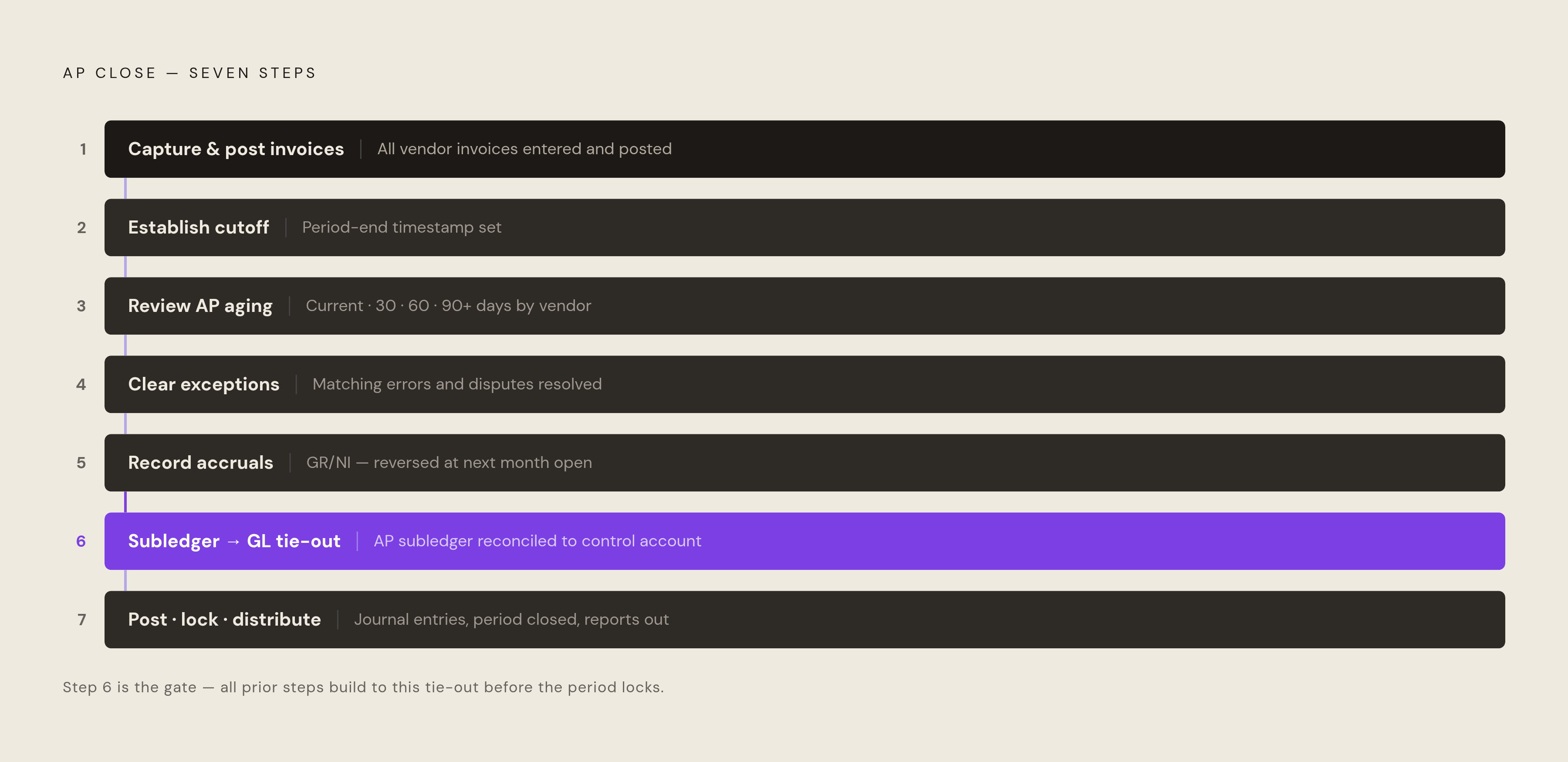
The first step is to capture and post every invoice received in the period, fully coded and approved. An incomplete invoice population undermines every later check. The second step establishes a cutoff timestamp, communicates it across AP, procurement, and receiving, and stops new invoices from being posted to the closing month after that point. Without this boundary, the numbers keep changing during review. Costs belonging to the old period but recorded only in the new one understate the earlier period’s expenses and overstate the later period’s expenses.
Once cutoff stabilizes the population, the third step reviews AP aging by vendor and age bucket, including current, 30, 60, and 90+ days. Older balances require individual judgment about whether they represent legitimate liabilities, stale entries to write off, or misclassified items. A large current vendor balance with an offsetting credit memo from three months ago needs to be sorted out before reconciliation. The fourth step is to clear matching exceptions and disputes. An invoice left on hold either delays completion or requires an accrual that earlier resolution could have avoided.
The fifth step is to record goods and services that have been received but not yet invoiced, with estimates based on purchase orders or prior invoices. The entry debits expense and credits accrued liabilities. Accruals are typically reversed at the start of the next month so the actual invoice can be booked normally. The sixth step reconciles the AP subledger to the GL control account and investigates every variance before proceeding. The seventh posts final journal entries, locks the period, and distributes reports, with completion contingent on the subledger tying to the ledger.
AP owns intake, coding checks, duplicates, vendor statements, and aging hygiene, while procurement owns PO controls and price or quantity dispute support. Receiving and operations own the receipt records, the evidence that services are complete, and the GR/IR cleanup. GL and the controller team own accrual review, the AP-to-GL tie-out, and period lock governance. Treasury and FP&A consume the resulting aging data for cash forecasting and working capital analysis.
How the AP timeline maps to a concrete close calendar
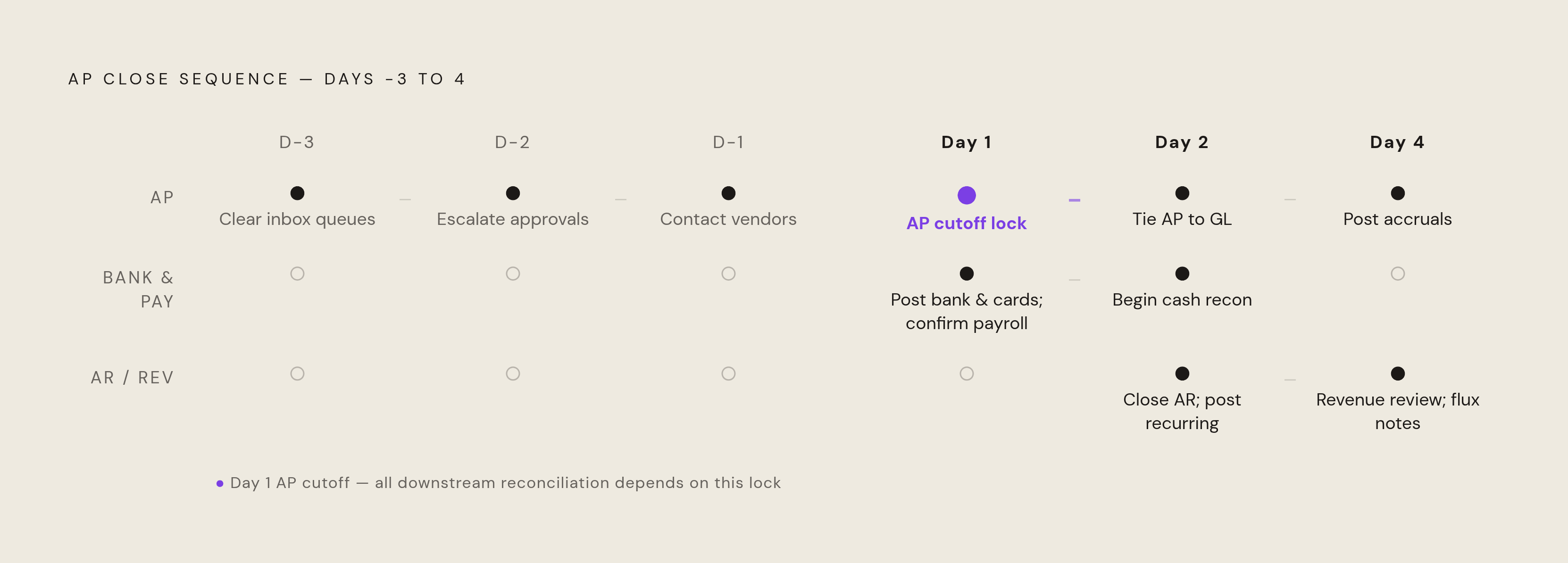
The practical AP calendar starts on Days −3 to −1, when inbox queues approach zero, pending approvals are escalated, and top vendors are contacted about missing invoices. Day 0 then enforces the communicated cutoff, routing late items to the next-period queue or logging them as exceptions. This preparation creates room for review after month-end. During Days +1 to +3, accruals are supported and reviewed, the AP-to-GL tie-out is completed, and GR/IR exceptions are assigned. Days +3 to +5 cover aging reasonableness, sign-offs, and the period lock.
A five-day close model makes the downstream handoffs more concrete. On Day 1, the team closes AP intake by cutoff, posts bank and credit card activity through cutoff, and confirms the final payroll numbers. On Day 2, the team closes the AR posting window, ties AR and AP to the GL, posts recurring entries, and begins cash reconciliation. The two subledger tie-outs therefore run in parallel. Some downstream tasks can start before AP’s final lock, but they need AP’s inputs to be settled before they can finish.
In that model, Day 4 posts accruals and deferrals, reviews revenue recognition support, runs variance checks, and drafts flux notes. An AP slip consumes time reserved for that work. The team often feels that pressure during review rather than entry, when one variance sends it searching through email, spreadsheets, and system notes to find out what happened. Getting ready before close keeps Days 0 and +1 from being spent dealing with exceptions. It leaves time to look into the numbers as well as post them.
Where AP close breaks in practice and why the same failures recur
When cutoff rules are loose, the closing period stays open in practice, even when the calendar says it is closed. Without a timestamp and a rule for late invoices, new postings change the aging report and restart a reconciliation that had already tied. GR/IR ownership gaps create a different form of instability. Received-not-invoiced items accumulate because no team has a clear mandate to resolve them. Those balances obscure receiving or matching problems and push unresolved variances into the next period.
Unsupported accruals conceal the unresolved gap. An entry without a purchase order anchor, a prior-invoice estimate, or a clear reversal creates an unexplained variance at the next close. Manual adjustments can then become the accepted way to make the accounts agree. The warning signs include AP-to-GL differences that “magically” disappear, GR/IR balances that never clear, and expenses posted to the wrong month. Stacked post-close adjustments compress future closes and can eventually lead to audit findings.
Slow invoice approvals compound each of these weaknesses. At cutoff, AP must either wait for approvals or accrue items that could otherwise have been recorded as payables. AP faces incomplete information as well as a longer timetable. Missing invoices distort department spend and margin, while weak accruals understate obligations on the balance sheet. Poor aging data also weakens cash forecasts, and missing reconciliation support or undocumented assumptions turn audit preparation into a search for evidence.
How usage-based and AI vendor contracts complicate the accrual step
Usage-based vendor contracts weaken the standard accrual workflow’s most useful assumption, which is that the cost is already known. A fixed retainer or recurring invoice provides a reasonably stable anchor, but cloud infrastructure and AI bills depend on consumption during the period. The invoice may arrive a week or more after month-end. AP has to estimate the cost before the final bill arrives. During a launch or migration, prior invoices can become unreliable guides to that estimate.
The contract itself can make the calculation harder. One vendor may bill for fixed retainers, usage-metered charges, and project-based milestone billing. Overages, tiered pricing, and true-up clauses each create uninvoiced liabilities that a standard accrual template does not handle cleanly. Outcome-contingent fees add a condition that must be checked because payment depends on whether the service delivered a result. The accrual therefore requires more than carrying forward last month’s amount.
These estimates compete with other period-end judgments. AP is also handling subscriptions billed midcycle, contractor invoices still under review, and prepaid annual arrangements being amortized. Companies that sell usage-based products face similar uncertainty on the revenue side as they handle variable revenue recognition, metered usage reconciliation, and deferred revenue tracking. Their finance teams must account for usage-based true-ups as variable consideration recognized as consumed and accrue sales and use tax liability on taxable consumption. Both sides need careful estimates, but they get their data from different processes.
What billing infrastructure quality means for the AP close on the sell side
For a company that sells metered or AI products, billing infrastructure that supplies usable revenue data at close saves it from having to make another estimate. Fragmented billing codepaths can leave subscription charges, usage overages, and prepaid credit drawdowns in separate systems. Finance then has three sets of numbers to reconcile before they can feed the GL. That work competes with the subledger close schedule. When those numbers disagree, reconciliation consumes the first week and prevents a controlled close.
Invoices should generate automatically from usage events rather than depend on finance to reconstruct consumption at month-end. When credit consumption occurs at millisecond speeds, the billing system must count it accurately in-flight. Otherwise, revenue has its own version of AP’s uninvoiced-cost problem. Billing infrastructure that ingests usage events at scale, models multiple pricing dimensions, and supports prepaid and postpaid mechanics on the same engine removes avoidable estimation work before it reaches the close calendar.
A product charging across tokens, GPU-minutes, audio minutes, and hardware tiers needs infrastructure that can model those dimensions natively. When it cannot, separate systems and manual reconciliations reappear. Prepaid credit wallets and conventional invoices likewise need treatment as first-class objects within the billing engine. Keeping them in separate systems adds a manual tie-out, delaying GL completion and introducing error risk.
Spend visibility and real-time usage alerts help customers see how much they have used before the invoice arrives. Without that visibility, bill shock can lead to disputes. The seller’s billing weakness then becomes a contested invoice in the buyer’s AP queue, potentially delaying matching, accrual decisions, and close. Billing infrastructure is therefore both a revenue-capture tool and a close-speed variable on both sides of the transaction.
How to run a faster AP close without sacrificing the accuracy the GL depends on
Remove rework before compressing deadlines. AP should run as a cadence beginning on Days −3 to −1, with intake queues cleared, approvals escalated, and missing vendor invoices pursued before cutoff. Within that preparation, an exception-first workflow prioritizes held invoices, disputed amounts, and aged balances likely to delay reconciliation. GR/IR cleanup should also run continuously under clear ownership to prevent items from accumulating for month-end.
Controls around the AP control account protect that progress. Every manual journal entry to it should have documentation and a second reviewer. Automation can then shorten the work that precedes judgment. Invoice capture, approval routing, and three-way matching reduce the delay and coding errors associated with keying invoices from PDFs. They leave more time for accrual review and reconciliation, but do not replace cutoff decisions, usage-based estimates, or judgments about disputed invoices.
Prioritization should preserve time for accounts that drive month-end decisions. Where appropriate, deferring lower-priority work such as stock-based compensation accounting to quarter- or year-end can protect capacity for revenue, cash, payroll, and AP. That choice needs a repeatable process behind it. Parker Gilbert, CEO of Numeric, recommends a simple checklist naming a preparer, reviewer, and estimated due date for each task. He recommends refining timing and setting stakeholder expectations after two to three closes, once actual dependencies and delays are visible.
Each close should then supply evidence for the next. Keeping track of bottlenecks, delays, and which teams depend on others shows where the schedule needs to change and where it is still unclear who owns the work. The objective is a documented process that gets measurably faster as recurring obstacles are identified and removed.


