
Usage-Based Billing Vendor Landscape for AI-Native Companies
Real-time metering and credit wallets are the core tests for AI billing vendors.
For AI-native companies, architectural tests are a better way to judge usage-based billing vendors than generic feature checklists. A platform needs real-time metering, native credit wallets, hybrid pricing and multidimensional charging to support the business at all. The strongest evaluation eliminates vendors in that order of operational consequence, before invoice features or entry-level pricing distract from the cost of missing infrastructure.
Why AI pricing breaks traditional billing platforms before a single invoice is sent
Two customers on the same AI plan can generate inference costs that differ by orders of magnitude. A light user can be highly profitable while a power user produces a negative margin, despite paying the same subscription fee. Traditional SaaS costs are roughly fixed per customer regardless of activity. Flat and per-seat pricing therefore leave the business exposed when revenue does not scale with the cost of serving customers.
GitHub Copilot moved monthly plans to usage-based AI credits on June 1, 2026, while annual subscribers stayed on legacy premium-request pricing until their plans ran out. The change illustrates the pressure on unlimited developer tooling plans. That pressure reaches billing before an invoice exists. A system designed to count seats and renew subscriptions must now connect consumption to charges as usage happens. The gap is architectural.
How hybrid subscription-plus-usage became the default AI pricing model
Hybrid pricing has become the dominant model for AI companies, while pure pay-as-you-go is less common than it was in 2024. The base subscription brings in recurring revenue the business can count on and gives customers a clear starting cost. Usage charges then scale with actual consumption. A typical plan includes a monthly token allowance, followed by a per-token rate beyond that allowance. This structure reduces revenue volatility without severing the link between the customer's bill and the resources consumed.
The difficulty is that these models rarely remain simple. Token-based pricing, credits, compute hours and subscriptions can coexist within one product. Salesforce Agentforce prices per conversation or per Flex Credits, so billing must capture a completed action as well as count tokens. The billable unit itself becomes part of the design. A platform must represent the subscription, measure consumption and apply credit rules together, rather than leave the buyer to reconcile separate interpretations of the same customer's activity.
That is why subscription support and metering support are insufficient as separate claims. The commercial agreement spans both, often with prepaid credits added to the same account. Each component changes what the customer owes. A platform that supports them only in isolation transfers the work of composing the final bill to the buyer.
What real-time metering actually requires at AI event volumes
As tokens are consumed, API calls run and agent actions finish, they create events at millisecond speeds. Batch-processing billing architectures cannot meet this workload merely by adding a counter. Metering is a streaming infrastructure problem before it is an invoicing problem. Its pipeline has three distinct layers, including ingestion that captures billable events, aggregation that sums them per customer and billing period, and a pricing engine that applies the rate card. A vendor's ability to produce invoices says little about whether those layers work at AI event volumes.
Correctness is as important as throughput here. Idempotent ingestion prevents an event sent twice from becoming a duplicate charge, while decimal precision protects the calculation itself. Late-arrival handling must account for events received after a billing period closes. Near-real-time aggregation lets customers see how much they have consumed before they get the final bill. These are operating requirements even before the business has more customers.
Charging GPT-4 differently from GPT-4o from one event stream requires the platform to distinguish model variants without a separate schema for each one. Otherwise, engineers must change billing with every model release. Per-model attribution also gives finance the detail needed to understand customer profitability. A platform that counts total tokens but loses their economic context clears only part of the metering requirement.
Why credit wallets are the single criterion that eliminates the most vendors
A credit note offsets an invoice after charges are calculated. A credit wallet holds a runtime balance that a request can check before it executes. If the billing platform cannot answer whether an account has balance in milliseconds, the product needs another system to enforce that constraint. The buyer is then building the capability the billing purchase was supposed to supply.
A native wallet must support recurring grants, rollover and expiry rules, with deductions at the moment of consumption. Those rules determine what remains available to spend. A prepaid invoice balance can record money available against future charges without controlling whether the next request may run. That distinction makes wallet architecture the most productive first filter in a vendor evaluation.
Credits also translate technical consumption into a unit customers can budget against. ElevenLabs' credit-based model charges per character rather than per API call or per minute of audio, illustrating the value of that abstraction. The wallet must preserve both the customer-facing unit and its consumption rules. Because AI and enterprise products routinely need prepaid credits and postpaid invoicing simultaneously, support for one cannot excuse the absence of the other. Both belong on the same engine.
Multidimensional pricing and why the pricing engine is a separate evaluation from the metering layer
A platform can ingest events correctly and maintain balances yet still fail to calculate the price of the product. AI charges can vary with the model type, whether tokens are input versus output tokens, how fast the response is, the image resolution and the voice or video quality. When several dimensions affect a charge, the pricing engine must compute their relationship. This is the next elimination after metering and wallet support.
The engine must use tiered, volume, matrix and committed-spend logic to price the usage it has aggregated. Customer segmentation adds another layer because developers may receive per-token rates, consumers may buy credits and enterprises may negotiate committed spend. Those arrangements can be active at the same time. Their charges must converge on one readable invoice from one source of truth, so that finance can reconcile the result without custom orchestration between separate billing systems.
Product and finance teams need to change tiers, add volume discounts and move customers between plans without help from engineers. When that logic is hardcoded in the application, each change needs a software release. A change to a rate then needs code review, deployment and regression testing against existing invoices.
Build versus buy at this level of complexity
Building hybrid pricing, credit wallets and basic revenue recognition in-house means committing to that product for good. The initial implementation is only the first expense. Maintenance, new pricing models and recurring architecture decisions continue to compete with revenue-generating work in each planning cycle. The commitment begins when credits are layered over usage, usage over a subscription or enterprise commitments over either. At that point, a billing system is being built whether or not the team describes it that way.
Buying payment or invoicing infrastructure while building the meter does not remove this obligation. The split leaves two systems to maintain and two integration surfaces to keep synchronized. Responsibility also becomes harder to assign when usage and charges do not reconcile. A platform built for this work can save those engineering hours, but the buyer still needs to check how it charges. Buying is not a reason to skip cost modeling.
Vendor fees should be weighed against three-year ARR projections. A percentage of billing volume grows with the business, independent of what it costs the vendor to process events. An acceptable early-stage fee can become a meaningful claim on gross margin at growth stage. Total cost of ownership must therefore include both the vendor bill and the engineering work its missing capabilities leave behind.
The finance and compliance requirements that eliminate vendors late in evaluation
Finance and compliance create a second wave of eliminations after technical qualification. When metering and billing live separately, every financial close can require reconciliation between customer consumption and the general ledger. That work grows with invoice volume. Accurate usage-to-invoice mapping is therefore a finance requirement as well as a technical one. Passing a high-volume ingestion test does not establish that the platform can support a reliable close.
ASC 606-10-55-18 provides the right-to-invoice practical expedient when the invoiced amount corresponds directly to the value delivered. Under that condition, revenue can be recognized in that amount without estimating total contract consideration. Accurate invoicing is essential to applying that treatment. Finance also needs cost to serve per customer against billed revenue, because token costs vary by model. Without cost attribution, an account that brings in a lot of revenue can hide poor margins.
SOC 2 Type 2 addresses a separate qualification. Enterprise procurement teams require the report before signing, so a vendor unable to produce it can block enterprise revenue regardless of its metering depth. Deployment requirements create a different exclusion. Where data residency is a hard constraint, a platform without on-premises or sovereign cloud deployment cannot qualify. These requirements often emerge late in sales cycles. The evaluation should confirm them before an otherwise promising vendor consumes months of work.
Customer-facing spend visibility as a retention and expansion mechanism, not a feature
Unexpected charges can cause customers to slow adoption or avoid expanding usage. Consumption-based pricing exposes them to variable bills, so visibility is part of the commercial model. A customer who sees consumption before invoicing can adjust behavior. A customer who sees only the final charge cannot. Bill shock is therefore an infrastructure problem.
Real-time alerts and in-flight spend dashboards connect the metering layer to customer control. Prepaid wallets add to that control by showing customers the capacity they have bought before they use it. The wallet becomes a trust mechanism as well as a payment mechanism. Together, these tools let customers manage the part of a hybrid plan that varies with usage, with less doubt about what more usage will cost. That distinction affects whether usage becomes an expansion opportunity or a reason to hold back.
The same consumption data supports decisions inside the business. Granular records help product and finance teams identify valuable features, expanding customer segments and pricing tiers associated with stronger net revenue retention. Visibility serves both sides of the invoice. Hybrid pricing's expansion potential depends not only on usage upside but also on customers being able to manage their spend.
The evaluation sequence that filters vendors in the right order
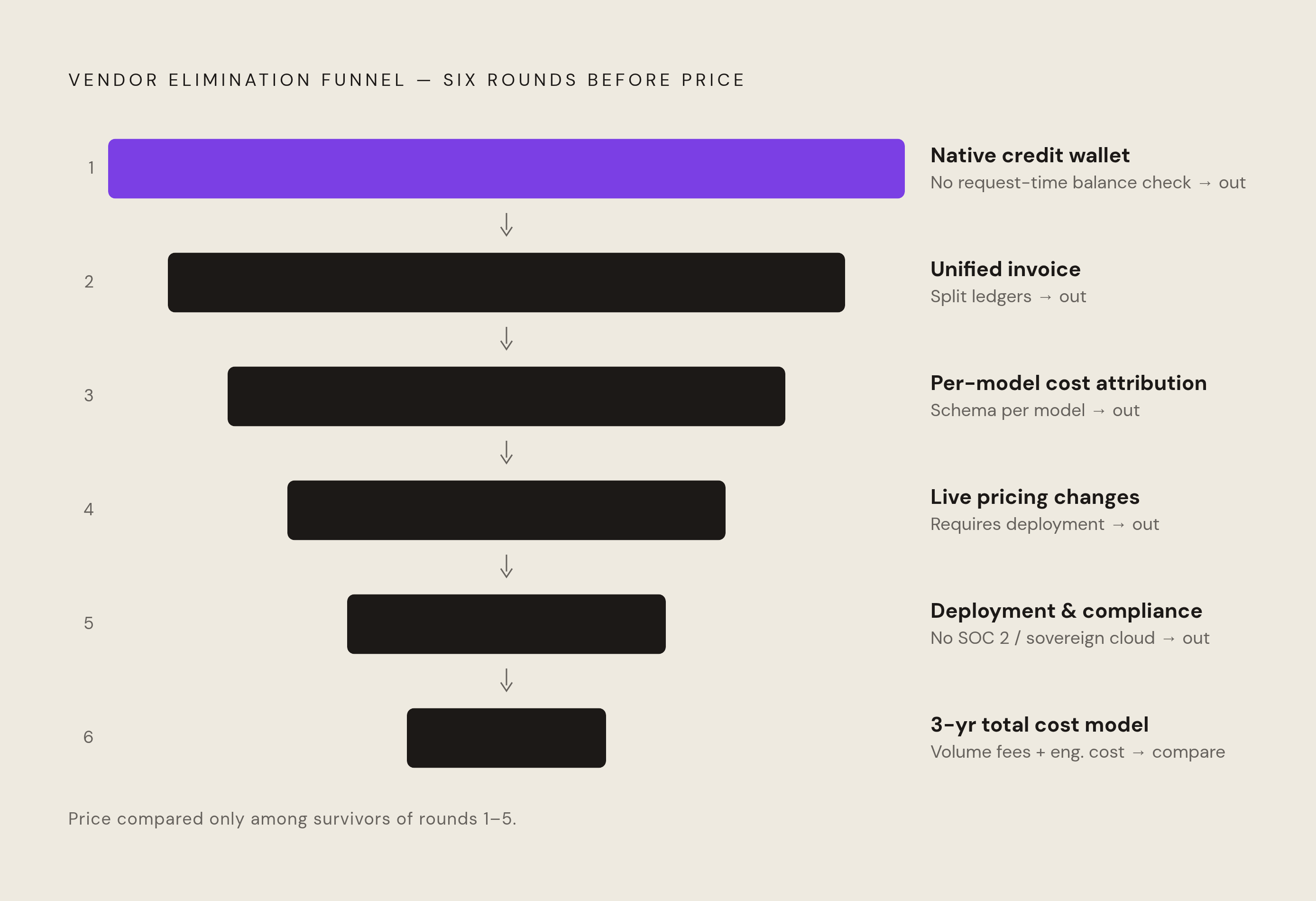
The evaluation should begin with native credit wallet architecture, because a request-time balance check eliminates more unsuitable platforms than a broad feature comparison. The next round should test subscription fees, usage overages and credit consumption on one invoice from a single ledger, without custom orchestration. Third comes per-model cost attribution from one event stream, without a separate schema for every model variant.
The fourth round should test whether pricing can change without application deployment, including new tiers, volume discounts, experiments and plan migrations. The fifth should confirm deployment and compliance requirements before the sales cycle runs long. SOC 2 Type 2 and support for on-premises or sovereign cloud each need their own test. The sixth should model the total cost at three-year ARR, including fees tied to billing volume and any engineering work the buyer still has to do. Prices can be compared only once those costs and tasks are clear.
Purpose-built platforms designed for metered, credit-based and hybrid pricing are the category most closely aligned with these tests. Subscription-first platforms tend to face the hardest tests in the opening rounds, before price drives the choice. Origin alone is not proof of qualification. The final decision should rest on demonstrated wallet behavior, coherent invoicing, cost attribution, pricing changeability, enterprise readiness and total cost at scale, with customer-facing visibility supported by the same underlying usage data.

