Enterprise Procurement Security Reviews for Billing Vendors
Billing vendors face harder security reviews because they handle financial data, PII.
A billing system holds three categories of sensitive data at once: financial transaction records, granular usage telemetry such as tokens consumed, API calls, and GPU-minutes, and customer identity records. No other common SaaS category stacks all three in a single platform, and that combination is what pushes billing vendors into a harder review than a CRM or a project management tool ever faces. Most enterprise security frameworks already treat financial data and personal information as the highest-risk categories on their own. A billing platform carries both, so it lands in the top risk tier the moment intake begins, and that tier decision shapes how much scrutiny follows at every later stage.
Usage-based and credit-based pricing add a layer that older billing reviews were never built to handle. A platform metering consumption in real time retains records that function as sensitive business intelligence in their own right: a customer's AI token consumption pattern exposes product usage, cost structure, and competitive position, not just a dollar figure on an invoice. Usage-based and credit-based pricing models compound this risk further, since metering platforms that ingest real-time consumption events at scale, like Flexprice, which handles tokens, credits, and API calls, must secure the event ingestion pipeline itself as a critical control point. An adversary who can manipulate that ingestion pipeline can alter invoices, suppress usage records, or manufacture credits. That is why a security review of billing infrastructure has to reach deeper into the architecture than a review of a tool that simply stores documents or tracks sales leads.
The seven-stage enterprise security review for billing vendors
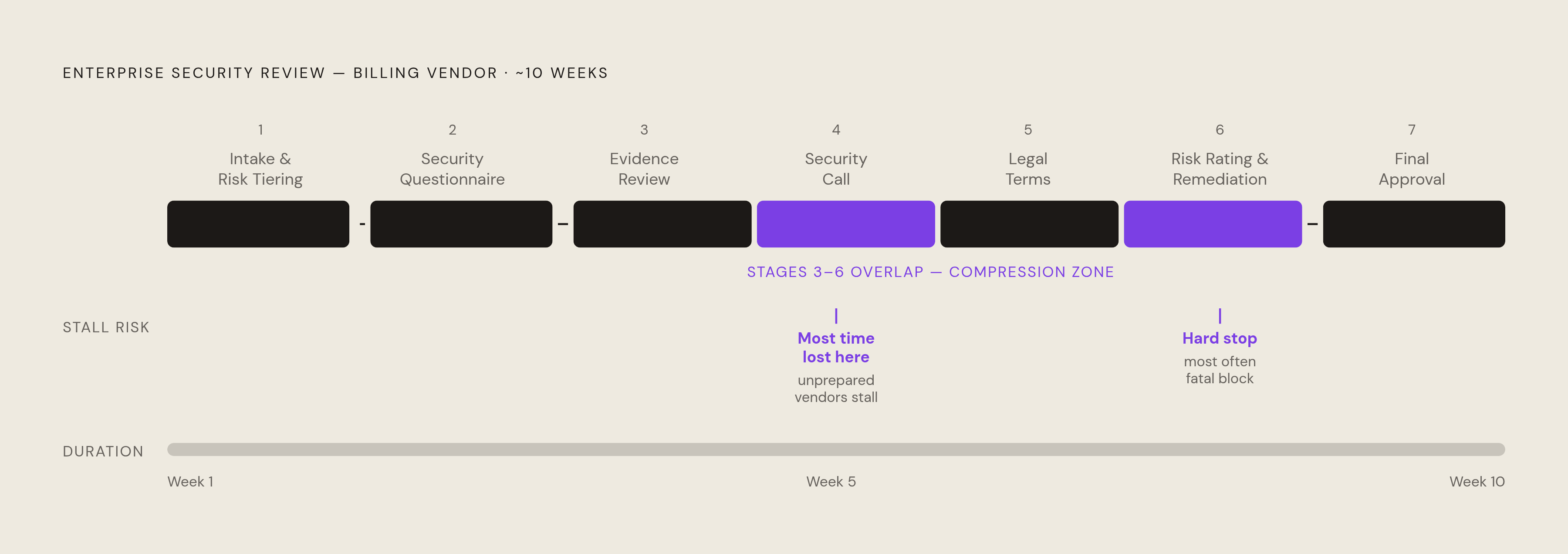
Enterprise security review for a billing vendor runs through seven stages: intake and risk tiering, the security questionnaire, evidence review, the security call, legal terms, risk rating with remediation, and final approval. For a mid-market buyer, the full sequence runs about ten weeks, with stages three through six overlapping. Billing vendors move through some of these stages at the same pace as any other SaaS applicant, but they stall at specific points where the review digs into financial data handling.
Intake sets the tone for everything that follows. The buyer assigns a risk tier based on what data the vendor touches, and a billing vendor handling both PII and financial records gets placed in a high risk tier from the start, which determines how much scrutiny every subsequent stage will carry. The questionnaire stage usually runs on a standard framework like SIG or CAIQ, or a custom spreadsheet running hundreds of questions, and billing vendors face questions on financial data handling, encryption, access controls, and subprocessor chains that go well beyond a typical SaaS questionnaire's scope.
The security call, covered later in more detail, presses billing vendors harder on key management and on the integrity of the metering pipeline than it would press a vendor selling marketing software. Legal terms bring a data processing agreement, breach notification windows with tight turnaround requirements, audit rights, cyber insurance minimums, and a business associate agreement if health data is in scope. Risk rating and remediation is where billing vendors most often hit a hard stop: findings that reveal missing MFA, shared service accounts, or API keys stored in source code require a fix plan, a compensating control, or a formal risk acceptance before the deal can move forward. Final approval often comes with conditions attached, and many buyers now require notification of any material security change in the window between annual reassessments.
SOC 2 Type II coverage for billing infrastructure
SOC 2 Type II functions as the de facto entry ticket for enterprise billing vendor approval, and most enterprise buyers ask for it by name. The distinction matters: Type I confirms that controls exist at a single point in time, while Type II evaluates whether those controls actually operated correctly over an extended period, usually several months. For a billing platform, that extended window is the only way to show that invoicing and metering held up under real operating conditions rather than just looking correct on the day of the audit.
Processing integrity is the Trust Services Criterion that matters most for a billing vendor specifically. It asks whether the system does its job without error or delay, and in a billing context that means you need invoices that are accurate, usage events that are captured completely, and credits that are applied correctly. In a metering context, processing integrity means the system has to capture, rate, and invoice consumption events without loss or manipulation, and that is what separates billing platforms built from the ground up for usage-based models from subscription tools retrofitted later to handle usage data.
Confidentiality coverage inside SOC 2 reports has expanded quickly: the share of reports including the Confidentiality criterion has roughly doubled since 2023, when 34% included it, and reports now include Availability even more often. Confidentiality covers how sensitive business data, including usage telemetry, gets protected, and billing vendors storing consumption records for multiple enterprise customers are now expected to demonstrate confidentiality controls on top of ordinary security controls, not as a substitute for them. Vendor and third-party risk management has also become a core piece of SOC 2 expectations: a billing vendor has to formally assess and document its own subprocessors, including payment processors, cloud infrastructure providers, and data warehouses, rather than treating its own perimeter as the full boundary of the audit.
Access control and audit log integrity scrutiny in billing systems
Access control and audit log integrity account for most of the findings that appear during a billing vendor's evidence review, and the failures found there are structural. A billing platform that serves many enterprise customers has to enforce strict tenant isolation, so a misconfigured access control there does not just expose a single record. It can expose one customer's entire usage history and invoice trail to another customer on the same platform, which is a different order of consequence than a misconfigured permission in a document-sharing tool.
API key hygiene carries unusually high stakes in billing systems for the same reason. An exposed API key opens a door to invoice manipulation, credit injection, or deletion of usage records, beyond data access alone. Reviewers probe for key rotation policies, vault-based storage, and whether keys are scoped to least privilege, because when a key with broad permissions sits in an unprotected location, a minor leak turns into a financial integrity failure.
Audit logs for billing carry a higher bar than for most other SaaS tools, because invoices are financial records, and audit obligations for them extend past the vendor's own security posture. Logs have to be tamper-evident, timestamped, and retained for periods that satisfy both the SOC 2 audit window and any contractual audit rights, and that retention period often runs longer than what a platform ships with by default. Logging from day one affects audit outcomes directly: platforms that added logging after initial deployment struggle to demonstrate the continuous control operation that SOC 2 Type II requires across the full audit period, and a gap in the log record counts as a finding.
The consequence for buyers runs past security policy and into the books themselves. If a billing vendor has weak access controls or inconsistent audit logs, it carries an invoicing integrity risk alongside the security risk. If a buyer cannot reconstruct who changed what in the billing system and when, that buyer cannot defend an invoice to its own auditors or to its own customers, and that failure traces straight back to the vendor's logging architecture.
Data residency and deployment model requirements as an early disqualifier for vendors
Data residency and deployment model requirements act as the earliest filter in enterprise billing procurement, and they are binary in a way that later-stage controls are not. At intake, buyers declare what data the vendor will handle and where that data must physically reside, and for billing vendors this means specifying whether financial records and usage telemetry can leave a given geographic region or must stay inside a sovereign cloud or private infrastructure. A vendor that cannot meet the stated requirement is disqualified before any security control gets evaluated.
Regulated industries, financial services, healthcare, defense contractors, and government agencies routinely require that billing data stay within specific jurisdictions. A vendor whose infrastructure runs in only a single geographic region is disqualified from European enterprise deals and from any buyer subject to data localization rules, and that disqualification happens before a single question on the security questionnaire gets answered. On-premises and VPC deployment are not rare exceptions in this market. Buyers with strict data sovereignty requirements or air-gapped environments need a billing vendor that can run entirely within their own infrastructure, but only a few platforms support VPC or on-prem deployment. Confirming that capability before entering a three-month evaluation saves both sides a wasted quarter.
Flexprice is built to run on-premises and within sovereign or private cloud environments, which places it among the smaller set of vendors able to pass this filter at intake. Its architecture keeps data inside the customer's infrastructure, and that design choice matters specifically when a buyer's procurement rules treat deployment location as a precondition. The subprocessor chain follows immediately behind the deployment model: a billing platform that relies on a separate metering tool, a distinct payment processor, and a cloud-hosted data warehouse has multiple subprocessors, and each one has to independently satisfy the buyer's data residency requirements. Each subprocessor is its own potential disqualification point, and none of them get absorbed into the vendor's own compliance posture.
Currency and geographic limitations extend this same risk into commercial terms. If a billing platform cannot price in local currencies, or if it imposes pricing floors calibrated to US markets, it cannot serve international enterprise customers, no matter how strong its security controls are elsewhere. A buyer evaluating billing vendors for a global rollout has to weed out vendors priced and structured only for a single region at the same early stage as the data residency check, because no amount of downstream remediation fixes a currency or jurisdiction mismatch.
What the security call and legal terms stage probe
The security call is where billing-specific technical questions concentrate and where unprepared vendors lose the most time, as reviewers ask how usage events are ingested, deduplicated, and stored, what happens when the ingestion pipeline drops an event, whether there is an at-least-once delivery guarantee, and whether the buyer can independently verify that usage records have not been altered after the fact. None of these questions appear on a generic SaaS security call, and a vendor walking in without prepared answers signals a gap the reviewer will flag regardless of how the rest of the call goes.
Encryption questions go further for billing vendors than for most SaaS categories. Reviewers ask not only whether data is encrypted at rest and in transit but whether financial records are encrypted with customer-managed keys, whether the vendor's own engineers can read invoice data, and whether key management decisions can be audited after the fact. Incident response gets a similar expansion: a security incident that corrupts usage records or invoice data is a financial incident as much as a security one, so reviewers ask whether the incident response plan covers data integrity failures specifically, not just confidentiality breaches, and what recovery looks like when billing data itself is the thing damaged.
Billing vendors often cause evidence production delays when they lack documentation of metering pipeline security and audit log retention, but that friction runs lower for vendors whose architecture was purpose-built around usage metering and the controls it demands, Flexprice among them. Bringing someone technical onto the security call is not optional at this stage. A sales representative improvising answers about key management is a reliable way to turn a two-week stage into a six-week stage, because every unclear answer generates a follow-up question, and follow-up questions are what stretch a review timeline past its expected length.
Legal terms bring their own set of billing-specific demands. The contract includes a data processing agreement, breach notification windows often set at 72 hours or less, audit rights, cyber insurance minimums, and a business associate agreement where health data is involved. Audit rights carry more weight in billing contracts than in most other SaaS categories, because the buyer is not only asking to review security controls. The buyer is asserting the right to inspect billing records, event logs, and pricing configuration directly, in order to verify that invoices issued against the contract are accurate. A vendor that resists broad audit rights in a billing contract raises an immediate red flag, since that resistance reads, fairly or not, as an unwillingness to let the buyer confirm the one thing the contract exists to govern: whether the numbers on the invoice are right.