Invoice Timeliness Benchmarks and Customer Payment Behavior
Most late B2B payments stem from billing errors, not customer unwillingness.
Most finance teams diagnose late payment as a customer problem: the buyer is slow, undercapitalized, or simply unwilling to pay on time. That diagnosis gets the direction of causality backward in a large number of cases. When an invoice arrives late, contains an error, or presents charges the customer cannot reconcile against their own records, the payment clock does not start. A dispute clock starts instead, running on a different schedule. A significant share of what appears in DSO reports and aging schedules as "customer payment behavior" is the downstream result of the sender's own billing process, not a verdict on the buyer's character or cash position. That reframing matters because it changes what can be fixed. If late payment is partly a billing problem, then it responds to the same kind of engineering and process discipline a company would apply to any other operational failure, rather than requiring a credit policy overhaul or a tougher collections posture. The benchmarks that follow should be read with that causal lens in mind: not as a scorecard on customers, but as a measure of how well billing systems are doing their job.
Benchmarks on Invoice Cycle Time and Payment Delay
Getting paid on time has become the exception rather than the rule in B2B. A large share of all B2B invoiced sales in the United States is currently overdue at any given moment, and the trend line on severity is not improving even where the headline numbers look stable. The same reporting shows average days delinquent moving in the wrong direction year-over-year: leading organizations are compressing their overall DSO, but the invoices that do slip into overdue status are aging a bit longer once they get there. The Atradius 2025 US B2B payment trends report put a finer point on the scale of it, finding that nearly half of the total value of credit-based B2B sales was overdue, with only slightly more than half paid on time and a residual share written off entirely as bad debt. Put together, these numbers describe a system where overdue invoices are not a tail risk sitting at the margins of an otherwise healthy process. They are close to half the dollar volume moving through B2B credit terms in the United States. That scale is the backdrop against which the rest of this argument has to be read: a failure mode this large cannot be explained away as a handful of bad-faith customers declining to pay what they owe.
Three mechanisms that convert billing process failures into payment delays
Payment delays do not spread evenly across invoices. They cluster around specific, identifiable points of failure in how the invoice was built and delivered, and three mechanisms account for most of that clustering.
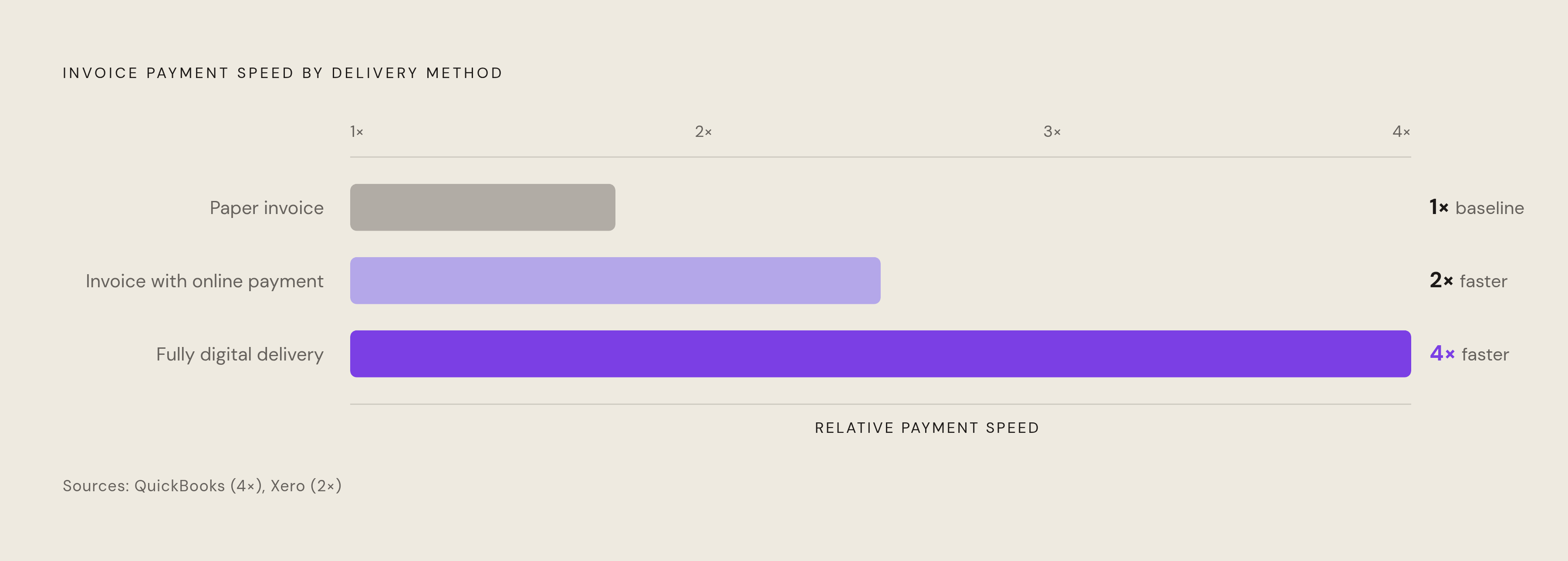
The first is invoice format and delivery method. Xero's data shows customers using online invoice payments get paid up to twice as fast as those who do not, and QuickBooks reports that invoices with online payment options get paid up to four times faster than paper invoicing. Those are not marginal differences. Yet Billentis data shows that in the United States, PDF by email remains the dominant delivery format, with more than half of invoices received still arriving as paper or PDF rather than as structured, machine-readable data. The format a company chooses for delivery is not a cosmetic preference. It directly determines how fast a customer can receive the invoice, match it against a purchase order, route it for approval, and release payment.
The second mechanism is errors and exceptions inside the invoice itself. An invoice that lands in a customer's accounts payable queue with a line-item discrepancy does not simply get paid a little late. It gets pulled out of the normal payment flow and routed into an exception queue, where it sits until someone on the buyer's side has the time to investigate and resolve it. That queue has its own backlog and its own priorities, almost none of which involve the seller's cash flow.
The third mechanism, less discussed in standard accounts-receivable literature but increasingly acute for AI and SaaS companies billing on consumption, is invoice unpredictability. When a customer cannot anticipate what an invoice will contain, they cannot pre-approve it internally before it arrives, and an invoice that cannot be pre-approved is structurally delayed while reconciliation happens after the fact rather than before. An invoice that shows charges across dimensions the customer was not tracking in real time functions, for all practical purposes, as a surprise invoice. Surprise invoices get disputed, and disputed invoices do not get paid on the original terms. This third mechanism is the bridge to a billing problem that is growing faster than the conventional B2B billing failures the first two mechanisms describe.
eDelivery Adoption and Digital Payment Rails
The organizations compressing DSO fastest are not doing it by tightening credit terms or leaning harder on collections. They are doing it by digitizing how invoices get delivered and how payments get collected. Billtrust's 2026 AR Benchmark Report shows eDelivery adoption climbing quickly year-over-year among its client base, and the leading organizations in that data set have already moved past treating eDelivery as a goal to reach. They treat it as a baseline, the minimum standard a modern AR operation has to clear before anything else gets optimized. Organizations with digitized invoice delivery and digital payment acceptance run structurally shorter payment cycles than the rest of the field, because engineering friction out of the process before the customer ever sees the invoice is what produces that result.
That gap is not closing quickly for most businesses. Billentis data shows incomplete digitization is still the norm across the industry, with a significant share of finance teams continuing to rely on manual processes for a meaningful portion of their invoicing work. The organizations pulling ahead on DSO and the organizations stuck with elevated DSO are, in large part, separated by how much of their invoicing has been automated end to end rather than left as a manual, paper-adjacent process running in parallel with digital efforts.
Usage-Based and AI Product Billing's Distinct Invoice-Timeliness Problem
The three mechanisms described above (format, errors, unpredictability) all respond to process improvement in conventional B2B billing. A company can switch from PDF-by-email to a structured eDelivery format, tighten its invoice QA to catch line-item discrepancies before the invoice goes out, and reduce disputes accordingly. Usage-based billing breaks that pattern because its core failure mode differs in kind: the invoice cannot be accurate unless the underlying billing system can first count usage accurately.
AI and developer-tool products bill on dimensions such as tokens, GPU-minutes, API calls, voice minutes, and completed agent steps. These are units of measurement that conventional subscription billing infrastructure, built around a small number of discrete plan tiers and monthly seat counts, was never designed to meter at the speed or granularity now required. When a billing system cannot ingest usage events as fast as consumption actually happens, it cannot produce an invoice that matches what the customer consumed. A customer who disputes charges on that kind of invoice is not behaving like a slow payer. The customer is responding rationally to a document that does not match their own internal usage records, and withholding payment until someone reconciles the two.
Credit-based pricing makes this harder still. When customers buy pools of capacity and draw them down across several use cases at once, the invoice has to reconcile credits consumed against credits remaining across multiple dimensions simultaneously, a modeling task that exceeds what most subscription billing tools were built to handle. The surprise-invoice dynamic named in the previous section is structurally built into any metered product that lacks real-time usage tracking: customers get invoices reflecting consumption they never saw accumulating, cannot pre-approve the charges, and have to investigate before they will release payment. That is why spend visibility and real-time usage alerts are not a nice-to-have feature layered on top of a metered product. A customer who can watch their own consumption accumulate in real time is a customer who can check the invoice against their own records the moment it arrives, and pay it without a detour through an exception queue. Getting that right requires metering and billing to function as one system rather than two separate tools stitched together after the fact, because every point where usage data has to cross from one system into another is a point where the invoice can drift from what actually happened.
Where Payment Behavior Problems Originate
When DSO stays elevated industry-wide while the best-performing teams compress it through digitization and touchless processing, the gap between those two groups says more about process than about customers. A large share of outstanding receivables reflects latency built into the sender's own operation rather than a payment-behavior problem on the buyer's side of the ledger.
The credit application data in Billtrust's 2026 report backs this up from another angle. Approval rates tightened year-over-year. Finance teams took on less credit risk overall during that period. DSO still improved for the leading organizations in that same window. If tighter credit risk were the main driver of better DSO, both numbers would move together in a straightforward way. Instead, the improvement tracks with process and infrastructure gains, not with who finance teams chose to extend credit to.
The bankruptcy data makes the stakes of getting this wrong concrete. Allianz Trade data attributes up to a quarter of business bankruptcies to late or unpaid invoices, a figure that represents more than a cash flow inconvenience. It marks the end point of a cascade that, in many cases, started with a billing process failure well upstream of the eventual collapse. For AI and SaaS companies in particular, the diagnostic reframe carries real consequence: a company that attributes its high DSO to enterprise customers paying slowly may actually be looking at an invoicing accuracy problem sitting entirely within its own control. The test for telling the two apart is specific and repeatable. If payment delays cluster around particular invoice types, around customers who just had an unusually high-consumption month, or around the first invoice issued after a pricing change, the problem is in the billing infrastructure, not in the customer base. That pattern points directly at what needs fixing and where to look first.
What organizations with improving payment cycles are doing differently at the infrastructure level
The gap between top-quartile and median accounts-receivable operations is explained by the infrastructure those teams have built underneath the billing process, not by industry, customer mix, or how strict a company's credit policy happens to be. On the AR side, Billtrust's 2026 data shows that the organizations with the highest touchless payment rates and the lowest DSO treated eDelivery, automated cash application, and digital payment acceptance as infrastructure investments made once and built to last.
For businesses running usage-based or credit-based pricing, that infrastructure requirement extends further upstream than conventional AR practice accounts for. The billing system has to ingest usage events continuously as they happen, model pricing accurately across multiple dimensions at once, produce invoices the customer can check against their own usage records, and show spend visibility before the invoice ever lands in the customer's inbox. Skipping any one of those steps causes the invoice to be disputed, and a disputed invoice is a late invoice by definition.
The build-versus-buy decision matters here because of where the real engineering effort sits. Metering, counting usage events accurately in real time, is a fraction of the total work. The harder parts come after: rating those events into charges, prorating mid-cycle changes, tracking credits and their consumption, generating the invoice itself, handling tax, running dunning workflows, and reconciling all of it against what the customer actually used. This is where most in-house billing systems stall, and it is where the invoice accuracy problems driving payment delay actually originate. Companies that treat metering and billing as two separate problems, handled by two separate tools bolted together through an integration, end up carrying the reconciliation overhead that produces the first-of-month errors customers flag and dispute. A system built to treat metering and billing as one problem, rather than two, produces invoices customers can verify against their own records and pay without escalating to an exception queue.
Billing infrastructure, read against this data, is a direct determinant of how fast cash actually comes in the door, as directly as credit policy or collections effort, and for usage-based businesses in particular, it is the lever that decides whether DSO reflects customer behavior or merely reflects billing errors.